SQL-Engineering-Handbook
FIRST_VALUE(), LAST_VALUE(), and NTILE()
Overview
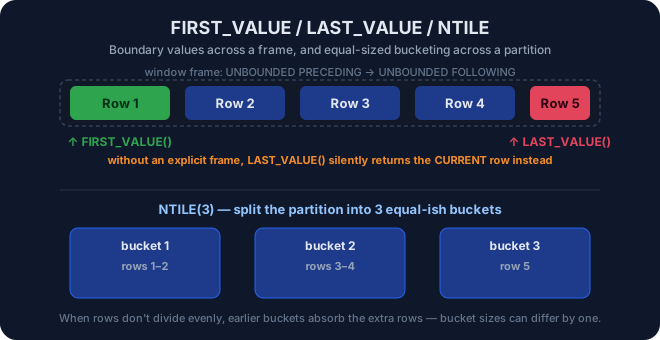
FIRST_VALUE() and LAST_VALUE() retrieve the value at the start
and end of a window’s frame. NTILE(n) divides the rows in a
window into n roughly equal-sized buckets and labels each row with
its bucket number.
Learning Objectives
- Retrieve the first and last value in an ordered window.
- Understand why
LAST_VALUE()requires an explicit frame clause to behave as expected. - Split a result set into equal groups using
NTILE().
Prerequisites
01_ROW_NUMBER04_PARTITION_BY
Syntax
FIRST_VALUE(column) OVER (ORDER BY sort_column) AS first_value

LAST_VALUE(column) OVER (
    ORDER BY sort_column
    ROWS BETWEEN UNBOUNDED PRECEDING AND UNBOUNDED FOLLOWING
) AS last_value

NTILE(n) OVER (ORDER BY sort_column) AS bucket_number
Dataset Used
employes joined to departments
Examples
Real World Applications
- Showing the “first” and “last” transaction in a customer’s history.
- Splitting customers into quartiles/deciles for marketing segmentation.
- Identifying the earliest and latest event in a partitioned timeline.
Business Use Cases
| Domain | Scenario |
|---|---|
| Marketing | Split customers into quartiles by spend (NTILE(4)) |
| Banking | First and last transaction per account statement |
| HR | First and last hire in each department |
Common Mistakes
- Using
LAST_VALUE()without the frame clauseROWS BETWEEN UNBOUNDED PRECEDING AND UNBOUNDED FOLLOWING. By default, SQL’s window frame isRANGE BETWEEN UNBOUNDED PRECEDING AND CURRENT ROW, soLAST_VALUE()silently returns the current row instead of the true last row in the partition – a very common, hard-to-spot bug. - Assuming
NTILE()produces perfectly equal-sized groups – when the row count is not evenly divisible byn, the earlier buckets absorb the extra rows.
Best Practices
- Always pair
LAST_VALUE()with an explicit frame clause. - Document the intended bucket count for
NTILE()and why that number was chosen (quartiles = 4, deciles = 10, etc.).
Engineering Notes
FIRST_VALUE() works correctly with the default frame because
“first” and “current position” align naturally as the window grows;
LAST_VALUE() does not share that property, which is why it is the
single most-cited source of window-function bugs in production code
reviews.
Practice Questions
- Show the first employee using
FIRST_VALUE(). - Show the last employee using
LAST_VALUE()(with the correct frame clause). - Divide employees into buckets using
NTILE().
Difficulty
Intermediate
Estimated Time
25 minutes
Learning Outcomes
- Correctly apply the frame clause required for
LAST_VALUE(). - Explain why
NTILE()bucket sizes can differ by one row.
Related Topics
Next Topic
Lesson Navigation
← Previous: 05_LAG_LEAD
↑ Module README
→ Next: 07_RUNNING_TOTALS