SQL-Engineering-Handbook
ROW_NUMBER()
Overview
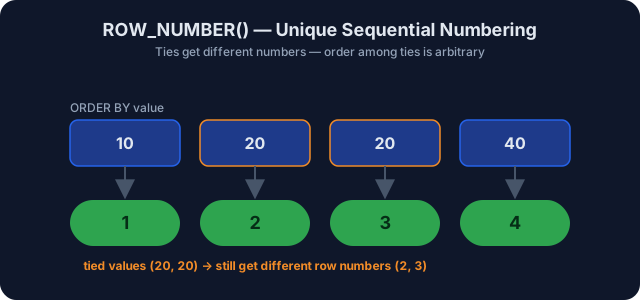
ROW_NUMBER() assigns a unique, sequential integer to every row within
its window, starting at 1. Ties in the ORDER BY are broken arbitrarily —
no two rows ever receive the same number.
Ordered values: [10, 20, 20, 40]
ROW_NUMBER():   [1,  2,  3,  4]
Learning Objectives
- Generate a unique sequence number per row.
- Understand that
ROW_NUMBER()never produces duplicate values, even on ties. - Use
ROW_NUMBER()inside a CTE/subquery to filter on it (since window function results cannot be referenced directly inWHERE).
Prerequisites
- Basic
SELECTstatements ORDER BY- CTEs (
WITHclause) — module06_CTEs
Syntax
SELECT
    column_a,
    column_b,
    ROW_NUMBER() OVER (ORDER BY sort_column) AS row_seq
FROM table_name;
Dataset Used
employes (emp_id, emp_name, dept_id, manager_id)
Examples
See 01_row_number.sql for five fully worked,
production-commented examples.
Real World Applications
- Assigning display order to a paginated report.
- Deduplicating rows (keep only
ROW_NUMBER() = 1per group). - Generating a synthetic sequence ID when no natural key exists.
Business Use Cases
| Domain | Scenario |
|---|---|
| HR | Assign a unique seniority sequence to employees |
| E-commerce | Number a customer’s orders chronologically |
| Banking | Sequence transactions for a statement |
Common Mistakes
- Referencing the
ROW_NUMBER()alias directly in aWHEREclause on the sameSELECT— this throws a syntax/semantic error becauseWHEREruns before window functions are evaluated. Always wrap in a CTE or subquery. - Forgetting
ORDER BYinsideOVER(), which makes the numbering non-deterministic. - Assuming
ROW_NUMBER()respects ties likeRANK()does — it does not.
Best Practices
- Always give window function aliases meaningful names (
emp_seq, notrn). - Use a CTE (not a nested subquery) when the query needs to be readable and reused later in the file — it mirrors how production analytics code is reviewed on GitHub.
- Prefer
ROW_NUMBER()overLIMITalone when you need deterministic, per-group “top-N” results (combine withPARTITION BY).
Engineering Notes
ROW_NUMBER() is computed by MySQL’s window function engine in a single
pass after the base result set is materialized. It is O(n log n) due to the
required sort on ORDER BY. For very large tables, ensure the ORDER BY
column is indexed to avoid an expensive filesort.
Practice Questions
- Assign a row number to every employee ordered by
emp_id. - Assign a row number ordered by
emp_nameinstead. - Return only the employee name and its row number.
- Return only the first 3 employees using
ROW_NUMBER(). - Return the employee whose
ROW_NUMBER() = 1(requires a CTE or subquery).
Difficulty
Beginner
Estimated Time
20–25 minutes
Learning Outcomes
- Comfortably write
ROW_NUMBER() OVER (ORDER BY ...). - Understand why window function aliases cannot be filtered directly in
WHERE, and how to solve that with a CTE.
Related Topics
Next Topic
Lesson Navigation
← Previous: Module README
↑ Module README
→ Next: 02_RANK