SQL-Engineering-Handbook
DENSE_RANK()
Overview
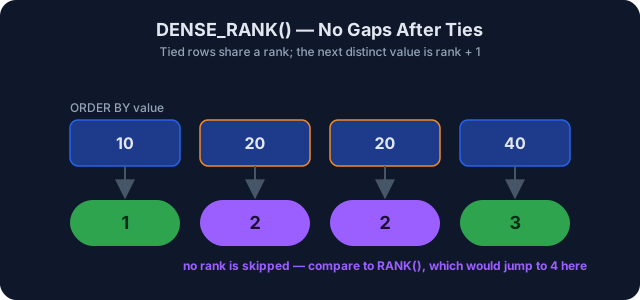
DENSE_RANK() behaves like RANK() except it never leaves a gap in
the ranking sequence after a tie.
Ordered values: [10, 20, 20, 40]
RANK():         [1,  2,  2,  4]
DENSE_RANK():   [1,  2,  2,  3]
Learning Objectives
- Assign gap-free competition ranks.
- Correctly choose between
RANK()andDENSE_RANK()based on business requirements. - Compare all three ranking functions side by side.
Prerequisites
01_ROW_NUMBER02_RANK
Syntax
SELECT
    column_a,
    DENSE_RANK() OVER (ORDER BY sort_column) AS dense_rank_value
FROM table_name;
Dataset Used
employes
Examples
See 03_dense_rank.sql.
Real World Applications
- Salary bands / pay-grade tiers where consecutive tier numbers matter.
- Product pricing tiers where no tier number should ever be “skipped”.
Business Use Cases
| Domain | Scenario |
|---|---|
| Finance | Assign consecutive risk tiers to loan applicants |
| Retail | Assign consecutive pricing tiers to products |
| HR | Assign consecutive seniority bands per manager group |
Common Mistakes
- Using
DENSE_RANK()when the business actually wants gap-aware standings (useRANK()instead). - Assuming
DENSE_RANK()andROW_NUMBER()are interchangeable when there are no ties in the sample data – they diverge as soon as a tie appears.
Best Practices
- Always test ranking functions against a dataset that contains ties before shipping to production; behavior on unique data hides real bugs.
- Comment the choice of ranking function inline so the next engineer does not have to reverse-engineer the intent.
Engineering Notes
DENSE_RANK() maintains an internal counter that increments only when
the ORDER BY value changes from the previous row – this is the single
mechanical difference from RANK(), which instead increments by the
number of rows seen so far.
Practice Questions
- Assign dense rank to employees ordered by
manager_id. - Show employee name and dense rank (ordered by
emp_id). - Show employees with dense rank ≤ 3.
- Compare
RANK()andDENSE_RANK()side by side. - Show the employee(s) with dense rank = 1.
Difficulty
Beginner
Estimated Time
20 minutes
Learning Outcomes
- Predict
DENSE_RANK()output on tied data without running the query. - Justify, in an interview, when to use
DENSE_RANK()overRANK().
Related Topics
Next Topic
Lesson Navigation
← Previous: 02_RANK
↑ Module README
→ Next: 04_PARTITION_BY