SQL-Engineering-Handbook
RANK()
Overview
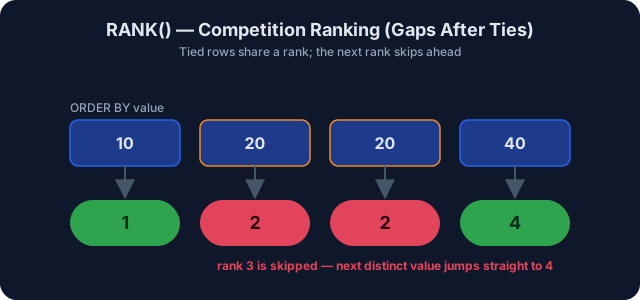
RANK() assigns a competition-style rank to each row. Rows with equal
ORDER BY values receive the same rank, and the next rank skips
the number of tied rows (like Olympic medal standings).
Ordered values: [10, 20, 20, 40]
RANK():         [1,  2,  2,  4]
Learning Objectives
- Assign competition ranks with correctly handled ties.
- Understand the “gap after a tie” behavior that distinguishes
RANK()fromDENSE_RANK(). - Filter ranked results using a CTE.
Prerequisites
01_ROW_NUMBER- CTEs (
06_CTEs)
Syntax
SELECT
    column_a,
    RANK() OVER (ORDER BY sort_column) AS rank_value
FROM table_name;
Dataset Used
employes, departments, locations
Examples
See 02_rank.sql.
Real World Applications
- Leaderboards where tied scores should share a position.
- Sales rankings where multiple reps can tie for the same quota tier.
Business Use Cases
| Domain | Scenario |
|---|---|
| Sales | Rank reps by revenue, allowing ties for shared bonuses |
| Education | Rank students by exam score with shared placements |
| Manufacturing | Rank suppliers by defect rate |
Common Mistakes
- Confusing
RANK()’s gap behavior withDENSE_RANK()’s no-gap behavior. - Forgetting that ties are determined entirely by the
ORDER BYcolumn(s) insideOVER()– not by any other column in theSELECTlist. - Filtering directly on the alias in
WHERE(same restriction asROW_NUMBER()– use a CTE).
Best Practices
- Choose
RANK()deliberately when business rules require gaps after ties (e.g., “rank 1 and 2 both get gold, next place is rank 3 not 3rd overall position”). - Document in a comment why
RANK()was chosen overDENSE_RANK()– future maintainers should not have to guess.
Engineering Notes
RANK() and DENSE_RANK() share the same sorting cost as ROW_NUMBER()
but additionally require a tie-comparison against the previous row’s
ORDER BY value, evaluated during the same single pass.
Practice Questions
- Assign rank to employees ordered by
emp_id. - Show employee name and rank.
- Show the employee with
rank = 1. - Show the top 3 ranked employees.
- Compare
ROW_NUMBER()andRANK()side by side onmanager_id.
Difficulty
Beginner
Estimated Time
20–25 minutes
Learning Outcomes
- Correctly predict
RANK()output on a dataset containing ties. - Explain, in an interview, the difference between
RANK()andROW_NUMBER().
Related Topics
Next Topic
Lesson Navigation
← Previous: 01_ROW_NUMBER
↑ Module README
→ Next: 03_DENSE_RANK