SQL-Engineering-Handbook
06 · Advanced CASE Patterns
Difficulty: Advanced · Estimated time: 30 min Schema:
00_Sample_Schema.sql
Introduction
Lessons 01–05 covered CASE in a flat SELECT. This lesson covers
every other place CASE shows up in real engineering work: inside
aggregates (conditional aggregation), inside window functions, nested
CASE, and how CASE compares to its cousins (COALESCE, IIF,
DECODE).
Learning Objectives
- Write conditional aggregation (
SUM(CASE WHEN ...)) to pivot rows into columns - Combine
CASEwith window functions for per-row and per-group logic in one query - Nest
CASEexpressions correctly without losing readability - Choose between
CASE,COALESCE,IIF, andDECODEfor a given task
1 · Conditional Aggregation
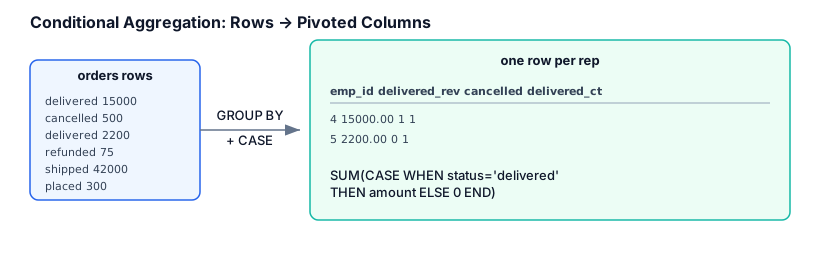
The single most valuable production pattern in this lesson. Instead of
running one query per category, SUM/COUNT combined with CASE
turns rows into columns in a single pass — the SQL equivalent of a
pivot table.
SELECT
    e.emp_id,
    e.emp_name,
    SUM(CASE WHEN o.order_status = 'delivered' THEN o.order_amount ELSE 0 END) AS delivered_revenue,
    SUM(CASE WHEN o.order_status = 'cancelled' THEN 1 ELSE 0 END)              AS cancelled_orders,
    COUNT(CASE WHEN o.order_status = 'delivered' THEN 1 END)                   AS delivered_count
FROM employees e
JOIN orders o ON e.emp_id = o.emp_id
GROUP BY e.emp_id, e.emp_name;
Engineering note: SUM(CASE ... ELSE 0 END) and
COUNT(CASE ... END) (no ELSE) are both common, but they behave
differently — SUM needs an explicit ELSE 0 because
SUM(NULL, NULL, NULL) returns NULL, not 0. COUNT(expression)
already ignores NULLs by definition, so omitting ELSE there is
intentional, not a bug.
2 · CASE with Window Functions
SELECT
    e.emp_name,
    e.dept_id,
    e.salary,
    CASE
        WHEN e.salary = MAX(e.salary) OVER (PARTITION BY e.dept_id) THEN 'Top Earner'
        ELSE 'Standard'
    END AS pay_tier
FROM employees e;
This runs CASE after the window function computes the per-department
maximum, giving you row-level logic that’s aware of group-level
context — without collapsing rows the way GROUP BY would.
3 · Nested CASE
SELECT
    e.emp_name,
    CASE
        WHEN e.performance_score IS NULL THEN 'Not Yet Reviewed'
        ELSE
            CASE
                WHEN e.performance_score >= 4 THEN 'High Performer'
                WHEN e.performance_score >= 2 THEN 'Meets Expectations'
                ELSE 'Needs Improvement'
            END
    END AS performance_label
FROM employees e;
Engineering note: nested CASE is legitimate when the outer
condition is a genuinely different kind of check (here: “does a
score even exist?”) from the inner ranking logic. If both levels are
just more thresholds on the same value, flatten them into one CASE
with more WHEN branches instead — nesting for its own sake hurts
readability.
4 · CASE inside ORDER BY, GROUP BY, HAVING, JOIN, UPDATE
-- ORDER BY: custom sort order not achievable with a plain column sort
SELECT emp_name, dept_id
FROM employees
ORDER BY CASE WHEN dept_id = 1 THEN 0 ELSE 1 END, emp_name;

-- GROUP BY: bucket rows into custom ranges before aggregating
SELECT
    CASE WHEN salary >= 150000 THEN 'High' ELSE 'Standard' END AS salary_band,
    COUNT(*) AS headcount
FROM employees
GROUP BY CASE WHEN salary >= 150000 THEN 'High' ELSE 'Standard' END;

-- HAVING: filter groups by a classification computed post-aggregation
SELECT dept_id, COUNT(*) AS headcount
FROM employees
GROUP BY dept_id
HAVING COUNT(*) > CASE WHEN dept_id = 1 THEN 2 ELSE 1 END;

-- JOIN condition: rare, but valid -- e.g. different join keys per data source
-- UPDATE: apply the same classification logic to persist a column
UPDATE employees
SET performance_score = CASE
    WHEN performance_score IS NULL THEN 3   -- default unreviewed employees to 'meets expectations'
    ELSE performance_score
END;
Comparison Table — CASE vs Its Alternatives
| Function | Purpose | Branch limit | Portable? |
|---|---|---|---|
CASE |
General conditional logic, any boolean expression | Unlimited | Yes — ANSI SQL, all dialects |
COALESCE(a, b, c) |
Return first non-NULL argument | N/A (not conditional logic, just NULL fallback) | Yes — ANSI SQL |
IIF(cond, t, f) |
Shorthand two-branch CASE | 2 | SQL Server, BigQuery only |
DECODE(expr, v1, r1, v2, r2, default) |
Exact-value lookup, like simple CASE | Unlimited but equality-only | Oracle only |
CHOOSE(index, v1, v2, ...) |
Return the Nth value by position | Fixed list | SQL Server only |
Rule of thumb: use COALESCE for pure NULL-fallback logic (it’s
shorter and clearer intent than CASE WHEN x IS NULL THEN y ELSE x
END). Use CASE for everything else — it’s the only one of these
that’s both fully general and portable across every dialect.
Interview Questions
- Why does
SUM(CASE WHEN ... THEN amount ELSE 0 END)need an explicitELSE 0, butCOUNT(CASE WHEN ... THEN 1 END)doesn’t? - When is nested
CASEjustified vs when should it be flattened? - What’s the practical difference between
COALESCE(x, 0)andCASE WHEN x IS NULL THEN 0 ELSE x END? - Why would you put a
CASEexpression inORDER BYinstead of just sorting by a column?