SQL-Engineering-Handbook
05 · Business Rules with CASE WHEN
Difficulty: Intermediate · Estimated time: 20 min Schema:
00_Sample_Schema.sql
Introduction
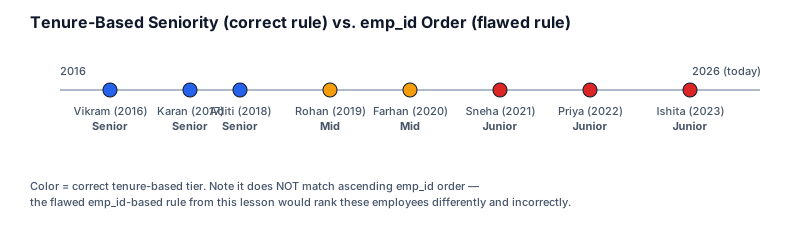
This lesson exposes a subtle but important flaw in a common pattern:
using a surrogate key (emp_id) as a stand-in for a business
attribute (seniority) it wasn’t designed to represent.
Learning Objectives
- Recognize when a
CASErule is encoding an accidental correlation instead of a real business rule - Rebuild the same classification against a column that actually means what the label claims
- Practice a 3-tier
CASEwith correctly ordered, non-overlapping ranges
Business Context
“Seniority” in a real HR system is a function of tenure
(hire_date) or role level — never of primary key order, which
merely reflects insertion order into the database and carries no
business meaning at all.
SQL
Engineering Notes
WHEN emp_id <= 2 THEN 'Senior'happens to “work” on 8 rows of demo data only because low IDs were inserted first. It is not a business rule — it’s coincidence dressed up as logic. In production this breaks the moment employee records are deleted, re-inserted, migrated, or merged from another system, none of which preserve ID order as a meaningful signal.- The engineering-correct version of this rule uses
hire_date, which actually means “how long has this person been here.” Tenure-based tiers are also relative to the query’s run date, so they should be computed againstCURRENT_DATE, not hardcoded years.
Best Practices
- Before writing a
CASEclassification, ask: “Does this column’s data type and meaning actually justify this business label?” A surrogate/primary key almost never does. - For date-driven tiers, compute the difference explicitly
(
CURRENT_DATE - hire_date, orDATEDIFFdepending on dialect) rather than hardcoding absolute cutoff dates that go stale.
Common Mistakes
| Mistake | Consequence |
|---|---|
| Classifying by primary key value | Rule breaks on any reordering, deletion, or re-insertion of rows |
Hardcoding absolute cutoff dates (hire_date < '2020-01-01') |
Correct today, silently wrong a year from now as “senior” should mean something relative to now |
| Overlapping range boundaries | Ambiguous or wrong classification for boundary values |
Dialect Differences
| Dialect | “Days since” expression |
|---|---|
| PostgreSQL | CURRENT_DATE - hire_date (returns integer days) |
| MySQL | DATEDIFF(CURDATE(), hire_date) |
| SQL Server | DATEDIFF(day, hire_date, GETDATE()) |
| BigQuery | DATE_DIFF(CURRENT_DATE(), hire_date, DAY) |
Interview Questions
- Why is classifying employees by
emp_ida fragile business rule, even if it produces the “right” result on today’s data? - How would you make a tenure-based
CASErule stay correct over time instead of needing yearly updates?
Answers
1. `emp_id` encodes insertion order, not any business fact — the rule only coincidentally matches seniority on the current dataset and will break under deletions, re-inserts, or data migrations that don't preserve ID order. 2. Compute the classification against a relative expression (`CURRENT_DATE - hire_date`) instead of hardcoded absolute dates, so the same query produces correct results every time it's run, indefinitely.Cross References
- Previous:
04_Employee_Labelling.md - Next:
06_Advanced_CASE_Patterns.md 09_Date_Functions