SQL-Engineering-Handbook
04 · Employee Labelling
Difficulty: Intermediate · Estimated time: 15 min Schema:
00_Sample_Schema.sql
Introduction
A three-table join (employees → departments → locations) used to
build a human-readable label column. This lesson’s real lesson is
scalability of WHEN branches — the original two-city version
doesn’t generalize, and that’s the point.
Learning Objectives
- Build
CASElabels across a multi-hop join - Recognize when hardcoded
WHENbranches become a maintenance liability - Refactor a hardcoded CASE into a scalable pattern using
CONCAT
Business Context
HR dashboards and workforce reports are read by people, not systems —
“Nagpur Employee” is a label a regional VP can scan in a table of 500
rows; location_id = 1 is not.
SQL
See 04_Employee_Labelling.sql.
Engineering Notes
- The original version of this query only ever produces two labels —
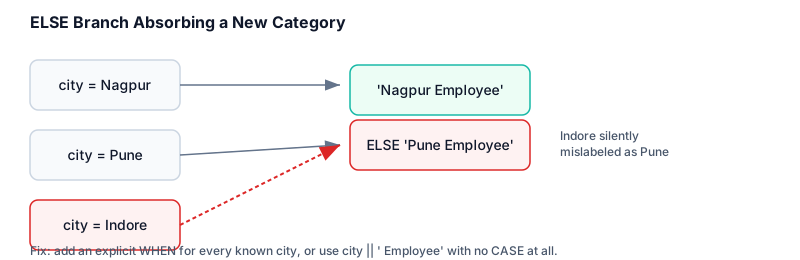
'Nagpur Employee'and'Pune Employee'— because it has an explicitWHENfor Nagpur and dumps everything else intoELSE 'Pune Employee'. Once a third city (Indore, present in the seed data) enters the picture, every Indore employee is mislabeled as Pune. This is flagged explicitly here because it’s a very common production bug: anELSEbranch that was written when only two categories existed silently absorbs every new category added later. - The fix isn’t more
WHENbranches — it’s recognizing thatcity || ' Employee'needs noCASEat all when the label is a pure, mechanical transformation of an existing column.
Best Practices
- Reach for
CASEwhen the mapping from input to output is not a 1:1 mechanical transformation (i.e. there’s real business logic: thresholds, groupings, exceptions). When it is 1:1, string concatenation is simpler, automatically correct for new values, and easier to read. - If a fixed, closed set of categories truly is the business
requirement (say, only Nagpur/Pune/Mumbai are ever valid regional
hubs and everything else should be flagged), make the fallback
explicit and honest:
ELSE 'Other Location', never a valid-sounding city name.
Common Mistakes
| Mistake | Consequence |
|---|---|
ELSE re-using a real value (‘Pune Employee’) as the fallback |
Every new/unanticipated category is silently mislabeled as an existing one — the most dangerous kind of CASE bug because it produces no error, just wrong data |
Hardcoding every known value as a WHEN branch |
Doesn’t scale; breaks the moment a new value is added upstream |
Interview Questions
- What’s wrong with using a real category name as the
ELSEfallback? - When should you prefer string concatenation over
CASEfor a labelling task?
Answers
1. It makes every future, unanticipated category silently indistinguishable from that one hardcoded category — a mislabeling bug that produces no error and is easy to miss in QA. 2. When the output is a pure, mechanical function of the input column (e.g. appending a fixed suffix) with no actual business rule or exception — CASE adds no value there and actively hides a bug for new inputs.Cross References
- Previous:
03_City_Analysis.md - Next:
05_Business_Rules.md 10_String_Functions