SQL-Engineering-Handbook
07 · Business Case Studies
Difficulty: Advanced · Estimated time: 40 min Schema:
00_Sample_Schema.sql
Introduction
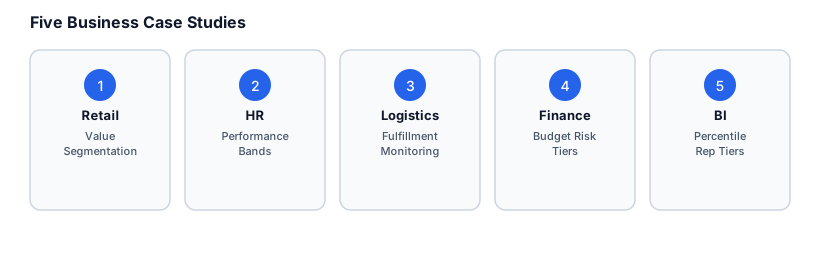
Five realistic, end-to-end business scenarios. Each follows the same structure — problem, dataset, rule, engineering decision, SQL, alternative, performance/production notes — so you can use this as a template for classification logic you’ll write on the job. Depth was chosen over breadth: five scenarios done properly teach more than twenty done superficially.
Runnable SQL for all five is in
07_Business_Case_Studies.sql.
Case Study 1 — Customer/Order Value Segmentation (Retail / E-commerce)
Business problem: Marketing wants to target high-value customers differently from low-value ones for a loyalty campaign, using order history rather than a single order.
Business rule:
- Lifetime delivered revenue ≥ 40,000 →
'VIP' - Lifetime delivered revenue ≥ 10,000 →
'Regular' - Otherwise →
'New / Low Value'
Engineering decision: This requires conditional aggregation
(Lesson 06, Pattern 1) followed by a CASE over the aggregated total
— two logical steps, best expressed with a CTE so the threshold logic
stays readable and testable independent of the aggregation.
Common mistake: Segmenting on order_amount per row instead of
lifetime revenue per customer conflates “placed one big order” with
“is a valuable customer” — very different business realities.
Case Study 2 — Employee Performance Bands (HR)
Business problem: Annual review cycle needs performance bands that correctly separate “not yet reviewed” from “reviewed and low” — HR cannot treat missing data as bad data without risking real complaints.
Business rule: see nested CASE pattern in Lesson 06, Pattern 3.
Engineering decision: NULL is checked first, explicitly, before
any numeric threshold — this ordering is not optional. Reversing it
(numeric thresholds first) would make NULL >= 4 etc. evaluate to
NULL/false and silently fall through to ELSE, mislabeling
unreviewed employees as “Needs Improvement,” a materially worse
outcome than the intended “Not Yet Reviewed.”
Case Study 3 — Order Status / Fulfillment Monitoring (Logistics / SaaS)
Business problem: Ops wants a single dashboard query that shows, per rep, how orders are distributed across their lifecycle — placed, shipped, delivered, cancelled, refunded — without five separate queries.
Business rule: one column per status, counted via conditional aggregation.
Engineering decision: This is the textbook conditional-aggregation
pivot (Lesson 06, Pattern 1). The alternative — a PIVOT operator
where the dialect supports one, or five separate COUNT(*) ... WHERE
status = X queries UNIONed together — is strictly worse: more
scans, more code, harder to keep in sync when a new status is added.
Performance note: conditional aggregation requires only a single
pass over orders; five separate filtered queries would each scan
the table independently unless the optimizer is unusually aggressive
about query folding.
Case Study 4 — Department Budget Risk Tiers (Finance)
Business problem: Finance wants departments flagged by how their actual headcount compares to what their budget “should” support, to catch over- or under-staffed teams before the quarterly review.
Business rule (illustrative):
budget / headcount < 200000→'Overstaffed Relative to Budget'budget / headcount > 800000→'Understaffed Relative to Budget'- Otherwise →
'Balanced'
Engineering decision: This combines two lessons’ worth of
technique — conditional aggregation for headcount (Lesson 02) plus a
derived ratio classified by CASE (this lesson). It’s also a good
example of a divide-by-zero risk: any department with zero
employees needs an explicit guard before the ratio is computed.
Common mistake: computing budget / headcount without first
checking headcount = 0, causing a runtime division error in
dialects that don’t return NULL/inf for divide-by-zero (e.g.
standard PostgreSQL raises an error; some warehouses instead return
NULL or Infinity — always check your dialect’s behavior).
Case Study 5 — Sales Rep Performance Tiers with Window Functions (BI / Executive Reporting)
Business problem: An executive dashboard needs each sales rep ranked against their peers, not just against a fixed number — “top 20% of reps by delivered revenue” is a relative, cohort-based label.
Business rule: use NTILE() or PERCENT_RANK() as a window
function, then apply CASE to the resulting rank/percentile.
Engineering decision: This is why Lesson 06’s Pattern 2 (CASE +
window function) matters at the executive level — fixed-threshold
tiers (Case Study 1’s approach) don’t work when the business question
is inherently relative (“top X% this quarter”), because thresholds
that made sense last quarter go stale as the whole business grows or
shrinks.
Cross References
- Previous:
06_Advanced_CASE_Patterns.md - Next:
08_Interview_Prep.md 18_Business_Case_Studies(module-wide case study index)