SQL-Engineering-Handbook
08 · Interview Preparation
Consolidated from every lesson in this module, plus scenario-based questions not covered elsewhere. Organized by difficulty.
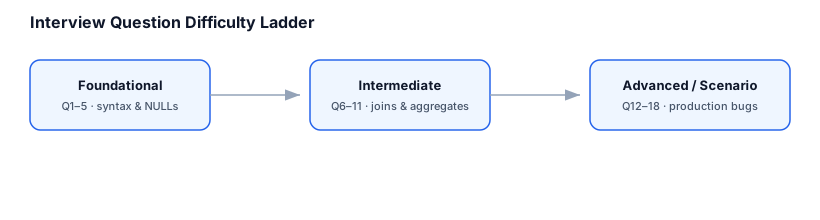
Foundational
-
What is
CASE WHENand where can it be used in a query? An expression, not a statement — valid anywhere a value is valid:SELECT,WHERE,ORDER BY,GROUP BY,HAVING, inside aggregates,JOIN ... ON,UPDATE ... SET. -
Simple vs searched CASE — what’s the difference? Simple compares one expression to exact values only. Searched evaluates arbitrary boolean conditions (ranges,
IS NULL,AND/OR). -
What happens if no
WHENmatches and there’s noELSE? ReturnsNULL. No error is raised. -
Does CASE evaluate every branch, or stop early? Stops at the first
TRUEcondition, evaluated top to bottom. -
Why does
WHEN x = NULL THEN ...never match?NULLrepresents “unknown”; any equality comparison against unknown is itself unknown, neverTRUE. UseIS NULL.
Intermediate
-
Why can’t a
CASEexpression reference an aggregate alias defined earlier in the sameSELECTlist? SELECT-list aliases aren’t visible to sibling expressions in standard SQL evaluation order — use a CTE or repeat the expression. -
Difference between filtering with
HAVINGand labelling withCASEinSELECT?HAVINGremoves grouped rows from the result.CASEinSELECTkeeps every row and assigns a label — no rows are lost. -
Why might
INNER JOINcause aCASE-based report to silently under-represent a category (e.g. “zero” never appears)? Rows with no match are excluded entirely beforeGROUP BY/CASEever run. UseLEFT JOINwithCOALESCE/0-handling if absence itself is a meaningful category. -
What’s the danger of an
ELSEbranch re-using a value that also appears as a real category (e.g.ELSE 'Pune Employee')? Any new/unanticipated input silently gets mislabeled as that category instead of flagged — a bug that produces no error and is easy to miss in QA. -
Why does
SUM(CASE WHEN ... THEN amount ELSE 0 END)need an explicitELSE 0, whileCOUNT(CASE WHEN ... THEN 1 END)doesn’t?SUMover an all-NULLinput returnsNULL.COUNT(expr)already ignoresNULLs by definition. -
When would you use
COALESCEinstead ofCASE? When the only goal is a NULL fallback —COALESCEstates that intent more directly and portably than aCASE WHEN x IS NULL.
Advanced / Scenario-Based
-
You need to classify customers into “Top 20% by revenue.” Why won’t a fixed dollar threshold work as well as
PERCENT_RANK()+CASE? Fixed thresholds go stale as the business grows or shrinks; percentile-based tiers stay meaningful relative to the current cohort automatically. -
You’re asked to classify departments by
budget / headcount. What production bug must you guard against? Division by zero whenheadcount = 0— add an explicitWHEN headcount = 0 THEN ...branch before the division. -
Given a nested
CASEdistinguishing “no score yet” (NULL) from “low score,” why must theNULLcheck come first? If numeric comparisons run first,NULL >= 4etc. evaluate to unknown/false and fall through toELSE, silently mislabeling unreviewed records as the worst category instead of “not yet reviewed” — a materially different (and often legally/HR-sensitive) distinction. -
A
CASEclassification was working correctly, then started producing wrong results after a database migration where employee IDs were reassigned. What’s the likely root cause, and how do you prevent it? The classification was almost certainly built on a surrogate key (likeemp_id) instead of a real business attribute (likehire_date). Prevent it by never classifying on primary/surrogate keys — verify the column’s actual business meaning first. -
How would you rewrite five separate
COUNT(*) WHERE status = Xqueries, unioned together, into a single more efficient query? Conditional aggregation: oneSELECTwithSUM(CASE WHEN status = X THEN 1 ELSE 0 END)per status, single pass over the table. -
Why is
CASEinside aWHEREclause on an indexed column often a performance problem? Wrapping an indexed column in an expression usually prevents the optimizer from using an index range scan on that column, forcing a full scan. Prefer raw column comparisons inWHERE; keepCASEfor derivedSELECTcolumns. -
What’s the tradeoff between hardcoding every known category as a
WHENbranch vs. a mechanical transformation like string concatenation? Hardcoded branches are correct for genuinely closed, validated sets where new/unexpected values should be flagged. Mechanical transformation (noCASEat all) is correct for open sets where the label is purely cosmetic — using the wrong one either creates a silent mislabeling bug or hides data-quality signals that should have been surfaced.
Common Traps Interviewers Look For
- Forgetting
ELSEand not realizing the result isNULL, not an error - Writing
= NULLinstead ofIS NULL - Assuming branch order doesn’t matter
- Classifying on a surrogate key instead of a real business column
- Not considering
INNERvsLEFT JOINimpact on a classification’s completeness - Missing the
ELSE 0requirement insideSUM(CASE ...)
Cross References
- Previous:
07_Business_Case_Studies.md 17_SQL_Interview_Questions(module-wide interview bank)