SQL-Engineering-Handbook
Conditional Aggregation
Introduction
Every function so far aggregated all rows in a group. Real reports almost never want that — they want “count how many were active” and “count how many were inactive” side by side, in a single row, without running two separate queries. That’s conditional aggregation, and it’s one of the highest-value, most interview-relevant patterns in all of SQL.
Learning Objectives
- Combine
CASE WHENwith aggregate functions to compute conditional totals and counts - Pivot category values into columns using conditional
SUM() - Use PostgreSQL’s
FILTER (WHERE ...)syntax as a cleaner alternative toCASE WHENinside aggregates - Recognize when conditional aggregation replaces the need for multiple separate queries or self-joins
Concept Overview
Wrapping a CASE WHEN expression inside an aggregate function lets you aggregate only the rows matching a condition, without filtering the whole query down with WHERE — because WHERE would remove the other rows from the group entirely, and you need all rows present to compute several conditional metrics side by side.
SELECT
    dept_id,
    SUM(CASE WHEN salary > 50000 THEN 1 ELSE 0 END) AS high_earners,
    SUM(CASE WHEN salary <= 50000 THEN 1 ELSE 0 END) AS standard_earners
FROM employes
GROUP BY dept_id;
Business Context
This is the exact pattern behind almost every “pivoted” dashboard tile you’ve ever seen: “Orders: Pending / Shipped / Delivered” as three columns in one row, “Tickets: Open / Closed” side by side, “Revenue: This Year / Last Year” in adjacent columns. Without conditional aggregation, each of those requires a separate query (or a self-join) per condition.
Where Companies Use It
- Support: open vs. closed ticket counts per team, in one row per team
- Sales: revenue this month vs. revenue same month last year, side by side
- HR: headcount by employment type (full-time vs. contractor) per department
Syntax
-- Conditional COUNT (the CASE WHEN ... THEN 1 ELSE 0 END pattern)
SELECT
    dept_id,
    SUM(CASE WHEN salary > 50000 THEN 1 ELSE 0 END) AS high_earner_count
FROM employes
GROUP BY dept_id;

-- Conditional COUNT, shorthand using COUNT() + CASE returning NULL
SELECT
    dept_id,
    COUNT(CASE WHEN salary > 50000 THEN 1 END) AS high_earner_count
FROM employes
GROUP BY dept_id;

-- PostgreSQL only: FILTER clause (cleaner, and typically faster to read)
SELECT
    dept_id,
    COUNT(*) FILTER (WHERE salary > 50000) AS high_earner_count
FROM employes
GROUP BY dept_id;
Execution Flow
Per row, before aggregation:
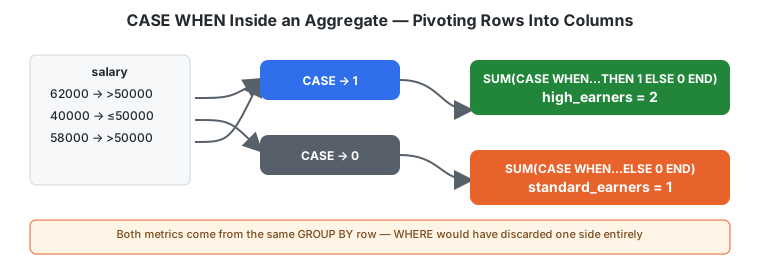
  salary=62000 -> CASE WHEN salary > 50000 THEN 1 ELSE 0 END -> 1
  salary=40000 -> CASE WHEN salary > 50000 THEN 1 ELSE 0 END -> 0
  salary=58000 -> CASE WHEN salary > 50000 THEN 1 ELSE 0 END -> 1

SUM() of those per-row 1s and 0s, per group
  = the conditional count for that group
Engineering Notes
SUM(CASE WHEN cond THEN 1 ELSE 0 END)andCOUNT(CASE WHEN cond THEN 1 END)(note: noELSE, defaulting toNULL) are functionally equivalent — both count only matching rows. TheCOUNTform is slightly more idiomatic sinceCOUNT()already ignoresNULLby design, removing the need for an explicitELSE 0.- Never write
WHERE salary > 50000when you need conditional counts alongside other conditions in the same row —WHEREwould discard the other rows entirely, making it impossible to also computestandard_earner_countin the same query. - Conditional
SUM()(rather thanCOUNT()) is the standard “pivot” pattern:SUM(CASE WHEN category = 'A' THEN amount ELSE 0 END) AS category_a_totalturns row-level categories into report columns.
PostgreSQL Notes
FILTER (WHERE ...) is PostgreSQL-specific (and supported by some other engines like SQLite) but not available in MySQL — MySQL requires the CASE WHEN form shown above. If a query needs to run identically on both engines, use CASE WHEN.
MySQL Notes
MySQL has no FILTER clause — always use SUM(CASE WHEN ...) or COUNT(CASE WHEN ... THEN 1 END).
Edge Cases
- If no row in a group matches the
CASE WHENcondition, the conditionalSUM()returns0(notNULL) — becauseCASE WHEN false THEN 1 ELSE 0 ENDstill produces a real0for every row, andSUM()of all-zeros is0. This is different from a plainSUM(salary)on an empty group, which returnsNULL. ConditionalCOUNT(CASE WHEN ... THEN 1 END)(withoutELSE) also returns0on no matches, becauseCOUNT()never returnsNULL. - Multiple
CASE WHENconditions in the same query can overlap or be mutually exclusive depending on how they’re written — be deliberate about which.
Common Mistakes
Wrong — using WHERE when multiple conditional metrics are needed side by side:
-- This only computes high earners — standard earners are gone entirely
SELECT dept_id, COUNT(*) AS high_earner_count
FROM employes
WHERE salary > 50000
GROUP BY dept_id;
Correct:
SELECT
    dept_id,
    COUNT(CASE WHEN salary > 50000 THEN 1 END) AS high_earner_count,
    COUNT(CASE WHEN salary <= 50000 THEN 1 END) AS standard_earner_count
FROM employes
GROUP BY dept_id;
Interview Questions
- Why would you use
CASE WHENinside an aggregate instead of just filtering withWHERE? - What’s the difference between
SUM(CASE WHEN cond THEN 1 ELSE 0 END)andCOUNT(CASE WHEN cond THEN 1 END)— and why do they produce the same result? - Write a query that returns, per department, both the count of employees earning above $50,000 and the count earning at or below $50,000, in a single row per department.
- Why is PostgreSQL’s
FILTER (WHERE ...)not portable to MySQL?
Summary
Conditional aggregation — CASE WHEN (or PostgreSQL’s FILTER) nested inside SUM()/COUNT() — lets a single query compute multiple category-specific metrics side by side, without the row-elimination that WHERE would cause. It’s the standard technique behind pivoted dashboard reporting.
Practice Challenges
- Write a query returning, per city, the count of employees earning above $55,000 vs. at or below, using
CASE WHEN. - Rewrite challenge 1 using PostgreSQL’s
FILTER (WHERE ...)syntax instead. - Write a query pivoting department headcount into columns for “Nagpur employees” and “Pune employees” per department, using conditional
SUM().
Further Reading
Related Topics: GROUP BY · HAVING · Business Cases · Advanced Aggregations (Module 12)
| ← Previous Lesson | ↑ Module README | Next Lesson → |