SQL-Engineering-Handbook
HAVING
Introduction
HAVING is the final filter in the aggregation pipeline — it filters the groups that GROUP BY produced, based on their aggregated values. It’s the single concept in this module most confused with WHERE, and interviewers know it.
Learning Objectives
- Explain precisely why
HAVINGexists whenWHEREalready filters - Use
HAVINGwith aggregate conditions correctly - Know when a condition belongs in
WHEREvsHAVING - Combine
WHEREandHAVINGin the same query
Concept Overview
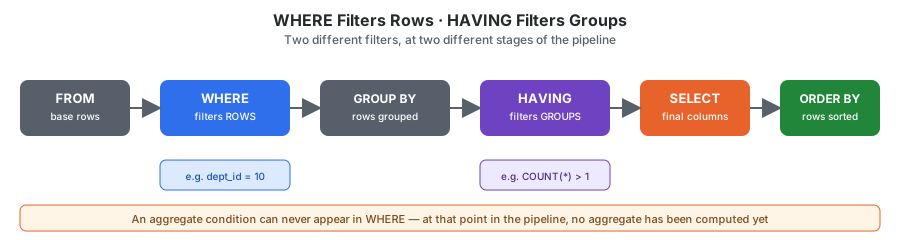
WHERE filters individual rows before grouping happens. HAVING filters groups after aggregation has already collapsed rows into summary values.
| Clause | Operates on | Runs |
|---|---|---|
WHERE |
Individual rows | Before GROUP BY |
HAVING |
Aggregated groups | After GROUP BY |
Business Context
“Show me departments with more than 5 employees” cannot be expressed with WHERE, because “more than 5 employees” is a fact about the group, not about any single row — no individual employee row has a “5 employees” value to filter on. That’s exactly the gap HAVING fills.
Syntax
SELECT dept_id, COUNT(*) AS employee_count
FROM employes
GROUP BY dept_id
HAVING COUNT(*) > 1;
Execution Flow
employes rows
   │
   ▼
WHERE      -- (optional) filter rows first, e.g. WHERE dept_id IS NOT NULL
   │
   ▼
GROUP BY dept_id  -- collapse into groups
   │
   ▼
HAVING COUNT(*) > 1   -- keep only groups matching this aggregate condition
   │
   ▼
SELECT dept_id, COUNT(*)   -- final output
Engineering Notes
- You cannot put an aggregate function inside
WHERE—WHERE COUNT(*) > 1is invalid in every mainstream engine, because at the pointWHEREexecutes, grouping hasn’t happened yet and there’s no aggregate to evaluate. HAVINGcan reference an aggregate that isn’t even in theSELECTlist — e.g.HAVING AVG(salary) > 50000is valid even ifAVG(salary)isn’t returned to the caller.WHEREshould always be preferred overHAVINGwhen the condition can be expressed on raw rows — filtering rows early withWHEREreduces the number of rows the engine has to group and aggregate, which is meaningfully cheaper on large tables than grouping everything and discarding whole groups afterward viaHAVING.
MySQL Notes
MySQL historically allowed HAVING to reference a SELECT-list alias directly (HAVING employee_count > 1), which is a convenient extension beyond strict ANSI SQL.
PostgreSQL Notes
PostgreSQL also supports referencing a SELECT-list alias inside HAVING, matching MySQL’s behavior here — this is one of the few areas where both engines are more permissive than strict ANSI SQL, in the same direction.
Edge Cases
HAVINGwith noGROUP BYtreats the entire table as a single group —SELECT COUNT(*) FROM employes HAVING COUNT(*) > 100;is valid and either returns one row or zero rows.- A
HAVINGcondition that no group satisfies simply returns zero rows — not an error.
Common Mistakes
Wrong:
SELECT dept_id, COUNT(*)
FROM employes
GROUP BY dept_id
WHERE COUNT(*) > 1;   -- invalid: aggregate function in WHERE
Correct:
SELECT dept_id, COUNT(*) AS employee_count
FROM employes
GROUP BY dept_id
HAVING COUNT(*) > 1;
Also wrong (using HAVING for a row-level condition that belongs in WHERE, wasting work by grouping unfiltered rows first):
SELECT dept_id, COUNT(*) AS employee_count
FROM employes
GROUP BY dept_id
HAVING dept_id = 10;   -- works, but should be WHERE dept_id = 10
Interview Questions
- Why can’t
WHEREreferenceCOUNT(*)? What has to happen first? - Rewrite this to use the correct clause:
... GROUP BY dept_id WHERE AVG(salary) > 50000. - Given a query with both
WHEREandHAVING, in what order do they logically execute? - Is
HAVINGwith noGROUP BYvalid? What does it operate on?
Summary
WHERE filters rows before grouping; HAVING filters groups after aggregation. Any condition involving an aggregate function must go in HAVING. Any condition that can be expressed on raw columns should go in WHERE, for both correctness and performance.
Practice Challenges
- Write a query listing cities with more than 2 employees.
- Write a query listing departments where the average salary exceeds $50,000, using both
WHERE(to exclude unassigned employees first) andHAVING(to filter the resulting averages) in the same query.
Further Reading
Related Topics: GROUP BY · COUNT() · Conditional Aggregation
| ← Previous Lesson | ↑ Module README | Next Lesson → |