SQL-Engineering-Handbook
COUNT()
Introduction
COUNT() answers the single most common question asked of any dataset: how many? It’s usually the first aggregate function anyone writes, and it’s also the one most often used incorrectly — the difference between COUNT(*), COUNT(column), and COUNT(DISTINCT column) trips up even experienced engineers under interview pressure.
Learning Objectives
By the end of this file you should be able to:
- Explain the behavioral difference between
COUNT(*),COUNT(column), andCOUNT(DISTINCT column) - Predict what
COUNT()returns when a table or group containsNULLvalues - Use
COUNT()correctly insideGROUP BYqueries - Recognize when
COUNT(*)is a performance smell on very large tables
Concept Overview
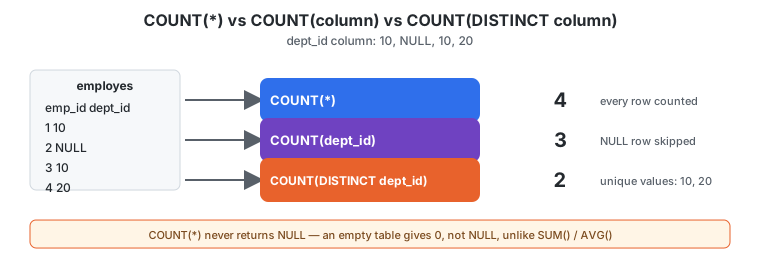
COUNT() returns the number of rows matched by a query, or the number of non-NULL values in a specific column.
| Form | Counts |
|---|---|
COUNT(*) |
Every row, including rows where every column is NULL |
COUNT(column_name) |
Only rows where column_name is not NULL |
COUNT(DISTINCT column_name) |
Only the number of unique non-NULL values |
Business Context
Almost every dashboard has a headline number in the top-left corner — total customers, total orders, total open tickets. That number is a COUNT(). Getting it wrong (e.g., silently excluding rows with a NULL email) means shipping a dashboard that under-reports reality.
Where Companies Use It
- HR: total headcount, active employees per department
- E-commerce: total orders, total distinct customers who ordered this month
- Support: total open tickets, tickets with no assigned agent (
NULLcheck)
Syntax
SELECT COUNT(*) FROM table_name;
SELECT COUNT(column_name) FROM table_name;
SELECT COUNT(DISTINCT column_name) FROM table_name;
Execution Flow
employes table
┌────────┬──────────┬─────────┐
│ emp_id │ emp_name │ dept_id │
├────────┼──────────┼─────────┤
│   1    │  Alice   │   10    │
│   2    │  Bob     │  NULL   │   <- unassigned
│   3    │  Carol   │   10    │
│   4    │  Dave    │   20    │
└────────┴──────────┴─────────┘

COUNT(*)              -> 4   (every row)
COUNT(dept_id)        -> 3   (NULL row excluded)
COUNT(DISTINCT dept_id)-> 2  (10, 20)
Engineering Notes
COUNT(*)does not need to reference any particular column, so the optimizer is free to use the smallest available index (or table metadata, in some engines) rather than scanning wide rows — this is whyCOUNT(*)is generally not slower thanCOUNT(1), contrary to a common myth.COUNT(1)andCOUNT(*)are functionally identical in every mainstream RDBMS. PreferCOUNT(*)for clarity; it’s the ANSI-idiomatic form.COUNT(column)forces aNOT NULLcheck on every row, which can matter on very large, sparsely-indexed columns.
MySQL Notes
COUNT(DISTINCT col1, col2) is a MySQL extension — it counts distinct combinations of col1 and col2 together. This is not standard ANSI SQL.
PostgreSQL Notes
PostgreSQL does not support multi-column COUNT(DISTINCT col1, col2). Use COUNT(DISTINCT (col1, col2)) (a row constructor) instead.
Edge Cases
COUNT(*)on an empty table returns0, neverNULL. This is different fromSUM()/AVG(), which returnNULLon an empty group — a frequent source of bugs when the result feeds into further arithmetic.- Inside
GROUP BY, a group with zero matching rows never appears in the output at all (there’s nothing to count0of) — don’t confuse “group has 0 rows” with “group exists with a count of 0.”
Common Mistakes
Wrong — assuming COUNT(column) behaves like COUNT(*):
-- Silently under-counts if manager_id has NULLs (e.g., the CEO)
SELECT COUNT(manager_id) AS total_employees FROM employes;
Correct:
SELECT COUNT(*) AS total_employees FROM employes;
Interview Questions
- What’s the difference between
COUNT(*)andCOUNT(1)? (Trick question — there isn’t one in practice.) - If a table has 100 rows and a column
emailisNULLin 5 of them, what doesCOUNT(email)return? - Write a query to count the number of distinct departments represented in the
employestable. - Why does
COUNT(*)return0instead ofNULLon an empty table, whileSUM()returnsNULL?
Summary
COUNT(*) counts rows. COUNT(column) counts non-NULL values in that column. COUNT(DISTINCT column) counts unique non-NULL values. Choosing the wrong form is the single most common aggregation bug in production reporting code.
Practice Challenges
- Write a query returning the number of employees with a non-
NULLdept_id. - Write a query returning the number of distinct cities employees work in (requires joining to
locations). - Predict — without running it — what
COUNT(*)returns on the result of aLEFT JOINwhere the right table has no match for some rows.
Further Reading
Related Topics: SUM() · GROUP BY · HAVING
| ← Previous Lesson | ↑ Module README | Next Lesson → |