SQL-Engineering-Handbook
MIN() and MAX()
Introduction
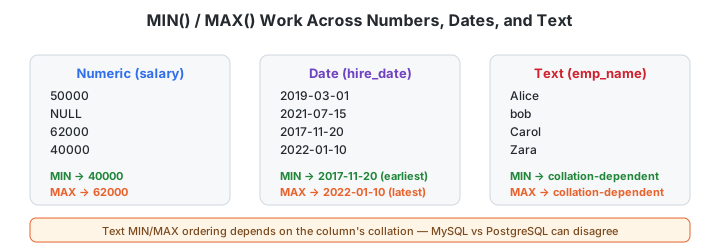
MIN() and MAX() find the smallest and largest values in a column. They look like the simplest aggregates in the module, but they’re the only two that work natively across numbers, dates, and text — which makes them more versatile, and more prone to surprising behavior on non-numeric columns, than SUM() or AVG().
Learning Objectives
- Use
MIN()/MAX()across numeric, date, and text columns - Explain why
MIN()/MAX()ignoreNULLthe same waySUM()/AVG()do - Understand how
MIN()/MAX()order text values (collation-dependent) - Combine
MIN()/MAX()withGROUP BYto find extremes per category
Concept Overview
| Function | Returns |
|---|---|
MIN(column) |
The smallest non-NULL value |
MAX(column) |
The largest non-NULL value |
Business Context
“What was our highest sale of the month?” “Who’s been here the longest?” “What’s the earliest unfulfilled order?” — every one of these is a MIN()/MAX() query, and they’re often the first thing an executive asks after seeing a SUM() or AVG() figure.
Where Companies Use It
- HR: earliest hire date, highest/lowest salary
- E-commerce: largest single order, earliest unshipped order
- Operations: longest downtime incident, latest deployment timestamp
Syntax
SELECT MIN(column_name) FROM table_name;
SELECT MAX(column_name) FROM table_name;
Execution Flow
salary column: [50000, NULL, 62000, 40000]

MIN() -> 40000   (NULL ignored, smallest of the rest)
MAX() -> 62000   (NULL ignored, largest of the rest)
Engineering Notes
MIN()/MAX()ignoreNULLexactly likeSUM()/AVG()— aNULLvalue is never “the minimum.”- On indexed columns,
MIN()/MAX()(with noGROUP BY) can often be satisfied by a single index seek rather than a full table scan — one of the cheapest aggregate queries an optimizer can run. This changes onceGROUP BYis introduced; per-groupMIN()/MAX()typically requires scanning each group. - On text columns,
MIN()/MAX()use the column’s collation to determine ordering — case sensitivity and locale can change what “largest” means ('Zebra'vs'apple'may not sort the way you expect under a case-insensitive collation). - On
DATE/TIMESTAMPcolumns,MIN()finds the earliest moment andMAX()the most recent — this is the standard pattern for “first order date” / “last login” style fields.
MySQL Notes
MySQL evaluates string MIN()/MAX() using the column’s collation (commonly case-insensitive by default, e.g. utf8mb4_general_ci).
PostgreSQL Notes
PostgreSQL string comparisons are case-sensitive by default ('Z' < 'a' in the default C-adjacent locale in many setups) — MIN()/MAX() on text can return different results than the “same” query in MySQL. Always verify collation when porting reports between the two.
Edge Cases
MIN()/MAX()on an empty group returnsNULL, matchingSUM()/AVG()behavior — not an error.MIN()/MAX()on a single-row group simply returns that row’s value.
Common Mistakes
Wrong — trying to get the entire row containing the max salary using only MAX():
-- This does NOT return the employee with the highest salary —
-- it mixes an aggregate with a non-aggregated column with no
-- GROUP BY, which is invalid or misleading depending on the engine.
SELECT emp_name, MAX(salary) FROM employes;
Correct — use ORDER BY ... LIMIT (covered in Module 01) or a window function (Module 07) to retrieve the full row:
SELECT emp_name, salary
FROM employes
ORDER BY salary DESC
LIMIT 1;
Interview Questions
- Why can’t you reliably get “the employee with the highest salary” using
MAX(salary)alone in aSELECTwith other non-aggregated columns? - What does
MIN()return on an empty result set? - Why might
MAX(employee_name)return a different “largest” name in MySQL vs. PostgreSQL on the same data?
Summary
MIN()/MAX() find extremes across numeric, date, and text data, ignoring NULL. They cannot pull an entire related row on their own — for that, pair ORDER BY with LIMIT, or use a window function.
Practice Challenges
- Find the earliest and latest
emp_idper department usingGROUP BY. - Find the highest-paid employee’s full row (name, department, salary) using
ORDER BY ... LIMIT 1instead ofMAX().
Further Reading
Related Topics: COUNT() · GROUP BY · Window Functions (Module 07)
| ← Previous Lesson | ↑ Module README | Next Lesson → |