SQL-Engineering-Handbook
AVG()
Introduction
AVG() returns the arithmetic mean of a numeric column. It looks trivial and is one of the most misused aggregate functions in production reporting — mostly because of how it interacts with NULL.
Learning Objectives
- Compute averages correctly across a table or group
- Explain precisely how
AVG()treatsNULLvalues (this is the crux of the whole file) - Avoid the classic “average of an average” mistake when combining pre-aggregated data
- Round
AVG()output appropriately for currency and reporting
Concept Overview
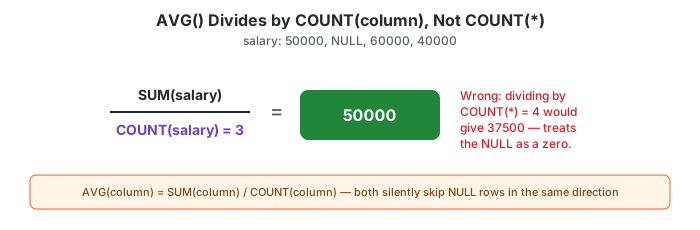
AVG(column_name) = SUM(column_name) / COUNT(column_name) — critically, the denominator is COUNT(column_name) (non-NULL rows), not COUNT(*) (all rows).
Business Context
“Average order value,” “average salary,” “average handling time” — these numbers drive pricing decisions, compensation benchmarking, and SLA reporting. An AVG() computed over the wrong denominator silently skews every one of them.
Where Companies Use It
- HR: average salary by department, average tenure
- E-commerce: average order value (AOV), average basket size
- Support: average ticket resolution time
Syntax
SELECT AVG(column_name) FROM table_name;
SELECT dept_id, AVG(salary) FROM employes GROUP BY dept_id;
Execution Flow
salary column: [50000, NULL, 60000, 40000]

SUM (NULL skipped)  = 150000
COUNT (NULL skipped)=      3     <- NOT 4
AVG                 =  50000
Engineering Notes
AVG()divides by the count of non-NULLvalues, not the total row count. This is the single most important fact in this file. If 2 out of 10 employees have aNULLsalary,AVG(salary)divides by 8, not 10.AVG(), likeSUM(), returnsNULLon an empty or all-NULLgroup.- Never average pre-averaged numbers directly.
AVG(AVG(x))across groups of different sizes is mathematically wrong unless every group has the same row count — this is a very common analyst mistake when rolling up department averages into a company-wide average. The correct rollup isSUM(x) / COUNT(x)at the ungrouped level, not the mean of the per-group means.
MySQL Notes
AVG() returns a DECIMAL for exact-numeric input and a DOUBLE for approximate-numeric input — round explicitly for display: ROUND(AVG(salary), 2).
PostgreSQL Notes
Same rounding guidance applies; PostgreSQL’s AVG(integer) returns numeric, which is exact but may print with more decimal places than desired without ROUND().
Edge Cases
- If a
WHEREclause filters out every row before aggregation,AVG()returns one row containingNULL— same empty-group behavior asSUM(). - Averaging a column with extreme outliers (e.g., one $10M enterprise deal among $500 average deals) can produce a misleading mean — consider reporting the median (via
PERCENTILE_CONTin Postgres, or window functions) alongsideAVG()for skewed distributions. That’s outside this module’s scope but worth flagging.
Common Mistakes
Wrong — rolling up department averages into a company average by averaging the averages:
-- WRONG if departments have different headcounts
SELECT AVG(dept_avg_salary) FROM (
  SELECT dept_id, AVG(salary) AS dept_avg_salary
  FROM employes GROUP BY dept_id
) t;
Correct:
SELECT AVG(salary) AS company_avg_salary FROM employes;
Interview Questions
- What does
AVG()divide by — total rows or non-NULLrows? Why does this distinction matter? - If department A has 2 employees averaging $80,000 and department B has 8 employees averaging $50,000, what is the company-wide average salary, and why isn’t it $65,000?
- Why might a company report both
AVG()andMAX()/MIN()together rather thanAVG()alone?
Summary
AVG() is SUM() / COUNT(column), both of which silently skip NULL. It returns NULL on empty groups. Never average pre-aggregated averages across groups of unequal size.
Practice Challenges
- Compute the correct company-wide average salary, and separately the (incorrect) average-of-department-averages, to see the discrepancy on your own data.
- Write a query for average salary per city.
Further Reading
Related Topics: SUM() · MIN() & MAX() · HAVING
| ← Previous Lesson | ↑ Module README | Next Lesson → |