SQL-Engineering-Handbook
SARGability and Index Usage
Module 16 · Query Optimization Home · Engineering Guide · Cheatsheet · Rewrite Cookbook
Lesson 03 of 12 · ← EXPLAIN · Next: Joins → · SQL Lab · Lab Benchmark
Introduction
An index doesn’t help just because it exists — it has to be usable for the specific way a predicate is written. This lesson covers the single most common reason a “properly indexed” production query still runs a full table scan: the predicate isn’t SARGable.
Learning Objectives
- Define SARGable (“Search ARGument-able”) and identify SARGable vs. non-SARGable predicates on sight
- Rewrite common non-SARGable patterns into SARGable equivalents
- Understand composite index column order and selectivity
- Explain what a covering index is and why it avoids a table lookup entirely
Why This Exists
Teams routinely add an index, watch the query stay slow, and conclude
“indexes don’t work here” — when the real problem is that the WHERE
clause wraps the indexed column in a function or implicit conversion,
making the index invisible to the optimizer. This is the highest-leverage,
most commonly misunderstood topic in practical query tuning.
Business Motivation
An HR system needs “everyone hired in 2023”:
-- Looks reasonable. Is not SARGable.
SELECT emp_name, hire_date
FROM employes
WHERE YEAR(hire_date) = 2023;
Even with a plain index on hire_date, this query can’t use it as a
range scan — the engine must compute YEAR(hire_date) for every row
before it can compare against 2023, which means reading every row
via a full table scan. (An expression/functional index built specifically
on YEAR(hire_date) could restore index usage on some engines — MySQL 8+
and PostgreSQL support functional indexes — but that’s a deliberate,
narrow fix for one expression, not a substitute for writing SARGable
predicates in the first place.)
What “SARGable” Means
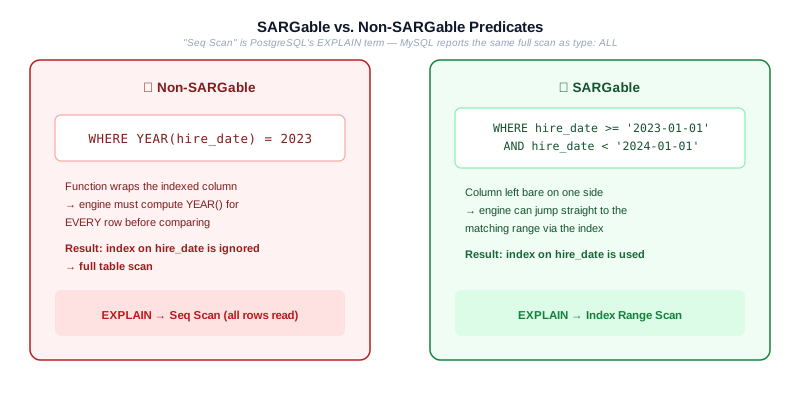
A predicate is SARGable when the engine can use an index to jump directly to matching rows, instead of having to evaluate an expression against every row first. The rule of thumb: the indexed column must appear alone, on one side of the comparison, with nothing applied to it.
| Non-SARGable | SARGable rewrite |
|---|---|
WHERE YEAR(hire_date) = 2023 |
WHERE hire_date >= '2023-01-01' AND hire_date < '2024-01-01' |
WHERE UPPER(emp_name) = 'AMMAR' |
WHERE emp_name = 'Ammar' (or a case-insensitive collation/index) |
WHERE dept_id + 1 = 5 |
WHERE dept_id = 4 |
WHERE emp_name LIKE '%mmar' |
WHERE emp_name LIKE 'Ammar%' (leading wildcard defeats standard B-tree indexes) |
WHERE CAST(dept_id AS VARCHAR) = '4' |
WHERE dept_id = 4 (avoid implicit/explicit type conversion on the column) |
The pattern in every “non-SARGable” row: something is applied to the column itself. The pattern in every fix: the column is left bare, and any transformation happens to the constant instead.
Composite Indexes and Column Order
An index on (dept_id, hire_date) supports:
WHERE dept_id = 4✅ (uses the leading column)WHERE dept_id = 4 AND hire_date > '2023-01-01'✅ (uses both, in order)
But does not efficiently support:
WHERE hire_date > '2023-01-01'alone ❌ — this skips the leading column, so the index mostly can’t be used (this is the “leftmost prefix” rule)
Column order in a composite index should generally put the highest-selectivity, most frequently equality-filtered column first.
Selectivity
Selectivity = how much a predicate narrows down the row set. dept_id
(a handful of distinct values across millions of rows) is low-selectivity;
an index on it alone helps far less than an index on a near-unique column
like emp_id. Extremely low-selectivity columns (e.g., a boolean flag with
90% TRUE) often aren’t worth indexing at all — the optimizer may
correctly choose a sequential scan over such an index anyway.
Covering Indexes
Index Usage Decision Flow
flowchart TD
    A[Predicate in WHERE/JOIN] --> B{Function or cast on column?}
    B -->|Yes| C[Non-SARGable — rewrite predicate]
    B -->|No| D{Leading wildcard in LIKE?}
    D -->|Yes| E[Non-SARGable — consider full-text/trigram index]
    D -->|No| F{Matching index exists?}
    F -->|No| G[Full scan: Seq Scan/type ALL — add or redesign index]
    F -->|Yes| H{All SELECT columns in index?}
    H -->|Yes| I["Index-only access: Index Only Scan (PG) / Using index (MySQL) — optimal"]
    H -->|No| J[Index lookup + table read: Index Scan (PG) / ref,range (MySQL)]
    C --> K[Rewrite and re-check plan]
    E --> K
    G --> K
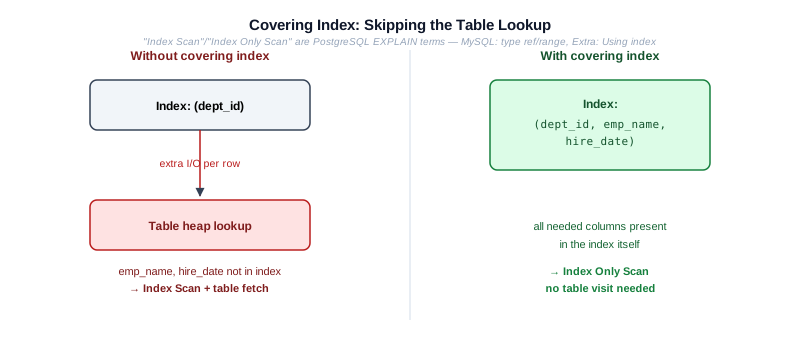
A covering index includes every column a query needs, so the engine can
answer entirely from the index without a separate lookup into the table
(an “Index Only Scan” in PostgreSQL’s EXPLAIN output, or Extra: Using
index in MySQL’s — see Lesson 02):
-- Index: (dept_id, emp_name, hire_date)
SELECT emp_name, hire_date
FROM employes
WHERE dept_id = 4;
Because emp_name and hire_date are both present in the index, the
engine never has to visit the underlying table row.
Engineering Notes
- Adding an index has a write-side cost (every
INSERT/UPDATEmaintains every index on that table) — indexing is always a read/write tradeoff, never a free performance upgrade. - Implicit type conversion is a silent SARGability killer: comparing an
INTcolumn against a string literal, or aVARCHARcolumn against an unquoted number, can force a conversion on every row.
MySQL / PostgreSQL / SQL Server Notes
- PostgreSQL supports functional/expression indexes
(
CREATE INDEX ON employes (UPPER(emp_name))) that make certain “non-SARGable” patterns SARGable again — at the cost of maintaining an extra index. - SQL Server query plans explicitly show “Index Seek” (SARGable, cheap) vs. “Index Scan” (the whole index was read — often a sign of poor selectivity or a non-SARGable predicate).
- MySQL (InnoDB) composite indexes strictly follow the leftmost-prefix rule described above.
Common Mistakes
- Wrapping the indexed column in a function in the
WHEREclause - Using a leading wildcard in
LIKE '%text' - Assuming an index helps without checking column order in a composite index against the actual query’s filter columns
- Over-indexing: adding an index for every possible filter combination, which slows down writes without meaningfully speeding up reads
Anti-patterns
WHERE column IS NOT NULLon a column indexed without a partial/filtered index — often can’t use the index efficientlyWHERE column != value— inequality predicates are frequently low-selectivity and often skip the index in favor of a scan
Interview Questions
- “What does SARGable mean, and can you give an example of a non-SARGable predicate and its fix?”
- “You have a composite index on
(a, b). Does a query filtering only onbuse it efficiently? Why or why not?”
Edge Cases
- Collation mismatches: comparing a case-sensitive-collated column against a case-insensitive literal (or joining two text columns with different collations) can silently defeat an index even though no function is visibly wrapping the column.
- Type-widening implicit conversions: comparing a
SMALLINTcolumn against a literal the engine treats asBIGINTcan force a conversion on the column side in some engines — the SARGability rule is easy to violate without any function call being visible in the SQL at all.
Troubleshooting Guidance
- Index exists, matches the filter column, and the query is still slow →
check
EXPLAINfor whether the index was actually chosen; if not, check selectivity (is the filter actually narrowing the row set?) and whether statistics are current. - Composite index exists but isn’t used for a query using its later columns → check the leftmost-prefix rule (Lesson 03) before assuming the index is broken.
Scalability Considerations
Every index added is write overhead on every future INSERT/UPDATE/
DELETE that touches indexed columns. At high write throughput, indexing
decisions are a genuine tradeoff against write latency — audit existing
indexes for actual read usage (most engines expose index-usage statistics)
before adding new ones, rather than only ever adding.
Additional Dialect Notes
- Oracle: supports function-based indexes directly, similar to
PostgreSQL’s expression indexes, letting you index
UPPER(column)etc. explicitly. - SQLite: supports partial indexes (
CREATE INDEX ... WHERE ...) since 3.8.0, useful for indexing only a frequently-queried subset of rows. - DuckDB: as a columnar analytical engine, relies more on automatic zone maps (min/max per column chunk) than traditional B-tree indexes — SARGability still matters, but the mechanism differs from row-store engines.
Summary
An index is a promise, not a guarantee — the WHERE clause has to be
written so the optimizer can actually keep that promise. SARGability is the
single check to run first whenever “I added an index and it didn’t help.”
Practice Challenges
- Rewrite
WHERE dept_id * 1 = 4to be SARGable (trick question — spot why it’s already effectively non-SARGable and fix it). - Given an index on
(location_id, dept_name), write one query that uses it efficiently and one that cannot, and explain why for each.
Real Company Usage
- Airbnb: Listing search with OR across city/neighborhood columns — neither single index served the combined predicate efficiently (Incident #6).
- Netflix: Partial index on
content_rating IS NOT NULLfixed a post-migration full table scan (PostgreSQLSeq Scan) — Incident #1. - Shopify: Index bloat from over-indexing (47 indexes on orders table) caused Black Friday degradation (Incident #7).
Production Applications
These scenarios are illustrative case studies inspired by common production failure modes; specific figures are illustrative unless an external source is cited in PRODUCTION_INCIDENTS.md. See its disclaimer for the full explanation.
- First check when “I added an index and it didn’t help”
- Required review for every WHERE clause in production SQL
- Composite index design for multi-column filter + ORDER BY patterns
Performance Notes
- Every index adds write overhead — audit before adding (PERFORMANCE_SMELLS #47)
- Low-selectivity columns (boolean flags, status enums) often aren’t worth indexing alone
- Functional/expression indexes (PostgreSQL, Oracle) can restore SARGability for required function forms
Optimization Notes
- Before adding an index, confirm the predicate is SARGable — an index on
hire_datecannot helpWHERE YEAR(hire_date) = 2023until you rewrite to a range. - Design composite indexes with the highest-selectivity equality column first, then range/sort columns —
(dept_id, hire_date)supportsWHERE dept_id = 4 ORDER BY hire_dateefficiently. - A covering index that includes all SELECT columns eliminates the table lookup entirely — check for
Index Only Scan(PostgreSQL) orKey Lookupabsence in the plan.
Interview Insight
SARGability questions test whether you understand why indexes fail, not just when to add them. Strong answers rewrite the predicate, explain the leftmost-prefix rule for composite indexes, and mention covering indexes as the next optimization step. Weak answers stop at “add an index on that column.” Interviewers also probe leading-wildcard LIKE patterns — know that standard B-tree indexes cannot help %value searches.
Further Experiments
- Create an index on
hire_date, run the non-SARGableYEAR(hire_date) = 2023query withEXPLAIN, then rewrite to a date range and compare plans. - Build a composite index
(dept_id, hire_date)and test three queries: filter ondept_idalone, filter on both columns, and filter onhire_datealone — observe the leftmost-prefix rule. - Complete the SARGability Benchmark — measure the function-on-column → range rewrite → covering index progression.
Continue Learning
- Next: Lesson 04 — Join Optimization
- Lab: Performance_lab/ — SARGability Benchmark
- Cookbook: REWRITE_COOKBOOK #1, #10, #11
Related Modules
02_EXPLAIN · 04_Join Optimization · 06_Anti-Patterns
Further Reading
- Use-the-index-luke.com — “SARGable” and “Anatomy of an Index” chapters
- PostgreSQL documentation: “Index-Only Scans and Covering Indexes”
- DECISION_TREE.md — Tree 2: Index vs Rewrite
- Performance_lab/ — hands-on SARGability benchmark at multi-million-row scale