SQL-Engineering-Handbook
04 · Banking — Window Functions in Transaction & Risk Analytics
Introduction
Banking data is sequential by nature: every account has an ordered history of transactions, and nearly every question a risk or operations team asks is really a question about how a transaction relates to the ones around it — is this withdrawal unusually large compared to this account’s own history? Has the balance dropped sharply? Is there a suspicious gap or spike in transaction frequency? This chapter applies the running-total and gap-analysis patterns from earlier chapters to the highest-stakes domain in this module: financial risk.
Business Background
A simplified banking schema centers on accounts and their transaction ledger:
accounts (account_id, customer_id FK, account_type, opened_date, ...)transactions (transaction_id, account_id FK, transaction_date, amount, transaction_type, ...)amountis signed: positive for deposits/credits, negative for withdrawals/debits.
customers (customer_id, customer_name, ...)
Risk, fraud, and operations teams consume this data primarily through running balances, outlier detection relative to an account’s own history, and gap/frequency analysis.
Typical KPIs
- Running account balance
- Largest single transactions (company-wide and per-account)
- Transaction gap (time between consecutive transactions per account)
- Number of transactions per account per period
- Customer ranking by total transaction volume
- Flagged transactions (statistical outliers relative to account history)
Typical Dashboards
- Balance Tracker — running balance per account over time, reconstructed from the transaction ledger.
- Fraud Signal Dashboard — transactions flagged as statistical outliers relative to an account’s own transaction history.
- Large Transaction Monitor — a ranked list of the largest transactions across the bank, refreshed daily, typically feeding a manual review queue.
- Account Activity Dashboard — transaction frequency and gap analysis, used to detect dormant or suddenly hyperactive accounts.
Business Problems
- “Reconstruct the running balance for every account, transaction by transaction.”
- “Show me the largest transactions bank-wide, for manual review.”
- “Flag any transaction that’s unusually large compared to that specific account’s own transaction history - a first-pass fraud signal.”
- “What’s the time gap between consecutive transactions on an account? Flag accounts with unusually long dormancy followed by sudden activity.”
- “Rank customers by total transaction volume, for a relationship-banking outreach list.”
- “Compare each account’s current balance to its balance at the start of the month.”
Why Window Functions Are Needed
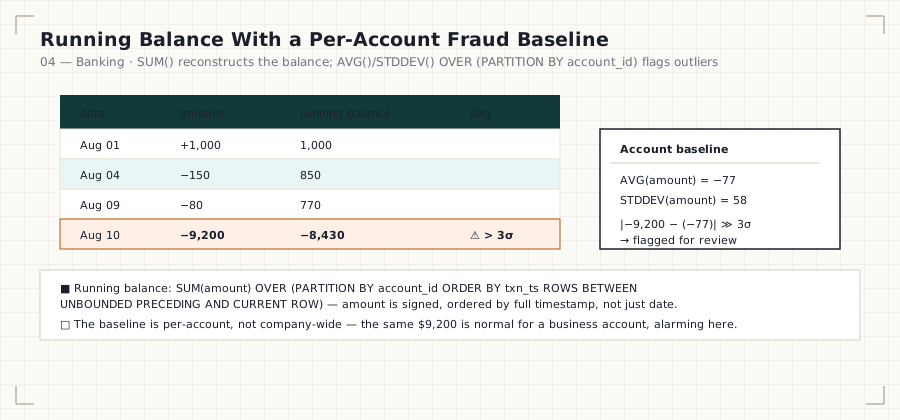
A running balance is, definitionally, a running total - SUM(amount) OVER (PARTITION BY account_id ORDER BY transaction_date ROWS BETWEEN UNBOUNDED PRECEDING AND CURRENT ROW) - reusing the exact pattern from Sales Analytics, now applied per account rather than per salesperson. Fraud-style outlier detection compares a transaction to the mean and standard deviation of that same account’s own history - the identical pattern used for the HR pay-equity screen in Chapter 01, applied here to transaction amounts instead of salaries. This consistency is intentional: window functions solve a small number of structural problems, and once you recognize the shape of the problem, the domain becomes a matter of relabeling columns.
Functions Used in This Chapter
| Function | Business Explanation |
|---|---|
SUM() OVER (PARTITION BY account_id ORDER BY transaction_date ...) |
Running account balance reconstruction. |
RANK() |
Largest transactions bank-wide; customer ranking by transaction volume. |
AVG() / STDDEV() OVER (PARTITION BY account_id) |
Per-account baseline for outlier / fraud-signal detection. |
LAG() |
Time and amount gap between consecutive transactions on an account. |
FIRST_VALUE() |
Balance at the start of a period, for period-over-period balance comparison. |
SQL Concepts Reinforced
- Reconstructing a running balance directly from a signed
amountcolumn, rather than assuming a pre-computedbalancecolumn exists in the ledger (which is common in real core-banking exports). - Using
AVG()andSTDDEV()as windowed aggregates - not just grouped aggregates - to build a per-account statistical baseline that stays attached to every individual transaction row. - Using
FIRST_VALUE() OVER (PARTITION BY account_id, period ORDER BY transaction_date)to retrieve a period’s opening balance without a separate query. - The importance of a strict, gapless
ORDER BY(transaction timestamp, not just date, when multiple transactions share a date) to avoid non-deterministic running balances.
Performance Notes
- Running balance queries over a full transaction ledger are among the most expensive window function patterns in this module - ensure
(account_id, transaction_date)(or a precise timestamp) is indexed, and consider maintaining a materialized daily balance snapshot table for accounts with very long histories, rather than recomputing the full running sum on every query. - Per-account outlier detection (
AVG()/STDDEV() OVER (PARTITION BY account_id)) recomputes the same statistics for every row in the partition; for very high-frequency accounts, consider pre-aggregating account-level statistics into a lookup table refreshed on a schedule, then joining rather than windowing over raw transactions on every query. - Large-transaction monitoring queries that scan the entire ledger daily should filter to a rolling time window (e.g.,
WHERE transaction_date >= CURRENT_DATE - INTERVAL '1 day') before ranking, rather than ranking the entire historical table and discarding all but the top few rows.
Common Mistakes
- Ordering a running balance calculation by
transaction_datealone when multiple transactions share the same date, producing a non-deterministic (and audit-unfriendly) running balance - always order by a full timestamp, or add a deterministic tiebreaker. - Applying a single company-wide average/standard deviation for fraud detection instead of a per-account baseline - a $50,000 transaction may be entirely normal for one account and a clear anomaly for another.
- Forgetting that
amountis signed in most ledger schemas, leading to a running balance calculation that adds withdrawals instead of subtracting them. - Treating
RANK()ties in a “largest transactions” report as if they were guaranteed unique, when in fact two transactions can legitimately share an identical amount.
Interview Questions
- “How would you reconstruct a running account balance from a transaction ledger?” — Expect
SUM(amount) OVER (PARTITION BY account_id ORDER BY transaction_date ROWS BETWEEN UNBOUNDED PRECEDING AND CURRENT ROW), with attention to signed amounts and deterministic ordering. - “How would you flag potentially fraudulent transactions using only SQL?” — Expect a discussion of per-account mean/standard-deviation baselines (
AVG()/STDDEV() OVER (PARTITION BY account_id)) and a threshold-based flag, with the caveat that this is a first-pass heuristic, not a full fraud model. - “Why is ordering important when calculating a running balance, and what happens if two transactions share the same timestamp?” — Expect recognition that ties in the
ORDER BYcolumn make the running balance non-deterministic unless a tiebreaker (e.g.,transaction_id) is added. - “How would you find the account with the largest balance drop within a single day?” — Expect
LAG()on the running balance itself (a window function applied to the output of another window function, typically via a CTE), then a computed delta. - “What’s the difference between windowing a statistic per account versus computing it once for the whole table, in a risk-detection context?” — Expect an explanation of why global baselines under- or over-flag depending on an account’s typical transaction size.
Summary
Banking analytics is where the running-total pattern (Sales Analytics) and the peer/self-comparison pattern (HR Analytics) converge on the highest-stakes use case in this module: financial risk. Every pattern in this chapter - running balances, per-account outlier baselines, and transaction gap analysis - reuses tools you have already built fluency with, applied to a domain where correctness and determinism carry real financial consequences.
Further Practice
- Extend the running balance query to flag any day where the balance drops below zero (an overdraft signal).
- Add a query that computes the largest single-day balance swing (max increase and max decrease) per account.
- Build a dormancy-then-spike detector: flag accounts with a transaction gap greater than 90 days immediately followed by a transaction amount more than 3 standard deviations above that account’s historical average.
Next: 04_BANKING.sql — the fully engineered SQL chapter for this domain.
Previous: 03_ECOMMERCE.md · Module: README · Next chapter: 05_FINANCE.md