SQL-Engineering-Handbook
03 · E-Commerce — Window Functions in Customer & Product Analytics
Introduction
E-commerce analytics blends the two patterns you’ve already built: peer comparison (Chapter 01) and time-based comparison (Chapter 02) - then adds a third dimension unique to this domain: the customer as the unit of analysis over their entire relationship with the business. Customer Lifetime Value, repeat purchase behavior, and order-level ranking all require looking at a customer’s or product’s full history, not just a single transaction.
Business Background
A typical e-commerce schema centers on orders and order line items:
customers (customer_id, customer_name, signup_date, ...)orders (order_id, customer_id FK, order_date, order_total, ...)order_items (order_item_id, order_id FK, product_id FK, quantity, unit_price, ...)products (product_id, product_name, category_id FK, ...)categories (category_id, category_name)
Analytics and growth teams use this data to understand who is buying, what they’re buying, and how often they return.
Typical KPIs
- Customer Lifetime Value (CLV)
- Average Order Value (AOV)
- Repeat purchase rate
- Top products / top categories by revenue
- Customer rank by total spend
- Running revenue per customer over their lifecycle
- Basket size ranking (largest orders by item count or value)
Typical Dashboards
- Customer Value Dashboard — ranks customers by lifetime spend, flags top-tier (“VIP”) customers.
- Product Performance Dashboard — ranks products and categories by revenue and units sold.
- Retention Dashboard — repeat purchase rate, time between orders, churn risk signals.
- Order Analytics Dashboard — average order value trends, largest baskets, order frequency.
Business Problems
- “Rank our customers by total lifetime spend - who are our VIP customers?”
- “What’s the running revenue contributed by each customer over time, so we can see growth in their relationship with us?”
- “Rank our products within each category by revenue.”
- “What percentage of customers make more than one purchase, and how long is the gap between their first and second order?”
- “What’s the average order value, and how does it compare to each customer’s own historical average?”
- “Rank our largest baskets (orders) by total value, for a case study on high-value orders.”
Why Window Functions Are Needed
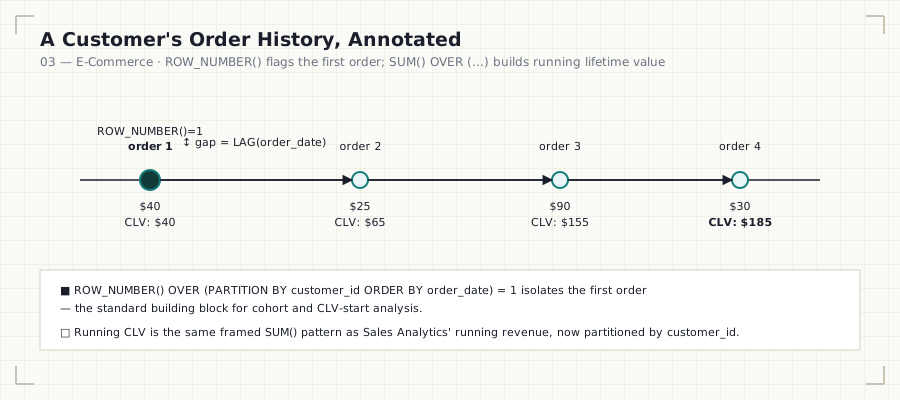
Customer Lifetime Value and repeat-purchase analysis both require comparing a customer’s current order to their own history - not to a fixed group like a department, and not strictly to a calendar period like a fiscal month, but to their own prior orders, in sequence. This is a natural extension of LAG()/LEAD() and running-total patterns, partitioned by customer_id instead of salesperson_id or dept_id. Product and category rankings reuse the exact RANK()/DENSE_RANK() leaderboard pattern from Chapters 01 and 02, now applied to product_id and category_id partitions.
Functions Used in This Chapter
| Function | Business Explanation |
|---|---|
RANK() / DENSE_RANK() |
Customer value leaderboard; product ranking within category. |
SUM() OVER (PARTITION BY customer_id ORDER BY order_date ...) |
Running lifetime revenue per customer. |
LAG() |
Time between a customer’s consecutive orders (repeat purchase gap). |
AVG() OVER (PARTITION BY customer_id) |
Customer’s own historical average order value, for anomaly comparison. |
ROW_NUMBER() |
Identifying each customer’s first order (for cohort and CLV-start analysis). |
SQL Concepts Reinforced
- Using
ROW_NUMBER() = 1percustomer_id(ordered byorder_date) to isolate each customer’s first order, a common building block for cohort and CLV-start analysis. - Distinguishing a “customer-level” running total (
PARTITION BY customer_id) from a “company-level” running total (no partition) - the same distinction introduced in Sales Analytics, now reused for a different grain. - Using
COUNT() OVER (PARTITION BY customer_id)to determine whether a customer is a repeat purchaser (count > 1) without a separate aggregation query. - Nesting a product-within-category rank alongside a category-level rank, to answer two related but distinct business questions in one query.
Performance Notes
- CLV and running-revenue queries partitioned by
customer_idscale well when(customer_id, order_date)is indexed - without it, the engine must sort the entireorderstable per partition on every query execution. - Repeat-purchase and basket analyses are frequently requested on a rolling basis (e.g., “repeat rate this month”) - consider materializing a customer-level summary table (first order date, order count, lifetime revenue) refreshed on a schedule, rather than recomputing window functions over the full order history on every dashboard load.
- Product-within-category ranking benefits from partitioning on
category_iddirectly rather than joining tocategoriespurely for the category name inside the window - join the name in an outerSELECTafter ranking, if the ranking column itself doesn’t require it.
Common Mistakes
- Computing “average order value” as a single global average when the business actually wants per-customer AOV for anomaly detection - always confirm the partition scope.
- Using
COUNT(*)instead ofCOUNT(DISTINCT order_id)when counting orders per customer in the presence of a joinedorder_itemstable, silently inflating the count by line-item quantity. - Forgetting to handle customers with exactly one order when computing “gap between first and second order” - a
LAG()will correctly returnNULLfor such rows, but downstream aggregate calculations must explicitly exclude or handle theseNULLs. - Ranking products by total revenue without partitioning by category, when the business intent was “best-selling product within its category,” not company-wide.
Interview Questions
- “How would you calculate Customer Lifetime Value using window functions?” — Expect a running
SUM(order_total) OVER (PARTITION BY customer_id ORDER BY order_date), and a discussion of the difference between “running CLV” and “final/total CLV.” - “How would you identify each customer’s very first order?” — Expect
ROW_NUMBER() OVER (PARTITION BY customer_id ORDER BY order_date) = 1. - “How would you calculate the repeat purchase rate for a cohort of customers?” — Expect a
COUNT() OVER (PARTITION BY customer_id)(or aGROUP BY+HAVING COUNT(*) > 1) to identify repeat purchasers, divided by total customers in the cohort. - “Rank products by revenue within their category - how would you write this?” — Expect
RANK() OVER (PARTITION BY category_id ORDER BY SUM(revenue) DESC)over a pre-aggregated product-revenue CTE. - “What’s the difference between average order value calculated globally vs. per customer, and why does the distinction matter for a churn model?” — Expect a discussion of how global AOV can mask individual behavioral drift that a churn model needs to detect.
Summary
E-commerce analytics is where peer comparison (Chapter 01) and time-based comparison (Chapter 02) combine and extend to a new grain: the customer’s own history. Running lifetime value, first-order detection, and repeat-purchase gap analysis are the foundational building blocks of nearly every growth and retention dashboard in the industry.
Further Practice
- Extend the CLV query to bucket customers into value tiers (e.g.,
NTILE(4)) for a tiered loyalty program. - Add a query that computes the average time between a customer’s first and second order, segmented by acquisition channel (if such a column exists).
- Build a “basket ranking” report that ranks the top 10 largest orders by total value, joined back to customer and product detail.
Next: 03_ECOMMERCE.sql — the fully engineered SQL chapter for this domain.
Previous: 02_SALES_ANALYTICS.md · Module: README · Next chapter: 04_BANKING.md