SQL-Engineering-Handbook
02 — Creating Views
Module: 14 — Views Previous: 01 — Introduction to Views · Next: 03 — Updatable Views
Learning Objectives
- Use full
CREATE VIEWsyntax including options MySQL exposes - Understand
CREATE OR REPLACEvsDROP+CREATE - Rename View columns explicitly and know when it’s required
- Alter and drop Views safely
Concept Overview
Creating a View is syntactically simple; the engineering decisions live in the options around it — algorithm hints, security context, and column naming — which is why this file separates creation mechanics from the business-logic examples in Module 01.
Why This Exists
A repository or team with dozens of Views needs consistent, predictable creation patterns — otherwise every View becomes a one-off with different conventions, and nobody can safely modify one without reading its full definition first.
Business Context
An Analytics Engineering team maintaining 40+ Views across Sales, Finance, and HR domains needs every View creation script to be idempotent (safe to re-run in CI/CD as schema migrates) and self-documenting.
Where Companies Use It
- CI/CD pipelines that redeploy View definitions on every merge to
main(dbt does this for View-materialized models) - Migration scripts that need to safely replace a View’s logic without a two-step drop/create that briefly breaks dependents
Real Business Examples
-- Idempotent creation — safe to re-run, never errors if the View exists
CREATE OR REPLACE VIEW vw_headcount_by_department AS
SELECT
    d.department_name,
    d.region,
    COUNT(e.employee_id) AS headcount
FROM hr_departments AS d
LEFT JOIN hr_employees AS e
    ON e.department_id = d.department_id
GROUP BY d.department_name, d.region;
Syntax
CREATE [OR REPLACE]
    [ALGORITHM = {UNDEFINED | MERGE | TEMPTABLE}]
    [DEFINER = user]
    [SQL SECURITY {DEFINER | INVOKER}]
    VIEW view_name [(column_list)]
    AS select_statement
    [WITH [CASCADED | LOCAL] CHECK OPTION];

ALTER VIEW view_name AS select_statement;   -- redefines, preserves privileges
DROP VIEW [IF EXISTS] view_name;
Visual Explanation
CREATE VIEW  ──►  writes definition to information_schema.VIEWS
ALTER VIEW   ──►  overwrites definition, keeps GRANTs intact
DROP VIEW    ──►  removes definition; dependents break immediately
Step-by-Step Walkthrough
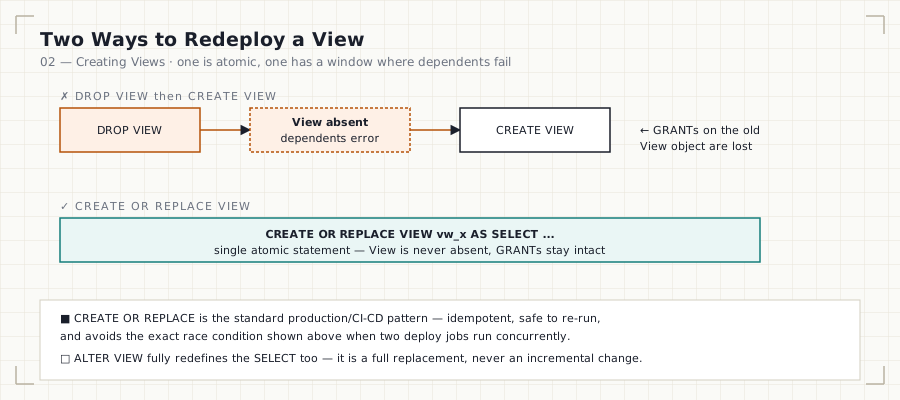
CREATE OR REPLACE VIEWis the standard production pattern — it avoids the race condition and privilege loss ofDROP VIEWfollowed byCREATE VIEW(aDROPbriefly leaves the View absent, and re-CREATEresets any GRANTs made directly on the View object).- Use
ALTER VIEWonly when you specifically want to keep the exact same View object identity (e.g., certain privilege inheritance edge cases) — in practice, most teams standardize onCREATE OR REPLACE. - Always name columns explicitly, either via the base query’s column aliases or the
(column_list)syntax, never rely on positional inference.
Engineering Notes
ALGORITHM is a hint, not a guarantee — MySQL’s optimizer can override MERGE back to TEMPTABLE if the query structure disqualifies merging (aggregates, DISTINCT, UNION, subqueries in SELECT, etc.), covered fully in Module 07.
Production Considerations
Every CREATE OR REPLACE VIEW in a migration script should be preceded by a comment block stating the business rule it encodes and the ticket/PR that introduced it — this is the difference between a maintainable View library and 40 undocumented objects nobody wants to touch.
Performance Notes
CREATE OR REPLACE and ALTER VIEW are metadata-only operations — near-instant regardless of base table size, since no data is copied or rewritten.
Edge Cases
DROP VIEW IF EXISTSon a View that other Views depend on does not cascade — dependents break at query time with an error, not at drop time.- Column list length in
CREATE VIEW view_name (col1, col2, ...)must exactly match the number of columns returned by theSELECT— a mismatch is a hard error at creation, not query time.
Best Practices
- Standardize on
CREATE OR REPLACE VIEWin all migration/deployment scripts. - Always specify explicit column names.
- Keep one View definition per file in version control, named to match the View name, for clean diffs and code review.
Common Mistakes
| Mistake | Consequence |
|---|---|
DROP then CREATE instead of CREATE OR REPLACE |
Brief window where dependents fail; GRANTs on the View object are lost |
| Relying on positional column inference | Silent column meaning swap if the base query’s SELECT order changes |
| No documentation comment | Business rule knowledge lost when the author leaves the team |
Interview Questions
- “What’s the difference between
CREATE OR REPLACE VIEWandDROP VIEW+CREATE VIEW?” — atomicity and privilege preservation. - “Can you
ALTERa View’s columns without recreating it?” — No;ALTER VIEWfully redefines theSELECT, so it’s a full column-set replacement, not incremental.
Summary
View creation is metadata-only and near-instant. The engineering discipline is in consistent, idempotent, documented creation patterns — not the syntax itself.
Practice Challenges
- Write a
CREATE OR REPLACE VIEWfor “employees hired in the last 2 years” usinghr_employees, with explicit column names. - Explain, without running it, why
DROP VIEWfollowed immediately byCREATE VIEWin a deployment script run by two concurrent CI jobs is a race condition.
Further Reading
- MySQL 8.0 Reference Manual — CREATE VIEW
- MySQL 8.0 Reference Manual — ALTER VIEW