SQL-Engineering-Handbook
03 — INTERSECT and EXCEPT
Introduction
If UNION answers “what’s the combined picture?”, INTERSECT and EXCEPT answer the two questions that matter most in reconciliation work: “what do these two sets have in common?” and “what’s missing from one side?” These are the operators behind every migration audit, every reconciliation report, and every “did we lose any data?” question.
Concept Overview
INTERSECT— returns only the rows that appear in both branches.EXCEPT(ANSI SQL / PostgreSQL / SQL Server) orMINUS(Oracle) — returns rows from the first branch that do not appear in the second. Order matters:A EXCEPT Bis not the same asB EXCEPT A.
Both operators de-duplicate their output, just like UNION.
Why This Exists
Comparing two datasets for overlap or difference is a constant need wherever the same kind of data lives in more than one place — which, in any real organization, is almost everywhere. INTERSECT and EXCEPT let you express “compare these two populations” as a single declarative statement instead of a manual JOIN-and-inspect process.
Business Context
A company migrating from an old CRM to a new one needs to know: which customers exist in both systems (INTERSECT — successfully migrated), and which exist only in the old system (EXCEPT — migration gaps that need investigation).
Real Company Examples
- A bank uses
EXCEPTto find accounts present in the core ledger but absent from the fraud-monitoring replica — a potential replication failure. - An e-commerce company uses
INTERSECTto find customers who appear in both the loyalty-program table and the newsletter subscriber table, to avoid sending duplicate welcome emails from two different systems. - A hospital network uses
EXCEPTboth directions to prove a patient-record migration between two EHR systems was complete.
Production Use Cases
- Migration completeness checks (
EXCEPTboth directions should return zero rows). - Cross-system reconciliation (ERP vs. CRM, production vs. staging).
- Finding overlap between two audiences for marketing, compliance, or fraud analysis.
- Detecting orphaned or missing foreign-key references across tables that should mirror each other.
Visual Explanation
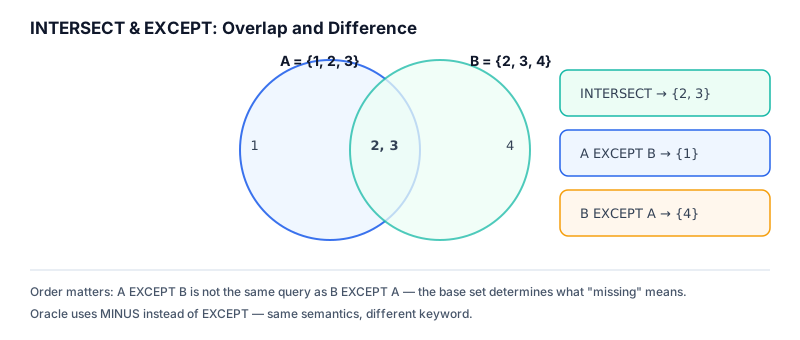
   A = {1, 2, 3}        B = {2, 3, 4}

   INTERSECT (A, B) → {2, 3}        (in both)
   EXCEPT (A - B)   → {1}           (in A only)
   EXCEPT (B - A)   → {4}           (in B only)

        A ┌────┬────┐ B
          │ 1  │2, 3│ 4
          └────┴────┘
             ↑
        intersection
Syntax
-- INTERSECT (all four target databases; MySQL 8.0.31+)
SELECT column_list FROM table_a
INTERSECT
SELECT column_list FROM table_b;

-- EXCEPT (ANSI SQL / PostgreSQL / SQL Server / MySQL 8.0.31+)
SELECT column_list FROM table_a
EXCEPT
SELECT column_list FROM table_b;

-- Oracle uses MINUS instead of EXCEPT
SELECT column_list FROM table_a
MINUS
SELECT column_list FROM table_b;
Detailed Explanation
EXCEPT/MINUS is directional and order-sensitive — this is the single most important thing to internalize. A EXCEPT B finds what A has that B lacks; reversing the order answers a completely different business question. A full reconciliation almost always requires running it both directions:
SELECT customer_id FROM crm_customers
EXCEPT
SELECT customer_id FROM erp_customers;   -- in CRM, missing from ERP

SELECT customer_id FROM erp_customers
EXCEPT
SELECT customer_id FROM crm_customers;   -- in ERP, missing from CRM
Both queries returning zero rows is the actual proof of a complete, matching migration — not a single query, and not a row count comparison (two tables can have the same row count and still contain entirely different rows).
Simulating INTERSECT and EXCEPT Without Native Support
Older MySQL versions (before 8.0.31) don’t support INTERSECT or EXCEPT natively. Both can be simulated using JOIN/EXISTS and NOT EXISTS:
-- INTERSECT simulation, using EXISTS
SELECT DISTINCT a.customer_id
FROM crm_customers a
WHERE EXISTS (
    SELECT 1 FROM erp_customers b
    WHERE b.customer_id = a.customer_id
);

-- EXCEPT / MINUS simulation, using NOT EXISTS
SELECT DISTINCT a.customer_id
FROM crm_customers a
WHERE NOT EXISTS (
    SELECT 1 FROM erp_customers b
    WHERE b.customer_id = a.customer_id
);
NOT EXISTS is preferred over NOT IN for this simulation because NOT IN behaves incorrectly — returning no rows at all — if the subquery’s column contains even a single NULL. NOT EXISTS has no such trap.
Business Examples
-- Customers who exist in both the loyalty program and the newsletter list
SELECT customer_id FROM loyalty_members
INTERSECT
SELECT customer_id FROM newsletter_subscribers;
-- Orders present in production but missing from the analytics staging copy
SELECT order_id FROM production.orders
EXCEPT
SELECT order_id FROM staging.orders;
Production Workflow
- Identify the two populations being compared and confirm they share a comparable key/column shape.
- Decide whether the question is “what’s shared?” (
INTERSECT) or “what’s missing?” (EXCEPT/MINUS). - For reconciliation, always run
EXCEPTin both directions. - If the target database lacks native support, simulate with
EXISTS/NOT EXISTS, never withNOT INon a nullable column. - Zero rows returned from both directions of
EXCEPTis the pass condition for a reconciliation check — treat it as a testable assertion, not just an inspection query.
Engineering Considerations
INTERSECT/EXCEPTcompare entire rows (all selected columns together), not just a single column, unless you deliberately select only one column — be precise about which columns define “the same row” for your comparison.- These operators are ideal candidates for automated data tests (e.g., a dbt test or a CI check that asserts an
EXCEPTquery returns zero rows).
Performance Notes
Like UNION, both INTERSECT and EXCEPT require de-duplication and are typically implemented via sort or hash-based set comparison. On large tables, an equivalent NOT EXISTS/EXISTS rewrite with proper indexes on the join column often outperforms the native set operator, because the optimizer can use an index seek per row rather than materializing and sorting both full sets. Always compare execution plans on your actual data volume rather than assuming either form is universally faster.
Database Compatibility
| Feature | MySQL | PostgreSQL | SQL Server | Oracle |
|---|---|---|---|---|
INTERSECT |
8.0.31+ | ✅ | ✅ | ✅ |
EXCEPT |
8.0.31+ | ✅ | ✅ | ❌ (use MINUS) |
MINUS |
❌ | ❌ | ❌ | ✅ |
EXISTS/NOT EXISTS simulation |
✅ (all versions) | ✅ | ✅ | ✅ |
Best Practices
- Always reconcile in both directions with
EXCEPT/MINUS— one direction alone proves nothing about the reverse. - Prefer
NOT EXISTSoverNOT INwhen simulatingEXCEPT, especially against nullable columns. - Wrap
EXCEPTreconciliation queries as automated tests with an expected result of zero rows, not manual inspection.
Common Mistakes
- Running
EXCEPTonly one direction and declaring a migration “complete.” - Using
NOT INinstead ofNOT EXISTS/LEFT JOIN ... IS NULLagainst a column that can containNULL, silently returning zero rows regardless of the real answer. - Assuming Oracle supports
EXCEPT— it requiresMINUS. - Forgetting that
INTERSECT/EXCEPTcompare the entire row across all selected columns, not just the first one.
Edge Cases
- If either branch is empty,
INTERSECTalways returns an empty set, andEXCEPTreturns the first branch unchanged (deduplicated). NULLvalues are treated as equal to each other inINTERSECT/EXCEPTcomparisons, consistent with their treatment inUNION.
Interview Questions
- (Foundational) What does
INTERSECTreturn, and how is it different from aJOIN? - (Intermediate) Why is
A EXCEPT Bnot the same asB EXCEPT A? - (Intermediate) How would you simulate
EXCEPTin a MySQL version that doesn’t support it? - (Advanced) Why is
NOT EXISTSgenerally safer thanNOT INfor this simulation? - (Staff-level) Design a two-query test that proves a table migration between two databases moved every row with no additions or losses.
Summary
INTERSECT finds overlap; EXCEPT/MINUS finds one-directional difference. Both are the backbone of reconciliation and migration-validation work, and both can be simulated with EXISTS/NOT EXISTS where native support is missing.
Practice Problems
- Write an
INTERSECTquery to find employees who are also referenced as amanager_idelsewhere in theemployeestable (i.e., employees who manage someone). - Write the same query as Problem 1 using
EXISTSinstead ofINTERSECT. - Write two
EXCEPTqueries (both directions) to comparedept_idvalues betweenemployeesanddepartments, and explain what a non-empty result in each direction would mean for data integrity.
Further Reading
- PostgreSQL Docs —
INTERSECT,EXCEPT - Oracle SQL Language Reference —
MINUS - Microsoft Learn —
EXCEPTandINTERSECT(Transact-SQL)