SQL-Engineering-Handbook
02 — UNION and UNION ALL
Introduction
UNION and UNION ALL look nearly identical in syntax and are opposites in behavior and cost. Choosing between them incorrectly is one of the most common — and most consequential — mistakes in production SQL: it can silently delete real business data (duplicate transactions treated as errors) or silently degrade performance (paying for a sort you never needed).
Concept Overview
UNION— stacks the results of two or moreSELECTstatements and removes duplicate rows from the combined set.UNION ALL— stacks the results of two or moreSELECTstatements and keeps every row, duplicates included.
The only difference is de-duplication. Everything else — column rules, naming, ORDER BY placement — is identical between them.
Why This Exists
Not every “combine these two result sets” problem has the same duplicate-handling requirement. Sometimes duplicates across the two sources are noise (the same city listed twice because two teams both maintain an office list) — UNION is correct. Sometimes duplicates are the entire point (two identical $50 transactions on the same card on the same day are two real events, not one) — UNION ALL is correct. SQL gives you both because business reality demands both.
Business Context
A finance team merging Q1 and Q2 transaction logs wants every transaction, including two identical-looking ones — UNION ALL. A marketing team merging two mailing lists wants one deduplicated list of contacts to email — UNION. Choosing the wrong one either fabricates data loss or fabricates duplicate outreach.
Real Company Examples
- A bank uses
UNION ALLto combinetransactions_checkingandtransactions_savingsinto one customer statement — every transaction must appear. - A retailer uses
UNIONto build a single, deduplicatedall_store_citieslist — the same city should not be listed twice just because two regional teams both entered it.
Production Use Cases
- Merging partitioned fact tables (
sales_2023,sales_2024) — alwaysUNION ALL. - Building a deduplicated contact or reference list —
UNION. - Quantifying duplicate rows before a cleanup project by comparing
UNIONandUNION ALLrow counts.
Visual Explanation
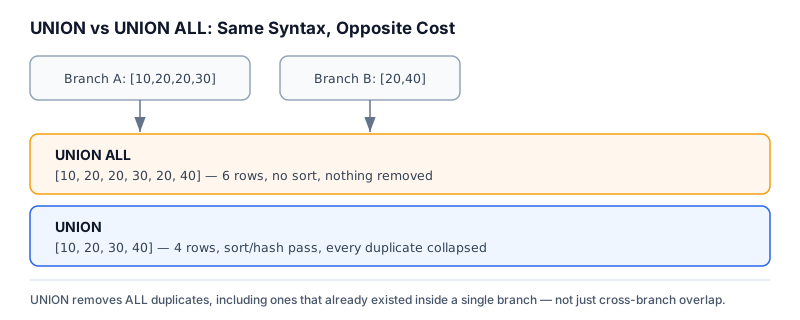
 Branch A: [10, 20, 20, 30]      Branch B: [20, 40]

 UNION ALL → [10, 20, 20, 30, 20, 40]     (6 rows — nothing removed)
 UNION     → [10, 20, 30, 40]             (4 rows — all duplicates collapsed,
                                            including the internal duplicate
                                            20 that already existed in A)
Syntax
SELECT col1, col2 FROM table_a
UNION ALL              -- or UNION
SELECT col1, col2 FROM table_b
ORDER BY col1;
Detailed Explanation
A critical, frequently-missed detail: UNION doesn’t just remove duplicates between the branches — it removes duplicates within the entire combined result, including duplicates that already existed inside a single branch before combination. If branch A alone contains the same row twice, UNION collapses those too, even if branch B is empty.
UNION ALL never inspects row content for duplication. It is a pure concatenation, which is why it’s inexpensive: no sort, no hash table, no comparison — just append.
Business Examples
-- Correct: every transaction matters, duplicates are real events
SELECT transaction_id, amount, transaction_date FROM transactions_q1
UNION ALL
SELECT transaction_id, amount, transaction_date FROM transactions_q2;
-- Correct: a reference list should never have duplicate entries
SELECT DISTINCT region_name FROM sales_us
UNION
SELECT DISTINCT region_name FROM sales_emea;
Production Workflow
- Ask: “Is a duplicate row here a data error, or a real, separate business event?”
- If it’s a real event (transactions, orders, log entries) →
UNION ALL. - If it’s a reference/lookup/reporting list where duplicates are noise →
UNION. - When unsure, default to
UNION ALLand de-duplicate explicitly downstream withGROUP BYorDISTINCT— this keeps the decision visible and intentional rather than silently baked into the operator.
Engineering Considerations
UNION ALLis the correct default inside ETL/ELT pipelines building fact tables — losing a legitimate duplicate transaction is a data integrity incident.UNIONis appropriate for dimension/reference-style outputs where identity, not event count, matters.- Row-count differences between
UNIONandUNION ALLon the same two branches is a fast, reliable way to measure exactly how much duplication exists between two sources.
Performance Notes
UNION requires the engine to detect and remove duplicates across the full combined result, which typically costs a sort or hash-based deduplication pass. On a combined result of millions of rows, that pass can dominate the query’s total cost. UNION ALL has none of this cost — it is a simple append operation. When you know duplicates are impossible or irrelevant, using UNION anyway is pure wasted cost.
Database Compatibility
| Behavior | MySQL | PostgreSQL | SQL Server | Oracle |
|---|---|---|---|---|
UNION de-duplicates |
✅ | ✅ | ✅ | ✅ |
UNION ALL keeps all rows |
✅ | ✅ | ✅ | ✅ |
UNION DISTINCT as explicit synonym for UNION |
✅ | ✅ | ❌ | ❌ |
Best Practices
- Default to
UNION ALLin pipeline/ETL code; make deduplication an explicit, visible step if needed. - Use
UNIONonly when duplicates are genuinely meaningless to the business question. - Never choose between them based on “which one runs” — both almost always run; the difference is correctness and cost, not validity.
Common Mistakes
- Using
UNIONout of habit, silently dropping real duplicate business events (classic financial reporting bug). - Using
UNION ALLwhen a report requires a clean, deduplicated reference list, producing visibly repeated rows in a customer-facing report. - Believing
UNION ALLis “wrong” or “sloppy” — it is simply a different, and often more correct, tool.
Edge Cases
UNIONtreats twoNULLvalues as duplicates of each other and collapses them, even thoughNULL = NULLevaluates to unknown everywhere else in SQL.- A
UNIONof a branch against itself (SELECT x FROM t UNION SELECT x FROM t) is a fast, idiomatic way to deduplicate a single table — equivalent toSELECT DISTINCT x FROM t.
Interview Questions
- (Foundational) What exactly does
UNIONremove duplicates from — each branch individually, or the combined result? - (Intermediate) Why is
UNION ALLalmost always preferred inside ETL pipelines building fact tables? - (Intermediate) How would you use
UNIONandUNION ALLtogether to count how many duplicate rows exist between two tables? - (Advanced)
SELECT x FROM t UNION SELECT x FROM t— what does this accomplish, and what simpler statement is it equivalent to? - (Staff-level) A nightly report suddenly shows fewer transactions than the source system. The only recent change was swapping
UNION ALLforUNIONin the report’s SQL. Explain the likely root cause.
Summary
UNION and UNION ALL differ only in de-duplication, but that single difference changes both the correctness and the performance profile of a query. Choose based on whether a duplicate row represents a real business event or noise — never by default.
Practice Problems
- Using
departmentsandlocations, write a query that would demonstrate — with row counts — how many duplicate values exist betweendept_nameandcityif any did. - Rewrite a
UNIONquery as aUNION ALLand explain, in a comment, exactly which rows would newly appear. - Write a query using
UNION ALLtwice on the same table to intentionally double a result set, and explain a legitimate business scenario where this is useful (hint: weighting or sampling).
Further Reading
- PostgreSQL Docs —
UNION,UNION ALL,UNION DISTINCT - Microsoft Learn —
UNION(Transact-SQL) - Oracle SQL Language Reference —
UNION [ALL]
← Introduction to Set Operators · Next: INTERSECT and EXCEPT →