SQL-Engineering-Handbook
02 — Multiple CTEs
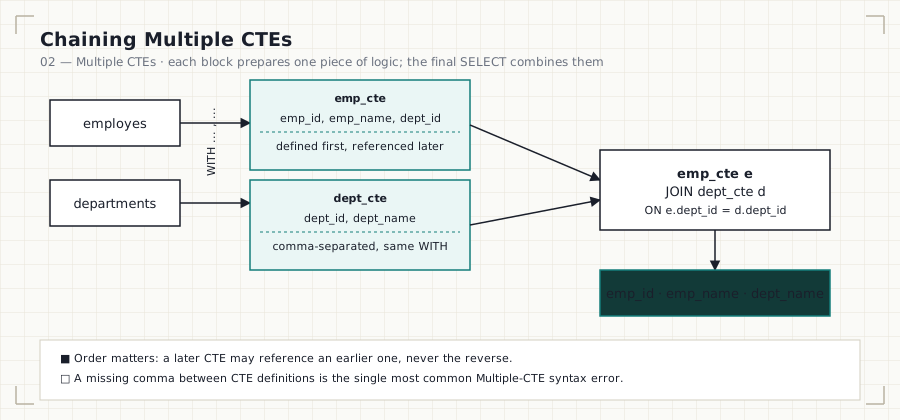
In this file: defining more than one CTE in a single
WITHclause, the rules for chaining and comma-separating them, and joining two staged CTEs together for the first time.
Business Question
How can multiple temporary datasets be prepared independently, then combined in one final query — instead of writing one query that does everything at once?
Why This Matters
Real reporting queries rarely touch a single table. The moment a query needs
employees and departments and locations, a single monolithic
SELECT becomes hard to reason about: which JOIN filters which rows? A
WITH clause holding several CTEs lets you build the query the same way you
would explain it out loud — “first get the employees, then get the
departments, then join them” — with each stage isolated and independently
testable.
SQL Solution
See 02_Multiple_CTEs.sql for all three queries.
WITH emp_cte AS (
    SELECT emp_id, emp_name, dept_id
    FROM employes
),
dept_cte AS (
    SELECT dept_id, dept_name
    FROM departments
)
SELECT
    e.emp_id,
    e.emp_name,
    d.dept_name
FROM emp_cte e
JOIN dept_cte d
    ON d.dept_id = e.dept_id;
Explanation
Multiple CTEs live inside one WITH keyword, separated by commas — not
repeated WITH statements:
WITH first_cte AS ( ... ),
     second_cte AS ( ... ),
     third_cte AS ( ... )
SELECT ...
Two rules govern how they interact:
- Ordering is directional. A CTE defined later in the list may reference one defined earlier (this is how File 03 builds a three-way join). A CTE can never reference one that comes after it.
- Each CTE is scoped to the same statement as the others — they all
disappear together once the final
SELECTfinishes.
This file takes that pattern from two CTEs (emp_cte, dept_cte) to three
(adding locations_cte), previewing the join pattern the rest of the module
builds on.
Finding
Employee and department data were separated into individual, reusable
blocks and combined only in the final SELECT. Each block can be read,
tested, and debugged on its own — comment out the final JOIN and run
SELECT * FROM emp_cte in isolation to confirm it looks right before
trusting the combined result. This is the core habit that makes large SQL
queries maintainable: isolate a stage, verify it, then compose.
Common Mistakes
- Using duplicate CTE names within the same
WITHclause — this raises a syntax or ambiguity error depending on the engine. - Referencing a CTE before it’s defined in the list (see the ordering rule above).
- Missing the comma between CTE definitions — the single most common typo in a Multiple-CTE query, and one that produces a confusing syntax error far from its actual cause.
- Forgetting to alias joined columns (
e.emp_idvs.d.dept_id) once two CTEs share a column name likedept_id.
Interview Tips
Multiple CTEs are the backbone of most real-world reporting and dashboard queries. Interviewers use this pattern to test whether you can decompose a vague business ask (“show me headcount by department and city”) into discrete, joinable stages — rather than attempting one sprawling query in a single pass.
Practice Questions
- Add a third CTE for locations and join all three (this is exactly what File 03 does next — try it before reading ahead).
- Filter departments before joining, inside
dept_cteitself, rather than filtering the final result — compare the two approaches. - Rewrite the query using a single CTE and a subquery in place of the second CTE. Which version is easier to read?
Previous: 01_Basic_CTE.md · Next:
03_CTE_Joins.md — extending this pattern to a full
three-table join.