SQL-Engineering-Handbook
04 — FULL OUTER JOIN
Keep every row from both tables — matched pairs, unmatched left rows, and unmatched right rows all appear, with
NULLfilling whichever side didn’t match.
Difficulty: Beginner → Intermediate · Estimated time: 30–40 min · Prerequisites: 02_LEFT_JOIN.md, 03_RIGHT_JOIN.md
📑 Contents
- Learning Objectives
- Concept Overview
- Business Context
- Syntax
- Execution Flow
- Engineering Notes
- Vendor Notes — the MySQL Gap
- Edge Cases
- Common Mistakes
- Best Practices
- Interview Questions
- Practice Challenges
- Further Reading
Learning Objectives
- Explain FULL OUTER JOIN as the union of what LEFT JOIN and RIGHT JOIN each produce.
- Write a portable FULL OUTER JOIN emulation for MySQL, which has no native
FULL OUTER JOINkeyword. - Use FULL OUTER JOIN to do genuine two-sided reconciliation — the class of business problem it exists for.
Concept Overview
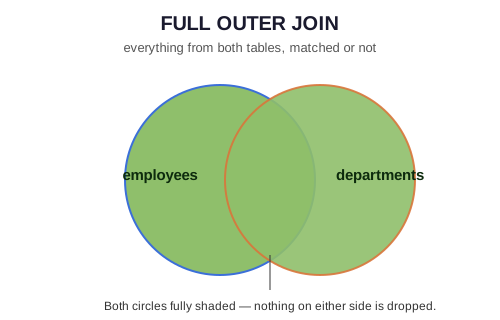
FULL OUTER JOIN (FULL JOIN) preserves rows from both tables regardless of whether a match exists on the other side. Conceptually, it’s LEFT JOIN and RIGHT JOIN merged into a single result set: every matched pair appears once, every unmatched left row appears with NULL on the right, and every unmatched right row appears with NULL on the left.
   employees only          matched (both sides)          departments only
  ┌───────────────┐      ┌────────────────────┐        ┌────────────────┐
  │  Farhan Ali    │      │ 9 employee rows ↔   │        │  Legal (dept)   │
  │  dept_id: NULL │      │ their departments   │        │  0 employees    │
  └───────────────┘      └────────────────────┘        └────────────────┘
        ▲                          ▲                              ▲
        └── LEFT JOIN keeps this ──┴── RIGHT JOIN keeps this ─────┘
                        FULL OUTER JOIN keeps ALL THREE
Business Context
Where companies use it: reconciliation problems — anywhere two datasets are supposed to represent the same entities but might disagree. Classic examples: comparing a payroll system’s employee list against an HR system’s employee list to find records that exist in one but not the other; comparing expected vs. actual inventory counts; comparing a source system export against a data warehouse load to find drift. FULL OUTER JOIN is the query that answers “where do these two datasets disagree, in either direction?” in a single pass.
Syntax
SELECT
    e.emp_name,
    d.dept_name
FROM employees e
FULL OUTER JOIN departments d
    ON e.dept_id = d.dept_id;
OUTER is optional (FULL JOIN is equivalent) but conventionally kept for symmetry with LEFT OUTER JOIN / RIGHT OUTER JOIN in codebases that write those out in full.
Execution Flow
FROM employees e
    │
    ▼
FULL OUTER JOIN departments d ON e.dept_id = d.dept_id
    │   ├─ matched rows:        both sides populated
    │   ├─ unmatched employees: dept_name = NULL
    │   └─ unmatched departments: emp_name = NULL
    ▼
SELECT e.emp_name, d.dept_name
Step-by-Step Walkthrough
Against the seed data: 9 employees match a department, Farhan Ali (dept_id = NULL) doesn’t match anything and appears with dept_name = NULL, and Legal (dept_id = 60, no employees) appears with emp_name = NULL. Total: 11 rows — the same 9 matched rows as the INNER JOIN, plus the 1 unmatched-left row LEFT JOIN would add, plus the 1 unmatched-right row RIGHT JOIN would add.
Engineering Notes
FULL OUTER JOIN is genuinely LEFT JOIN UNION RIGHT JOIN where native support is missing (see the MySQL workaround below) — but even where it’s natively supported, it’s worth understanding this equivalence because it explains the performance characteristics: the engine typically executes it as something functionally close to that union internally, which is more expensive than a plain LEFT or RIGHT JOIN. Don’t reach for FULL OUTER JOIN by default “to be safe” — use it specifically when the business question genuinely requires seeing gaps on both sides at once. If you only care about one side’s gaps, LEFT or RIGHT JOIN alone is cheaper and clearer.
Vendor Notes — the MySQL Gap
MySQL (all versions through 8.0 at time of writing) has no FULL OUTER JOIN keyword. This is the single most important vendor difference in this entire module, and it’s a frequent interview question specifically because it separates candidates who’ve only used Postgres/SQL Server from those who’ve had to actually solve this in MySQL production code.
PostgreSQL / SQL Server / Oracle: FULL OUTER JOIN is fully native — use the syntax above directly.
MySQL workaround — UNION (not UNION ALL) of a LEFT JOIN and a RIGHT JOIN:
SELECT e.emp_name, d.dept_name
FROM employees e
LEFT JOIN departments d ON e.dept_id = d.dept_id

UNION

SELECT e.emp_name, d.dept_name
FROM employees e
RIGHT JOIN departments d ON e.dept_id = d.dept_id;
UNION (which deduplicates) rather than UNION ALL is required here — without it, every genuinely matched row (present in both the LEFT and RIGHT JOIN results) would be duplicated. This has a real cost: UNION’s deduplication requires sorting or hashing the combined result, which is more expensive than a native FULL OUTER JOIN would be. On large tables, this is a legitimate reason some teams choose to materialize a reconciliation as two separate queries (missing-on-the-right, missing-on-the-left) rather than paying for the union.
Edge Cases
NULL behavior: exactly as in LEFT and RIGHT JOIN, mirrored to both sides simultaneously — a row can have NULL on the left, NULL on the right, but never NULL on both (a row with no join-key match on either side simply doesn’t exist to join).
The MySQL UNION workaround’s own NULL trap: if emp_name itself can legitimately be NULL in real data (unlike this schema, where it’s NOT NULL), the UNION deduplication could incorrectly collapse two genuinely different rows that happen to both have NULL in the same column — worth testing explicitly if your MySQL emulation involves a nullable column in the SELECT list, not just the join key.
Cardinality: minimum row count is MAX(unmatched left rows, 0) + MAX(unmatched right rows, 0) + matched rows — always greater than or equal to what either LEFT JOIN or RIGHT JOIN alone would return.
Common Mistakes
❌ Using UNION ALL instead of UNION in the MySQL workaround — silently duplicates every matched row. This is easy to miss because the query still runs without error; it just returns a subtly wrong row count.
❌ Reaching for FULL OUTER JOIN when a plain LEFT JOIN would answer the question — if you only need “employees with no department,” you’re paying for a two-sided reconciliation you don’t need. Match the join to the actual business question.
Best Practices
- Reserve FULL OUTER JOIN for genuine two-sided reconciliation problems — data migration validation, source-vs-warehouse drift detection, cross-system comparisons.
- On MySQL, know the
UNIONworkaround well enough to write it from memory — it’s asked often enough in interviews that hesitating on it is a real signal. - When reconciling two large datasets in MySQL, consider whether two separate, indexed anti-join queries (missing-on-left, missing-on-right — see
07_MULTI_TABLE_JOINS.md) would be cheaper than theUNION-based FULL OUTER JOIN emulation, especially if you need the two directions reported separately anyway.
Interview Questions
- “How do you write a FULL OUTER JOIN in MySQL?” — see the Vendor Notes section; this is asked constantly.
- “Why is
UNION, notUNION ALL, required in the MySQL FULL OUTER JOIN emulation?” — matched rows would otherwise be counted twice, once from each half of the union. - “Write a query to find records that exist in table A but not table B, OR in table B but not table A, in a single result set.” — this is precisely what FULL OUTER JOIN + a
WHERE a.key IS NULL OR b.key IS NULLfilter accomplishes; a strong candidate volunteers this filter unprompted.
Summary
FULL OUTER JOIN preserves unmatched rows from both sides at once — it’s the join for two-sided reconciliation, not a “safer default” for everyday queries. Postgres, SQL Server, and Oracle support it natively; MySQL requires a UNION of a LEFT and RIGHT JOIN, a gap worth memorizing precisely because it’s a favorite interview probe.
Practice Challenges
- Write the FULL OUTER JOIN of
employeesanddepartments, then filter it (in a second query) to show only the rows representing a genuine mismatch on either side — i.e., exclude the 9 matched rows. - Rewrite Q1 as the MySQL-compatible
UNIONemulation and confirm the row count matches the native version exactly. - Using
locationsanddepartments, write a FULL OUTER JOIN that would reveal both “a location with no departments” and “a department with no location” in one query, if either currently exists in the seed data.
Further Reading
02_LEFT_JOIN.md·03_RIGHT_JOIN.md— the two joins FULL OUTER JOIN combines.07_MULTI_TABLE_JOINS.md— anti-join patterns as a lighter-weight alternative for one-directional gap detection.