📖 Books
Part of the Resources Library — SQL Engineering Handbook
Every book here cleared the bar in How Resources Were Selected: a real publisher or a verifiable engineering track record, a stated reason it beat the alternatives, and no overlap with something already on this page. Fields follow the Resource Card Template.
[!TIP]
Don’t buy in category order. Read the Recommended Reading Order line at the top of each section — it tells you which book to start with and which one to save for later.
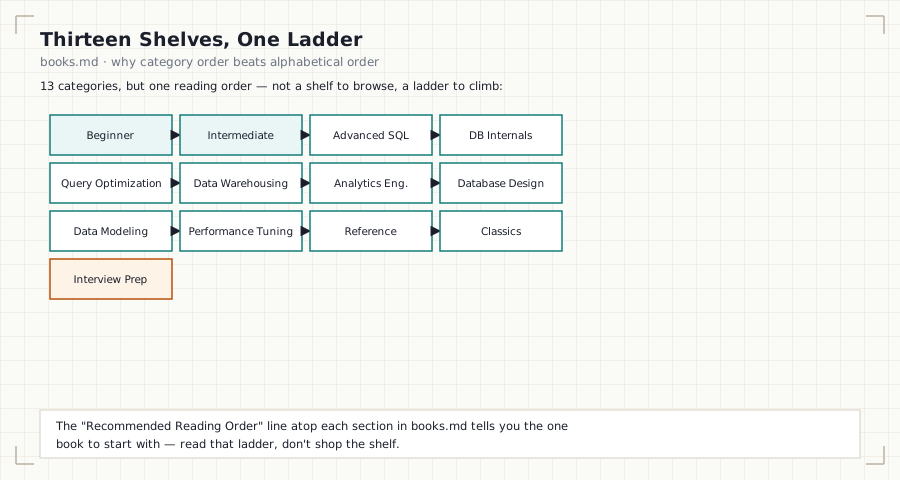
Table of Contents
Essential Beginner Books
Recommended reading order: Learning SQL first, cover to cover. Keep Head First SQL as a second pass if the first one felt dry — same ground, much more visual.
Learning SQL (3rd Edition)
| Field |
Details |
| Author / Organization |
Alan Beaulieu |
| Category |
Essential Beginner Books |
| Difficulty |
Beginner |
| Best For |
A first, properly sequenced introduction to SQL that doesn’t assume prior programming experience |
| Why It Is Recommended |
Builds from schema design through joins, subqueries, and transactions in a deliberate order, using one running example database throughout — the same “one schema, build up gradually” approach this Handbook uses |
| Key Topics Covered |
SELECT statements, filtering, joins, subqueries, grouping, transactions, indexes, views |
| Estimated Time |
3–4 weeks at a relaxed pace |
| Official Website |
O’Reilly Media catalog |
| Free or Paid |
Paid |
| Prerequisites |
None |
| Who Should Read It |
Complete beginners; anyone whose SQL knowledge is copy-pasted and shaky |
| Related SQL Handbook Modules |
00_SAMPLE_DATABASE, 01_FUNDAMENTALS, 02_AGGREGATIONS, 03_JOINS |
Head First SQL
| Field |
Details |
| Author / Organization |
Lynn Beighley |
| Category |
Essential Beginner Books |
| Difficulty |
Beginner |
| Best For |
Readers who find dense technical prose hard to stay with |
| Why It Is Recommended |
The Head First series’ visual, puzzle-driven format covers the same beginner ground as a traditional text but is far easier to stay consistent with — useful if straight prose isn’t sticking |
| Key Topics Covered |
SQL syntax fundamentals, table design basics, joins, aggregate functions |
| Estimated Time |
2–3 weeks |
| Official Website |
O’Reilly Media catalog |
| Free or Paid |
Paid |
| Prerequisites |
None |
| Who Should Read It |
Visual learners; anyone who bounced off a more traditional SQL textbook |
| Related SQL Handbook Modules |
01_FUNDAMENTALS, 02_AGGREGATIONS |
Recommended reading order: Practical SQL if you want a hands-on, project-based bridge from beginner material. SQL Antipatterns once you’re already comfortable writing queries and want to stop making the mistakes that work but shouldn’t.
Practical SQL (2nd Edition)
| Field |
Details |
| Author / Organization |
Anthony DeBarros |
| Category |
Intermediate Books |
| Difficulty |
Beginner–Intermediate |
| Best For |
Learning SQL through real, messy public datasets instead of toy tables |
| Why It Is Recommended |
Uses PostgreSQL and genuine public datasets (census data, election results) end to end, which matches this Handbook’s own philosophy of business-question-first practice over syntax drills |
| Key Topics Covered |
Data cleaning, joins, aggregate functions, working with dates and text, basic statistics in SQL, PostGIS intro |
| Estimated Time |
4–5 weeks |
| Official Website |
No Starch Press catalog |
| Free or Paid |
Paid |
| Prerequisites |
01_FUNDAMENTALS |
| Who Should Read It |
Beginners moving into applied, dataset-driven practice |
| Related SQL Handbook Modules |
02_AGGREGATIONS, 03_JOINS, 09_DATE_FUNCTIONS, 11_NULL_HANDLING_AND_DATA_CLEANING |
SQL Antipatterns
| Field |
Details |
| Author / Organization |
Bill Karwin |
| Category |
Intermediate Books |
| Difficulty |
Intermediate |
| Best For |
Learning what not to do — schema and query mistakes that work in testing and fail in production |
| Why It Is Recommended |
Organized around real recurring mistakes (naive trees, EAV tables, ambiguous NULLs) rather than features, which makes it a rare “here’s why the obvious approach breaks” book |
| Key Topics Covered |
Schema antipatterns, query antipatterns, application-development antipatterns involving SQL |
| Estimated Time |
3 weeks |
| Official Website |
Pragmatic Bookshelf catalog |
| Free or Paid |
Paid |
| Prerequisites |
03_JOINS, 05_SUBQUERIES |
| Who Should Read It |
Anyone about to design their own schema for the first time |
| Related SQL Handbook Modules |
05_SUBQUERIES, 11_NULL_HANDLING_AND_DATA_CLEANING, 18_SQL_BUSINESS_CASE_STUDIES |
Advanced SQL
Recommended reading order: SQL Cookbook for pattern recognition (recognizing “oh, this is a gaps-and-islands problem”), then Joe Celko’s SQL for Smarties for the theory underneath those patterns.
SQL Cookbook (2nd Edition)
| Field |
Details |
| Author / Organization |
Anthony Molinaro and Jonathan Gennick |
| Category |
Advanced SQL |
| Difficulty |
Intermediate–Advanced |
| Best For |
Building a mental library of query patterns (running totals, gaps and islands, pivoting) you’ll recognize instantly later |
| Why It Is Recommended |
Problem → multiple dialect-specific solutions → discussion of trade-offs, which mirrors how you actually solve unfamiliar queries on the job |
| Key Topics Covered |
Window functions, pivoting/unpivoting, hierarchical queries, string manipulation, date arithmetic across dialects |
| Estimated Time |
5–6 weeks, used as a reference more than read cover to cover |
| Official Website |
O’Reilly Media catalog |
| Free or Paid |
Paid |
| Prerequisites |
06_CTEs, 07_WINDOW_FUNCTIONS |
| Who Should Read It |
Intermediate developers who can already write joins and subqueries confidently |
| Related SQL Handbook Modules |
07_WINDOW_FUNCTIONS, 08_WINDOW_BUSINESS_CASES, 13_SET_OPERATORS |
Joe Celko’s SQL for Smarties (5th Edition)
| Field |
Details |
| Author / Organization |
Joe Celko |
| Category |
Advanced SQL |
| Difficulty |
Advanced |
| Best For |
Understanding SQL as a declarative, set-based language instead of writing it like procedural code with SQL syntax |
| Why It Is Recommended |
The book most responsible for the “think in sets, not loops” mindset shift that separates intermediate from advanced SQL writers; still the standard advanced reference two decades on |
| Key Topics Covered |
Set-based thinking, advanced JOIN logic, temporal data, hierarchical and graph data in SQL, NULL handling theory |
| Estimated Time |
6–8 weeks, reference-style |
| Official Website |
Morgan Kaufmann / Elsevier catalog |
| Free or Paid |
Paid |
| Prerequisites |
06_CTEs, 07_WINDOW_FUNCTIONS, 12_ADVANCED_AGGREGATIONS |
| Who Should Read It |
Developers who write correct SQL but suspect they’re still thinking in loops |
| Related SQL Handbook Modules |
12_ADVANCED_AGGREGATIONS, 13_SET_OPERATORS |
Database Internals
Recommended reading order: Designing Data-Intensive Applications first for the broad map of the territory, then Database Internals to go deep on the storage-engine details DDIA only surveys.
Designing Data-Intensive Applications
| Field |
Details |
| Author / Organization |
Martin Kleppmann |
| Category |
Database Internals |
| Difficulty |
Advanced |
| Best For |
Understanding the trade-offs behind every “should we use SQL or NoSQL / one big database or many” decision |
| Why It Is Recommended |
The reference point nearly every other book in this section gets compared against — broad, rigorous coverage of storage, replication, partitioning, and consistency, grounded in real systems rather than abstract theory |
| Key Topics Covered |
Storage engines, replication, partitioning, transactions, consistency and consensus, batch and stream processing |
| Estimated Time |
8–10 weeks |
| Official Website |
O’Reilly Media catalog |
| Free or Paid |
Paid |
| Prerequisites |
Advanced Roadmap modules complete |
| Who Should Read It |
Backend, data, and analytics engineers who want the systems-level picture behind the SQL they write daily |
| Related SQL Handbook Modules |
14_VIEWS, 15_INDEXES, 16_QUERY_OPTIMIZATION |
Database Internals
| Field |
Details |
| Author / Organization |
Alex Petrov |
| Category |
Database Internals |
| Difficulty |
Advanced |
| Best For |
Going one level deeper than DDIA into how storage engines and distributed consensus are actually implemented |
| Why It Is Recommended |
Where Designing Data-Intensive Applications surveys the landscape, this book dissects specific storage engine implementations (B-Trees, LSM-Trees) and distributed algorithms in detail — the natural next step, not a duplicate |
| Key Topics Covered |
B-Tree and LSM-Tree storage engines, page structures, buffer management, recovery, distributed consensus algorithms |
| Estimated Time |
8 weeks |
| Official Website |
O’Reilly Media catalog |
| Free or Paid |
Paid |
| Prerequisites |
Designing Data-Intensive Applications, or equivalent systems background |
| Who Should Read It |
Engineers building or evaluating database/storage systems, not just querying them |
| Related SQL Handbook Modules |
15_INDEXES, 16_QUERY_OPTIMIZATION |
Query Optimization
Recommended reading order: SQL Performance Explained is the whole point of this category — read it before anything else here, including the Advanced SQL section above.
| Field |
Details |
| Author / Organization |
Markus Winand |
| Category |
Query Optimization |
| Difficulty |
Intermediate–Advanced |
| Best For |
Understanding indexing well enough to predict, not guess, whether a query will be fast |
| Why It Is Recommended |
Explains indexing from the data-structure level up (what a B-Tree index actually does to a query plan) rather than listing rules of thumb, and stays dialect-aware throughout |
| Key Topics Covered |
Index fundamentals, the WHERE clause and index use, sorting and indexes, joins and execution plans, partial and functional indexes |
| Estimated Time |
3–4 weeks |
| Official Website |
Author’s own site, use-the-index-luke.com — the core content is free to read online; the print/PDF edition is paid |
| Free or Paid |
Free (web) / Paid (print, PDF) |
| Prerequisites |
15_INDEXES |
| Who Should Read It |
Anyone who has ever run EXPLAIN and not been sure what they were looking at |
| Related SQL Handbook Modules |
15_INDEXES, 16_QUERY_OPTIMIZATION |
| Field |
Details |
| Author / Organization |
Silvia Botros and Jeremy Tinley |
| Category |
Query Optimization |
| Difficulty |
Advanced |
| Best For |
Going deep on one specific engine (MySQL/InnoDB) once the general indexing theory is solid |
| Why It Is Recommended |
The dialect-specific complement to SQL Performance Explained — where that book teaches the general theory, this one applies it to InnoDB’s actual internals, replication, and operational tuning |
| Key Topics Covered |
InnoDB internals, indexing strategy, replication, query optimization, schema design for performance |
| Estimated Time |
5–6 weeks, reference-style |
| Official Website |
O’Reilly Media catalog |
| Free or Paid |
Paid |
| Prerequisites |
SQL Performance Explained |
| Who Should Read It |
Engineers operating MySQL/InnoDB in production, not just querying it |
| Related SQL Handbook Modules |
16_QUERY_OPTIMIZATION |
Data Warehousing
Recommended reading order: The Data Warehouse Toolkit is the foundational text — read it before Star Schema, which assumes the vocabulary Kimball defines.
| Field |
Details |
| Author / Organization |
Ralph Kimball and Margy Ross |
| Category |
Data Warehousing |
| Difficulty |
Intermediate–Advanced |
| Best For |
Learning dimensional modeling — facts, dimensions, star schemas — from the people who defined the vocabulary the industry still uses |
| Why It Is Recommended |
The founding text of dimensional modeling; every “fact table,” “slowly changing dimension,” and “star schema” you’ll hear on a data team traces back to this book |
| Key Topics Covered |
Dimensional modeling, star schemas, slowly changing dimensions, fact table grain, industry-specific case studies |
| Estimated Time |
6–8 weeks |
| Official Website |
Wiley catalog |
| Free or Paid |
Paid |
| Prerequisites |
06_CTEs, 18_SQL_BUSINESS_CASE_STUDIES |
| Who Should Read It |
Anyone designing a warehouse schema, analytics engineers especially |
| Related SQL Handbook Modules |
18_SQL_BUSINESS_CASE_STUDIES, projects/nagpurlens |
Star Schema: The Complete Reference
| Field |
Details |
| Author / Organization |
Christopher Adamson |
| Category |
Data Warehousing |
| Difficulty |
Advanced |
| Best For |
A denser, more implementation-focused companion once Kimball’s concepts are familiar |
| Why It Is Recommended |
Goes further into edge cases — bridge tables, multi-valued dimensions, late-arriving data — that Kimball’s book introduces but doesn’t fully resolve |
| Key Topics Covered |
Star schema design patterns, aggregate tables, bridge tables, ETL implications of schema choices |
| Estimated Time |
4–5 weeks |
| Official Website |
McGraw-Hill catalog |
| Free or Paid |
Paid |
| Prerequisites |
The Data Warehouse Toolkit |
| Who Should Read It |
Analytics/data engineers implementing a warehouse, not just designing one on a whiteboard |
| Related SQL Handbook Modules |
18_SQL_BUSINESS_CASE_STUDIES |
Analytics Engineering
Note: analytics engineering as a named discipline is young enough that its best material lives in official docs and blogs, not books — see documentation.md → dbt Documentation and blogs.md → dbt Blog for the primary sources. One book earns a place here for the broader data-platform context.
Fundamentals of Data Engineering
| Field |
Details |
| Author / Organization |
Joe Reis and Matt Housley |
| Category |
Analytics Engineering |
| Difficulty |
Intermediate |
| Best For |
Understanding where analytics engineering (dbt-style modeling) sits inside the larger data platform, before or after the pipeline |
| Why It Is Recommended |
Covers the full data lifecycle — ingestion, storage, transformation, serving — so a SQL-focused analytics engineer can see what’s upstream and downstream of their own models |
| Key Topics Covered |
Data lifecycle, storage and ingestion patterns, transformation and modeling, orchestration, data platform architecture |
| Estimated Time |
5 weeks |
| Official Website |
O’Reilly Media catalog |
| Free or Paid |
Paid |
| Prerequisites |
Intermediate Roadmap complete |
| Who Should Read It |
Analytics engineers who want the platform context around their SQL models |
| Related SQL Handbook Modules |
projects/nagpurlens, projects/olist |
Database Design
Recommended reading order: Database Design for Mere Mortals end to end before you design your first real schema — it’s written specifically for that purpose.
Database Design for Mere Mortals (3rd Edition)
| Field |
Details |
| Author / Organization |
Michael J. Hernandez |
| Category |
Database Design |
| Difficulty |
Beginner–Intermediate |
| Best For |
Designing a normalized schema from a business requirements conversation, step by step |
| Why It Is Recommended |
Walks through the actual design process — interviewing stakeholders, identifying entities, normalizing — rather than just defining normal forms in the abstract |
| Key Topics Covered |
Entity identification, normalization (1NF–5NF explained practically), primary/foreign keys, relationship types |
| Estimated Time |
4 weeks |
| Official Website |
Addison-Wesley / Pearson catalog |
| Free or Paid |
Paid |
| Prerequisites |
03_JOINS |
| Who Should Read It |
Anyone designing a schema from scratch for the first time, including for datasets/employee_management-style projects |
| Related SQL Handbook Modules |
03_JOINS, 14_VIEWS, 15_INDEXES |
Data Modeling
Recommended reading order: read after Database Design for Mere Mortals — this book assumes normalization is already second nature and moves into modeling for analytics rather than transactional use.
Data Modeling Made Simple (2nd Edition)
| Field |
Details |
| Author / Organization |
Steve Hoberman |
| Category |
Data Modeling |
| Difficulty |
Intermediate |
| Best For |
Bridging conceptual, logical, and physical data models — and knowing which one you’re actually looking at in a meeting |
| Why It Is Recommended |
Most SQL books jump straight to physical schemas; this one is specifically about the conceptual/logical modeling work that happens before a CREATE TABLE statement |
| Key Topics Covered |
Conceptual vs. logical vs. physical models, entity-relationship diagramming, subtype/supertype modeling |
| Estimated Time |
3–4 weeks |
| Official Website |
Technics Publications catalog |
| Free or Paid |
Paid |
| Prerequisites |
Database Design for Mere Mortals |
| Who Should Read It |
Analytics engineers and data modelers moving beyond single-table thinking |
| Related SQL Handbook Modules |
18_SQL_BUSINESS_CASE_STUDIES |
Recommended reading order: Use The Index, Luke! first — it’s free and it’s the fastest path to the “why” behind tuning decisions. Treat it as the practical companion to SQL Performance Explained above (same author, web-first format).
Use The Index, Luke!
| Field |
Details |
| Author / Organization |
Markus Winand |
| Category |
Performance Tuning |
| Difficulty |
Intermediate |
| Best For |
A free, browsable reference for indexing and query tuning questions as they come up, rather than a book read start to finish |
| Why It Is Recommended |
The free web companion to SQL Performance Explained, organized for lookup rather than linear reading — genuinely useful as a bookmark, not just an introduction |
| Key Topics Covered |
Index fundamentals, WHERE clause indexing, sorting, partial indexes, pagination performance |
| Estimated Time |
Ongoing reference; 3–4 hours for a full first pass |
| Official Website |
use-the-index-luke.com |
| Free or Paid |
Free |
| Prerequisites |
15_INDEXES |
| Who Should Read It |
Anyone who wants a bookmarked answer the next time a query is unexpectedly slow |
| Related SQL Handbook Modules |
15_INDEXES, 16_QUERY_OPTIMIZATION |
Reference Books
Recommended reading order: not meant to be read start to finish — keep on the shelf (or the second monitor) and look things up as needed.
SQL Pocket Guide (4th Edition)
| Field |
Details |
| Author / Organization |
Jonathan Gennick |
| Category |
Reference Books |
| Difficulty |
All levels |
| Best For |
A fast syntax lookup across dialects when you can’t remember whether a function is called differently in PostgreSQL vs. SQL Server |
| Why It Is Recommended |
Compact, dialect-comparative reference rather than a teaching text — exactly what a “which database calls it what” question needs |
| Key Topics Covered |
Cross-dialect syntax comparison (PostgreSQL, MySQL, Oracle, SQL Server, SQLite), data types, functions |
| Estimated Time |
Reference only, not sequential |
| Official Website |
O’Reilly Media catalog |
| Free or Paid |
Paid |
| Prerequisites |
None |
| Who Should Read It |
Anyone regularly switching between two or more SQL dialects |
| Related SQL Handbook Modules |
Applies across all modules |
Classic Books
Recommended reading order: Codd’s original paper first — it’s short, foundational, and everything else in this library is downstream of it. Date’s book afterward, as the full-length treatment.
“A Relational Model of Data for Large Shared Data Banks”
| Field |
Details |
| Author / Organization |
E. F. Codd — originally published in Communications of the ACM, 1970 |
| Category |
Classic Books |
| Difficulty |
Advanced (short, but dense) |
| Best For |
Reading the actual origin of the relational model, in the author’s own words |
| Why It Is Recommended |
Every table, key, and normal form taught in this Handbook descends directly from this paper — it’s the single most foundational document in the field |
| Key Topics Covered |
The relational model, normalization’s theoretical basis, why relations (not hierarchies or networks) won |
| Estimated Time |
1–2 hours |
| Official Website |
ACM Digital Library |
| Free or Paid |
Free (widely mirrored by universities; ACM Digital Library may require access) |
| Prerequisites |
None, though it lands better after 03_JOINS |
| Who Should Read It |
Anyone who wants to know why SQL is shaped the way it is, not just how to use it |
| Related SQL Handbook Modules |
01_FUNDAMENTALS, 03_JOINS |
An Introduction to Database Systems (8th Edition)
| Field |
Details |
| Author / Organization |
C. J. Date |
| Category |
Classic Books |
| Difficulty |
Advanced |
| Best For |
The full academic grounding in relational theory, for readers who want rigor over speed |
| Why It Is Recommended |
The standard university textbook on relational theory for decades — dense, but nothing since has replaced it as the rigorous, first-principles treatment |
| Key Topics Covered |
Relational algebra and calculus, normalization theory, integrity constraints, transaction theory |
| Estimated Time |
10+ weeks, textbook-paced |
| Official Website |
Pearson catalog |
| Free or Paid |
Paid |
| Prerequisites |
Intermediate Roadmap complete |
| Who Should Read It |
Readers who want the theoretical foundation, not primarily practitioners in a hurry |
| Related SQL Handbook Modules |
01_FUNDAMENTALS through 13_SET_OPERATORS |
Interview Preparation
Note: the deepest interview preparation material is structured, not a single book — see interview-resources.md for the full staged roadmap and platform list. One book is listed here for offline, structured drilling.
SQL Practice Problems
| Field |
Details |
| Author / Organization |
Sylvia Moestl Vasilik |
| Category |
Interview Preparation |
| Difficulty |
Beginner–Intermediate |
| Best For |
Self-contained, graded practice problems with worked solutions, usable offline |
| Why It Is Recommended |
Problems are staged by difficulty with full setup scripts and solutions, closer to interview-style drilling than most textbooks attempt |
| Key Topics Covered |
Filtering, joins, aggregation, and subquery problems staged in three difficulty tiers |
| Estimated Time |
2–3 weeks of daily drilling |
| Official Website |
Self-published; available via major book retailers |
| Free or Paid |
Paid |
| Prerequisites |
Intermediate Roadmap complete |
| Who Should Read It |
Interview candidates who want offline, no-distraction drilling before moving to timed platforms |
| Related SQL Handbook Modules |
17_SQL_INTERVIEW_QUESTIONS, exercises/interview |
Next in the library: blogs.md. Back to Resources Library.