SQL-Engineering-Handbook
🎯 Interview Resources
Part of the Resources Library — SQL Engineering Handbook
This is the file README.md points to for interview prep. It’s structured as a staged plan, not a flat link list — a SQL interview at each level tests something specific, and the plan below is built around that, not around “here are 40 links, good luck.”
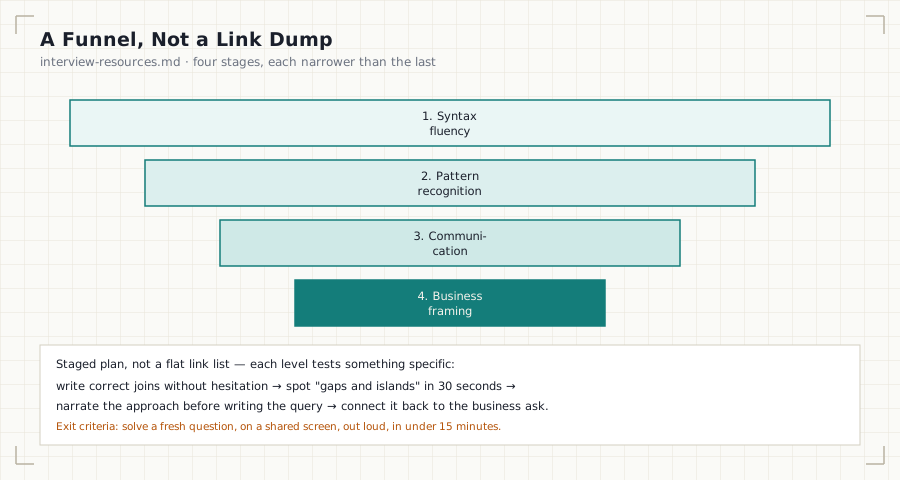
Table of Contents
- Interview Roadmap
- Interviews by Level
- System Design
- Behavioral Preparation
- Platforms
- SQL Cheat Sheets
- Business Case Studies
- Common Mistakes
- Practice Plans
Interview Roadmap
Four stages, each building on the last:
- Syntax fluency — write correct joins, aggregations, and subqueries without hesitation, on a shared screen, while talking.
- Pattern recognition — recognize a “running total,” “gaps and islands,” or “top-N per group” problem within the first 30 seconds of reading it.
- Communication — narrate your approach before writing the query, not after. Interviewers are grading the reasoning as much as the SQL.
- Business framing — connect the query back to the business question it’s answering, the way every module in this Handbook is written.
Pair this file with this repo’s own 17_SQL_INTERVIEW_QUESTIONS module and exercises/interview directory — those give you Handbook-schema practice; this file gives you the platforms and plan to go wider.
Interviews by Level
| Level | What Gets Tested | Prepare With |
|---|---|---|
| Beginner | SELECT, WHERE, basic joins, GROUP BY/HAVING — correctness and syntax fluency |
01_FUNDAMENTALS–03_JOINS, Coding Platforms below |
| Intermediate | CTEs, window functions, subqueries, CASE WHEN logic, explaining your own query out loud |
04_CASE_WHEN–09_DATE_FUNCTIONS, Practice Websites below |
| Senior SQL | Query optimization reasoning, index trade-offs, schema critique, defending design decisions | 15_INDEXES, 16_QUERY_OPTIMIZATION, books.md → Query Optimization |
| Analytics Engineer | Data modeling (star schema), metric definitions, testing philosophy, dbt-style thinking | 18_SQL_BUSINESS_CASE_STUDIES, books.md → Data Warehousing, documentation.md → dbt |
| Data Engineer | Distributed query behavior, partitioning, pipeline-adjacent SQL, platform-specific dialects | 13_SET_OPERATORS–16_QUERY_OPTIMIZATION, documentation.md → Cloud Data Warehouses |
| FAANG-style | All of the above, under tighter time pressure, often with an unfamiliar schema handed to you cold | Full roadmap, then timed practice on Mock Interview Platforms below |
System Design
SQL interviews at the Senior and Data Engineer level increasingly fold in system-design questions — “how would you shard this table,” “would you denormalize here.” This isn’t a separate skill from SQL; it’s SQL judgment applied at a larger scale.
- Review
youtube.md→ ByteByteGo for how database choices fit into a larger system design answer. - Review
books.md→ Designing Data-Intensive Applications for the reasoning behind partitioning and replication trade-offs you’ll be asked to defend. - Practice narrating trade-offs out loud — “I’d denormalize here because reads outnumber writes 100:1” is a stronger answer than a diagram alone.
Behavioral Preparation
SQL interviews aren’t purely technical — expect at least one “tell me about a time” question, usually about a data quality problem you found or a decision you had to defend.
- Prepare 2–3 stories using the STAR structure (Situation, Task, Action, Result), pulled from real project work — your own
projects/work in this repo is legitimate material to draw from. - Practice the story that ends in “I was wrong, and here’s what I did about it” — interviewers specifically listen for this one, and most candidates don’t have it ready.
Platforms
Coding Platforms
| Field | Details |
|---|---|
| Title | LeetCode — Database category |
| Category | Coding Platforms |
| Difficulty | Beginner → Advanced (tiered) |
| Best For | Timed, graded SQL problems in the exact format many companies use for take-home or live-coding rounds |
| Why It Is Recommended | The most widely referenced platform for SQL interview practice — many companies’ actual interview questions are directly inspired by problems here |
| Free or Paid | Free tier available; premium unlocks company-tagged questions |
| Who Should Read It | Anyone in active interview prep |
| Related SQL Handbook Modules | 17_SQL_INTERVIEW_QUESTIONS |
| Field | Details |
|---|---|
| Title | HackerRank — SQL domain |
| Category | Coding Platforms |
| Difficulty | Beginner → Advanced |
| Best For | Structured, certificate-backed SQL practice tracks |
| Why It Is Recommended | Clear difficulty progression and official skill certificates that are recognized on LinkedIn and by some recruiters |
| Free or Paid | Free |
| Who Should Read It | Beginners wanting a structured track with a credential at the end |
| Related SQL Handbook Modules | 01_FUNDAMENTALS–09_DATE_FUNCTIONS |
Practice Websites
| Field | Details |
|---|---|
| Title | StrataScratch |
| Category | Practice Websites |
| Difficulty | Intermediate → Advanced |
| Best For | Real interview questions sourced from specific companies, with a data-science/analytics lean |
| Why It Is Recommended | Questions are tagged by the actual company that reportedly asked them, which is useful for targeted prep ahead of a specific interview |
| Free or Paid | Free tier available; premium unlocks full company-tagged question bank |
| Who Should Read It | Analytics/data science interview candidates |
| Related SQL Handbook Modules | 18_SQL_BUSINESS_CASE_STUDIES |
| Field | Details |
|---|---|
| Title | DataLemur |
| Category | Practice Websites |
| Difficulty | Beginner → Advanced |
| Best For | SQL and product-analytics interview questions with a clean, distraction-free practice interface |
| Why It Is Recommended | Strong free tier with company-tagged questions and clear worked solutions, good for daily short practice sessions |
| Free or Paid | Free tier available; premium unlocks more questions |
| Who Should Read It | Anyone doing short, consistent daily practice sessions |
| Related SQL Handbook Modules | 17_SQL_INTERVIEW_QUESTIONS |
Mock Interview Platforms
| Field | Details |
|---|---|
| Title | Pramp |
| Category | Mock Interview Platforms |
| Difficulty | Intermediate → Advanced |
| Best For | Free, live, peer-to-peer mock interviews with real-time feedback |
| Why It Is Recommended | Practicing out loud, under time pressure, in front of another person is a different skill than solving a problem alone — this is the free way to get that specific rep in |
| Free or Paid | Free |
| Who Should Read It | Candidates within 2–4 weeks of a real interview |
| Related SQL Handbook Modules | 17_SQL_INTERVIEW_QUESTIONS |
Interview Question Collections
| Field | Details |
|---|---|
| Title | Interview Query |
| Category | Interview Question Collections |
| Difficulty | Intermediate → Advanced |
| Best For | Curated question banks combined with data-role-specific career content (not just SQL in isolation) |
| Why It Is Recommended | Covers the full interview loop context (SQL, product sense, statistics) rather than SQL as an isolated skill, useful once you’re past pure syntax practice |
| Free or Paid | Free tier available; premium unlocks full content |
| Who Should Read It | Analytics/data science candidates preparing for a full interview loop, not just the SQL round |
| Related SQL Handbook Modules | 18_SQL_BUSINESS_CASE_STUDIES |
SQL Cheat Sheets
The primary cheat sheet is this repo’s own 20_SQL_CHEATSHEET and the topic-specific quick references in cheatsheets/ (joins, CTEs, windows, dates, strings, aggregation) — built against the same schema you’ve already been practicing on, so nothing needs translating.
[!TIP] Print or screenshot the cheat sheet the night before an interview. Don’t try to memorize syntax you can otherwise look up in five seconds during actual work — memorize the patterns (see Interviews by Level) instead.
Business Case Studies
Interview questions increasingly wrap SQL inside a business scenario (“find customers at risk of churning”) rather than asking for raw syntax. Practice with:
- This repo’s
18_SQL_BUSINESS_CASE_STUDIESmodule - The end-to-end portfolio projects in
projects/— particularlyhr-analyticsandecommerce, which map closely to common interview scenario types books.md→ SQL Cookbook, for pattern recognition across scenario types
Common Mistakes
The same handful of mistakes account for most lost points at every level:
- Confusing
WHEREandHAVING— filtering before aggregation vs. after it. Say out loud which one you’re using and why. - Forgetting a
GROUP BYcolumn — every non-aggregated column in theSELECTlist needs to be in theGROUP BY, or the query is wrong even if it happens to run. NULLcomparison errors —= NULLsilently returns nothing;IS NULLis required. This trips up even experienced candidates under pressure.- Not narrating the approach first — jumping straight to typing without stating the plan reads as guessing, even when the final query is correct.
- Ignoring edge cases out loud — a strong answer mentions duplicate rows,
NULLs, or empty result sets even if the final query doesn’t fully handle them; it signals awareness. - Overcomplicating with nested subqueries when a CTE would be clearer — interviewers are also grading readability, not just correctness.
Practice Plans
Recommended Weekly Practice Plan
| Day | Focus |
|---|---|
| Mon–Wed | 1–2 problems/day from Coding Platforms, one level above comfortable |
| Thu | Review this repo’s 18_SQL_BUSINESS_CASE_STUDIES — one full case study |
| Fri | 1 mock interview (Pramp) or explain a solved problem out loud, recorded |
| Weekend | Rest, or light review of 20_SQL_CHEATSHEET — no new material |
30-Day Interview Plan
For: candidates with solid fundamentals who need to sharpen interview-specific execution.
- Week 1: Beginner–Intermediate problems daily; drill
Common Mistakesabove until they stop happening. - Week 2: Intermediate–Advanced problems; start narrating solutions out loud before typing.
- Week 3: Company-tagged questions on StrataScratch/DataLemur if a specific employer is known; 2 mock interviews.
- Week 4: Timed full-length practice sessions; behavioral story prep; final cheat-sheet review.
60-Day Interview Plan
For: candidates who need to build from Intermediate to Senior-level SQL judgment, not just execute faster.
- Weeks 1–2: Complete Intermediate Roadmap in
README.mdif not already solid. - Weeks 3–4:
16_QUERY_OPTIMIZATION+books.md→ Query Optimization category; start explaining index trade-offs out loud. - Weeks 5–6: Follow the 30-Day Interview Plan above, compressed slightly, now with optimization reasoning folded in.
- Weeks 7–8 (overlap intentional): Heavy mock-interview cadence — 2–3/week — plus behavioral prep.
90-Day Interview Plan
For: candidates starting from the Beginner Roadmap and targeting a Senior or Analytics Engineer role.
- Weeks 1–4: Beginner Roadmap in full — see
README.md. - Weeks 5–8: Intermediate Roadmap in full.
- Weeks 9–11: Advanced Roadmap, focused on
15_INDEXESand16_QUERY_OPTIMIZATION. - Weeks 12–13: Compressed 30-Day Interview Plan above, with 3+ mock interviews and full behavioral prep.
This closes out the core six files. Second wave next: newsletters.md, courses.md, datasets.md, playgrounds.md, certifications.md, communities.md, awesome-tools.md. Back to Resources Library.