SQL-Engineering-Handbook
07 — Real-World Case Study: Retail Merger Data Consolidation
Introduction
This is the capstone of Module 13. Every operator and pattern from Topics 01–06 gets applied together against one continuous business scenario, the way they actually show up in a single real project — not as isolated syntax demonstrations.
Concept Overview
The scenario: GlobalMart, a mid-size retailer, has just acquired UrbanCart, a regional e-commerce competitor. The data engineering team has one quarter to deliver three things leadership is asking for directly:
- A single, unified sales report across both companies’ regions
- Proof that the customer database migration from UrbanCart’s legacy CRM into GlobalMart’s CRM was complete and lossless
- A cleaned, deduplicated combined loyalty list for the first joint marketing campaign
Every one of these is a set-operator problem, and this file solves all three end to end.
Why This Exists
Textbook examples teach one operator at a time. Production work never arrives that way — a single project typically needs integration reporting, reconciliation, and deduplication together, often against the same tables, often under a deadline. This case study is deliberately built to require moving between UNION ALL, INTERSECT, EXCEPT, and their EXISTS/NOT EXISTS equivalents in one coherent piece of work, so the decision-making — not just the syntax — gets exercised.
Business Context
Mergers and acquisitions are one of the most common real-world triggers for heavy set-operator use: two companies, each with their own customers, sales history, and product catalogs, need one combined operational picture fast, and leadership needs proof — not a verbal assurance — that no customer or transaction was lost in the process.
Real Company Examples
- A large grocery chain acquiring a regional chain runs a full customer and inventory reconciliation before consolidating loyalty programs, using exactly the bidirectional
EXCEPTpattern from Topic 05. - A telecom acquiring an MVNO (mobile virtual network operator) integrates subscriber tables with
UNION ALLand a discriminator column while the two billing systems run in parallel for a transition period, following the pattern from Topic 04. - A SaaS company acquiring a competitor deduplicates two overlapping trial-user lists with
UNION/INTERSECTbefore a combined onboarding email campaign, following Topic 02’s and Topic 03’s patterns.
Production Use Cases
- Post-merger customer and sales data consolidation
- Migration completeness sign-off for a compliance or audit function
- Deduplicated cross-company marketing lists
- Ongoing dual-source reporting during a transition period before systems are fully merged
Visual Explanation
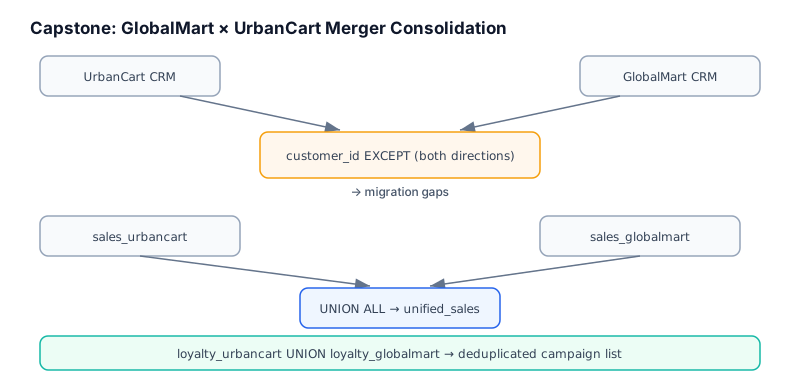
 UrbanCart CRM ──┐                        ┌── GlobalMart CRM
                 │                        │
                 ▼                        ▼
         ┌───────────────────────────────────────┐
         │   customer_id EXCEPT (both directions)  │  → migration gaps
         └───────────────────────────────────────┘
                 │                        │
                 ▼                        ▼
         sales_urbancart          sales_globalmart
                 │                        │
                 └──────── UNION ALL ─────┘  → unified_sales (Topic 04 pattern)

         loyalty_urbancart  UNION  loyalty_globalmart  → deduplicated campaign list
Syntax
No new syntax is introduced in this file — every statement below is a direct application of UNION, UNION ALL, INTERSECT, EXCEPT, and EXISTS/NOT EXISTS as taught in Topics 01–06.
Detailed Explanation
The case study is deliberately sequenced to mirror a real project timeline:
- Integrate first (Topic 04 pattern) — leadership wants a combined sales view immediately, before any cleanup work is done, because a rough combined picture today is more valuable than a perfect one next month.
- Reconcile second (Topics 03 and 05 patterns) — once the combined view exists, the migration of UrbanCart’s customers into GlobalMart’s CRM must be formally verified, in both directions, before UrbanCart’s legacy system is decommissioned.
- Deduplicate last (Topic 02 pattern) — the joint loyalty list is only built once the reconciliation confirms which customers are genuinely distinct versus already-migrated duplicates.
This order is itself an engineering decision: reversing steps 2 and 3 risks building a marketing list on top of an unverified, possibly incomplete migration.
Business Examples
-- Step 1 preview: unified sales, tagged by originating company
SELECT order_id, order_total, order_date, 'GlobalMart' AS source_company
FROM sales_globalmart
UNION ALL
SELECT order_id, order_total, order_date, 'UrbanCart' AS source_company
FROM sales_urbancart;
-- Step 2 preview: migration gap check, one direction
SELECT customer_id FROM urbancart_customers
EXCEPT
SELECT customer_id FROM globalmart_customers;
Production Workflow
- Confirm schema compatibility between UrbanCart and GlobalMart tables (column count, types) before writing any combining query — see Topic 01.
- Build the unified sales report with
UNION ALLand asource_companydiscriminator — see Topic 04. - Run the bidirectional
EXCEPTmigration audit oncustomer_id— see Topics 03 and 05. - Route any non-empty
EXCEPTresult to a manual investigation queue before proceeding. - Once the audit passes, build the deduplicated joint loyalty list with
UNION— see Topic 02. - Re-express the costliest queries as
EXISTS/NOT EXISTSand compare — see Topic 06 — before scheduling any of this as a recurring job.
Engineering Considerations
- This case study uses three previously-independent schemas (
sales_globalmart/sales_urbancart,urbancart_customers/globalmart_customers,loyalty_globalmart/loyalty_urbancart) rather than the runningemployees/departmentsschema from Topics 01–06, because a real merger scenario involves genuinely separate systems, not variations of one company’s internal data. - The migration audit (Step 2) is the query that should be automated and re-run on a schedule until UrbanCart’s legacy CRM is formally decommissioned — not run once and forgotten.
- The
source_companydiscriminator introduced in Step 1 is what allows leadership to ask “how is UrbanCart’s book of business performing since the acquisition?” without a schema redesign.
Performance Notes
At small scale, every form below performs indistinguishably. At the actual scale a merger reconciliation runs at — often hundreds of thousands to millions of customer records — the EXISTS/NOT EXISTS rewrites from Topic 06 are very likely to outperform the native EXCEPT/INTERSECT forms, provided customer_id is indexed on both sides. This file includes both forms for the migration audit specifically so the choice can be benchmarked on real data rather than assumed.
Database Compatibility
| Feature used | MySQL | PostgreSQL | SQL Server | Oracle |
|---|---|---|---|---|
UNION ALL integration (Step 1) |
✅ | ✅ | ✅ | ✅ |
EXCEPT migration audit (Step 2) |
8.0.31+ | ✅ | ✅ | use MINUS |
NOT EXISTS rewrite (Step 2 alt.) |
✅ | ✅ | ✅ | ✅ |
UNION deduplication (Step 3) |
✅ | ✅ | ✅ | ✅ |
Best Practices
- Sequence the work: integrate, reconcile, then deduplicate — not in an arbitrary order.
- Never decommission a legacy source system until its bidirectional
EXCEPTaudit against the target system returns zero rows. - Keep the discriminator column from the integration step even after reconciliation is complete — provenance stays valuable long after the migration project ends.
Common Mistakes
- Building the joint marketing list (
UNION) before the migration audit passes, risking a campaign sent against an incomplete or duplicated customer base. - Treating a passing migration audit as permanent — if UrbanCart’s legacy system is still writable during the transition period, the audit must be re-run until it’s formally retired.
- Forgetting that Step 1’s
UNION ALLand Step 3’sUNIONare solving different problems (integration vs. deduplication) and are not interchangeable.
Edge Cases
- A customer who signed up independently with both UrbanCart and GlobalMart before the acquisition (same person, two different
customer_idvalues, no shared key) will not be caught by anEXCEPT/INTERSECTaudit oncustomer_id— that is a fuzzy-matching problem (name, email, address similarity), outside the scope of exact-match set operators, and worth flagging explicitly to stakeholders as a known limitation. - Orders placed during the exact cutover window may exist in both source systems momentarily — define and document a clear cutover timestamp before running Step 1’s integration query to avoid double-counting.
Interview Questions
- (Foundational) In this case study, why is
UNION ALLcorrect for the sales integration butUNIONcorrect for the loyalty list? - (Intermediate) Why does the workflow reconcile customers before building the joint loyalty list, rather than after?
- (Advanced) What limitation does an exact-match
EXCEPT/INTERSECTaudit have when the same real-world customer has two different, unrelated ID values in each system? How would you address it? - (Staff-level) Design the recurring automated check that should run for as long as UrbanCart’s legacy CRM remains writable during the transition period, and describe what should happen when it fails.
Summary
A real merger data-consolidation project needs every pattern from this module, applied in a deliberate sequence: integrate for an immediate combined view, reconcile to prove the migration is trustworthy, then deduplicate to produce a clean downstream asset. The SQL file accompanying this topic implements all three steps against a realistic two-company schema, including a performance-rewrite comparison for the reconciliation step.
Practice Problems
- Extend Step 1’s unified sales query to include a
product_categorybreakdown, assuming bothsales_globalmartandsales_urbancartgain aproduct_categorycolumn. - Write the
NOT EXISTSequivalent of Step 2’s migration audit for the reverse direction (GlobalMart customers missing from UrbanCart) and explain when that direction would legitimately return non-empty results. - Propose, in a comment, a fuzzy-matching approach (outside pure set operators) for the same-person/different-ID edge case described above.
Further Reading
- dbt Developer Hub — data testing and reconciliation patterns
- PostgreSQL Docs — Combining Queries
- Microsoft Learn — Set Operators (Transact-SQL)