SQL-Engineering-Handbook
05 — CROSS JOIN
Pair every row of the left table with every row of the right table — no join condition, no matching logic, just the full Cartesian product.
Difficulty: Beginner → Intermediate · Estimated time: 25–35 min · Prerequisites: 01_INNER_JOIN.md
📑 Contents
- Learning Objectives
- Concept Overview
- Business Context
- Syntax
- Execution Flow
- Engineering Notes
- Vendor Notes
- Edge Cases
- Common Mistakes
- Best Practices
- Interview Questions
- Practice Challenges
- Further Reading
Learning Objectives
- Explain why CROSS JOIN has no
ONclause, and calculate its output row count from the two input row counts alone. - Distinguish an intentional, well-designed CROSS JOIN (date spines, combinatorial generation) from an accidental one (a forgotten join predicate).
- Build a date-spine or “every X × every Y” combinatorial report — the single most common legitimate production use of CROSS JOIN.
Concept Overview
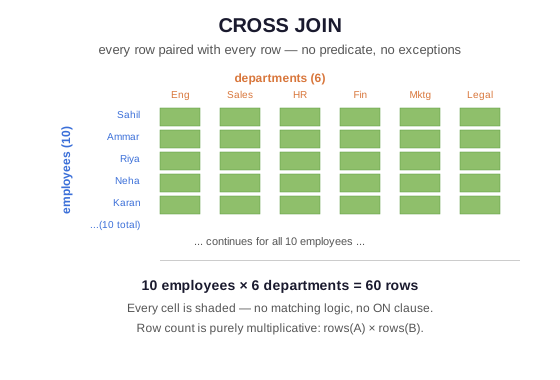
CROSS JOIN produces every possible pairing of rows between two tables — the full Cartesian product, with no filtering at all. If employees has 10 rows and departments has 6, employees CROSS JOIN departments returns exactly 60 rows, every one of the 10×6 combinations, regardless of whether dept_id values line up.
This is the join type every other join in this module is secretly built on top of: INNER JOIN, conceptually, is “compute the CROSS JOIN, then keep only the rows where the ON predicate is true.” CROSS JOIN is what you get when you skip that filtering step entirely — deliberately.
Business Context
Where companies legitimately use it:
- Date spines — generating one row per day/month for a reporting period, then LEFT JOINing actual data onto it, so a chart doesn’t have gaps for days/months with zero activity.
- Combinatorial generation — “every product × every size” for a retail SKU matrix, “every sales rep × every territory” for a coverage-planning grid.
- Test data generation — quickly generating N×M rows of synthetic data for load testing.
Where it shows up by accident: almost everywhere else. A forgotten WHERE clause on an implicit comma-join (FROM a, b), or a missing ON clause typo, silently produces a CROSS JOIN instead of the INNER JOIN the author intended — this is covered exhaustively in 01_INNER_JOIN.md’s Common Mistakes section, and it’s worth re-reading here with CROSS JOIN’s row-count math in mind: on real table sizes, an accidental CROSS JOIN doesn’t just return “extra rows,” it can return billions of rows and take down a database.
Syntax
SELECT
    e.emp_name,
    d.dept_name
FROM employees e
CROSS JOIN departments d;
No ON clause — that’s not an omission, it’s the defining feature. Some dialects also allow the comma form (FROM employees e, departments d) to mean the same thing, but never use the comma form: it’s visually indistinguishable from a forgotten INNER JOIN predicate, whereas CROSS JOIN unambiguously signals “this Cartesian product is intentional” to every future reader.
Execution Flow
FROM employees e            (10 rows)
    │
    ▼
CROSS JOIN departments d    (6 rows)   ← no predicate; every pairing is kept
    │
    ▼
SELECT e.emp_name, d.dept_name          → 10 × 6 = 60 rows
There is no “matched vs. unmatched” concept for CROSS JOIN — every row on both sides participates in every output row exactly once per counterpart.
Engineering Notes
Row count is purely multiplicative: rows(A) × rows(B), with no dependency on data values at all — unlike every other join in this module, you can compute the exact output row count from the two input counts alone, before running the query or looking at any data.
CROSS JOIN with a WHERE clause is a legitimate, common pattern — and it’s worth recognizing this isn’t “secretly an INNER JOIN in disguise” so much as it is, definitionally, one valid way to write one:
-- Equivalent to an INNER JOIN, written via CROSS JOIN + WHERE.
-- Legal and occasionally seen in generated SQL, but prefer explicit
-- INNER JOIN ... ON for anything hand-written — it states intent directly.
SELECT e.emp_name, d.dept_name
FROM employees e
CROSS JOIN departments d
WHERE e.dept_id = d.dept_id;
Vendor Notes
- ANSI SQL / PostgreSQL / MySQL / SQL Server / Oracle:
CROSS JOINsyntax and behavior is standard and identical across all four. - PostgreSQL / SQL Server: both offer
generate_series()/ a numbers/tally table respectively, frequently paired withCROSS JOINto build date spines — see the practice challenges below.
Edge Cases
Zero rows on either side: a CROSS JOIN where either table is empty returns zero rows — 0 × N = 0 — which is the one case where the multiplicative row-count rule can surprise someone expecting “at least some” output.
Duplicate rows: not really a distinct “edge case” for CROSS JOIN the way it is for the other joins — every duplicate row on one side simply multiplies through normally, exactly as the row-count formula predicts. There’s no matching logic to be confused by duplicates in the first place.
Common Mistakes
❌ An accidental CROSS JOIN from a missing predicate, which on production-sized tables is a genuine incident, not a cosmetic bug — a 10,000-row table CROSS JOINed against a 5,000-row table produces 50,000,000 rows, easily enough to exhaust memory or lock up a shared database for every other query running against it.
❌ Using CROSS JOIN for a genuinely relational question (i.e., you actually do have a foreign key relating the two tables) — if a join predicate exists in your data model, express it with INNER JOIN ... ON, not CROSS JOIN ... WHERE. The explicit form documents the relationship for the next reader; the CROSS JOIN + WHERE form hides it.
Best Practices
- Write
CROSS JOINexplicitly, never the bare-comma form — the keyword itself is the safeguard against an accidental Cartesian product being mistaken for an intended one. - Before running a CROSS JOIN against real (not seed/test) data, compute
rows(A) × rows(B)by hand or with a quickSELECT COUNT(*)on each side first — it costs one extra query and prevents a genuinely dangerous accident. - If you’re building a date spine or combinatorial matrix, generate the smaller “dimension” side (e.g., dates, sizes) programmatically rather than hardcoding it, so it stays correct as the reporting window changes.
Interview Questions
- “Table A has 500 rows, table B has 30. How many rows does
A CROSS JOIN Breturn?” — exactly 15,000, always, regardless of data values. - “What’s the difference between
CROSS JOINand anINNER JOINwith an always-true condition (ON 1=1)?” — none functionally;ON 1=1is a way of writing a CROSS JOIN usingINNER JOINsyntax, occasionally seen in generated SQL, butCROSS JOINstates the same intent more clearly. - “Give a real production use case for CROSS JOIN that isn’t a mistake.” — a date spine or combinatorial matrix; see Business Context and the practice challenges.
Summary
CROSS JOIN produces the unfiltered Cartesian product of two tables — rows(A) × rows(B), always. It’s dangerous by accident (a missing predicate on large tables) and genuinely useful by design (date spines, combinatorial matrices). The keyword itself, used explicitly rather than via comma-join, is what separates “I meant to do this” from “I forgot a WHERE clause” in code review.
Practice Challenges
- Compute, without running anything, the exact row count of
employees CROSS JOIN locationsusing the seed data’s row counts, then verify withSELECT COUNT(*). - Build a “coverage matrix” showing every department paired with every location, with a
TRUE/FALSE(or1/0) column indicating whether that department is actually assigned to that location — this requires a CROSS JOIN plus aCASEcomparing against the realdepartments.location_id. - Research your database’s date/number-generation function (
generate_series()in PostgreSQL, a recursive CTE or tally table in MySQL/SQL Server) and sketch — in comments, no need to run it — a query that CROSS JOINs a 12-month date spine againstdepartmentsto produce one row per department per month, ready for a LEFT JOIN onto real monthly headcount data.
Further Reading
01_INNER_JOIN.md— Common Mistakes section covers the accidental-CROSS-JOIN failure mode in detail.07_MULTI_TABLE_JOINS.md— combining CROSS JOIN with other join types in a single query.