SQL-Engineering-Handbook
ALIAS
Definition
An alias gives a column or table a temporary name for the duration of a query. Column aliases make output more readable; table aliases make multi-table queries (joins, subqueries) shorter and less repetitive.
Syntax
Column alias:
SELECT emp_name AS employee_name
FROM employes;
Table alias:
SELECT e.emp_name
FROM employes AS e;
The AS keyword is optional in MySQL — emp_name employee_name works identically to emp_name AS employee_name — but including it is the convention this handbook follows, since it makes queries easier to scan.
Visual Explanation
An alias is scoped to a single query — it exists from the moment SELECT creates it until the query finishes, and is invisible to any clause that runs before SELECT in logical execution order.
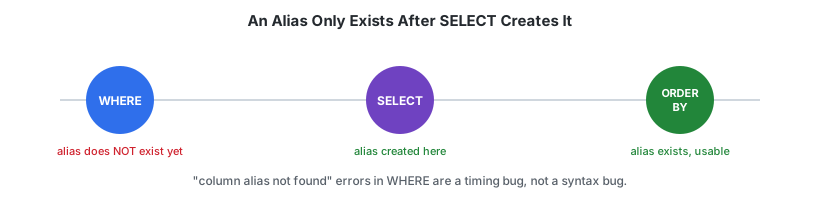
flowchart LR
    A[WHERE: alias does NOT exist yet] -.-> B[SELECT: alias created]
    B --> C[ORDER BY: alias exists, usable]
    style B fill:#6f42c1,color:#ffffff
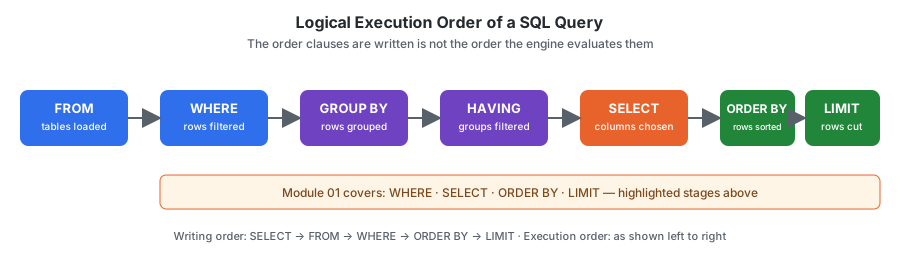
See the full 7-stage picture in assets/diagrams/execution-order-flow.svg — this is the same rule from 01_SELECT.md applied specifically to aliases.
Dialect Differences
Is AS required?
| Engine | Column alias | Table alias |
|---|---|---|
| MySQL | Optional | Optional (but AS is not allowed before a table alias in some MySQL versions — use employes e, not employes AS e, for maximum compatibility) |
| PostgreSQL | Optional | Optional |
| SQL Server | Optional | AS not allowed before a table alias (employes e, never employes AS e) |
| Oracle | Optional | AS not allowed before a table alias (same restriction as SQL Server) |
This handbook uses AS consistently for column aliases (readability), but omits it for table aliases in examples involving joins, since that form is universally accepted.
Quoting an alias that needs it (reserved words, spaces)
| Engine | Quote character |
|---|---|
| MySQL | `backticks` |
| PostgreSQL | "double quotes" |
| SQL Server | [square brackets] or "double quotes" |
| Oracle | "double quotes" |
Avoiding aliases that need quoting at all (employee_name instead of Employee Name) sidesteps this inconsistency entirely — the convention this handbook follows.
Schema Used
employes
| Column | Description |
|---|---|
| emp_id | Employee ID |
| emp_name | Employee Name |
| dept_id | Department ID |
| manager_id | Reporting Manager |
departments
| Column | Description |
|---|---|
| dept_id | Department ID |
| dept_name | Department Name |
| city | Department city |
| country | Department country |
Examples
Example 1: Column alias for a cleaner report header
SELECT
    emp_name AS employee_name,
    dept_id  AS department_id
FROM employes;
Example 2: Column alias on an aggregate
SELECT COUNT(*) AS total_employees
FROM employes;
Without the alias, most clients label this column COUNT(*), which is awkward to reference in application code or a BI tool.
Example 3: Table alias in a join (preview)
SELECT
    e.emp_name,
    d.dept_name
FROM employes AS e
JOIN departments AS d
    ON e.dept_id = d.dept_id;
Table aliases (e, d) remove the need to repeat full table names on every column reference — this becomes essential once queries involve three or more tables. Joins are covered in full in 04_Joins; this example is here purely to show why table aliasing matters.
Business Use Cases
- Cleaner column headers in reports and dashboards
- Shorter, more readable multi-table queries
- Renaming cryptic database column names (
emp_nm,dt_id) into business-friendly labels for BI tools - Disambiguating columns with the same name across joined tables (e.g. both
employesanddepartmentscould have anamecolumn)
Common Mistakes
Mistake 1: Using a SELECT alias inside WHERE
WHERE executes before SELECT (see the execution order in 01_SELECT.md), so an alias defined in SELECT doesn’t exist yet when WHERE runs.
❌ Wrong — errors in MySQL
SELECT emp_name AS employee_name
FROM employes
WHERE employee_name = 'Ammar';
✅ Correct — filter on the real column name
SELECT emp_name AS employee_name
FROM employes
WHERE emp_name = 'Ammar';
Mistake 2: Forgetting to quote aliases containing spaces
SELECT emp_name AS Employee Name   -- ❌ invalid — parsed as two tokens
FROM employes;
SELECT emp_name AS `Employee Name`   -- ✅ backtick-quoted (MySQL)
FROM employes;
Prefer aliases without spaces (employee_name) wherever possible — they’re portable across databases and don’t need quoting.
Edge Cases
- Aliasing to an existing column name —
SELECT dept_id AS emp_id FROM employes;is legal; the output column is labeledemp_idbut holdsdept_id’s values. This is legal but actively misleading — avoid it outside of deliberate testing. - Same alias used twice —
SELECT emp_name AS x, dept_id AS x FROM employes;runs in most engines, but produces two output columns both labeledx, making the result ambiguous to consume programmatically.
Interview Tip
A common follow-up question: “Can you use a column alias in ORDER BY?” Yes — unlike WHERE, ORDER BY executes after SELECT in the logical order, so the alias already exists by the time ORDER BY runs:
SELECT emp_name AS employee_name
FROM employes
ORDER BY employee_name;   -- ✅ valid
Knowing exactly which clauses can and can’t see a SELECT alias is a direct test of whether you understand SQL’s execution order, not just its syntax.
Practice Questions
Easy
- Alias
emp_nameasfull_name. - Alias
COUNT(*)asemployee_count. - Give the
employestable the aliaseand selecte.emp_name.
Intermediate
- Write a query with a column alias, then explain why that alias cannot be reused in the same query’s
WHEREclause. - Alias both
employesanddepartmentsin a join and select one column from each (preview — full joins covered in04_Joins).
Advanced
- Explain why table aliases become necessary (not just convenient) once a query joins the same table to itself (a self-join, e.g. matching employees to their managers within
employes).
Related Topics
- SELECT
- WHERE
- ORDER BY
- JOIN
Further Reading
GLOSSARY.md— “alias” and “identifier” definitionsFAQ.md— see theWHERE/ORDER BYalias-scope questionINTERVIEW_PREP.md— see “Why can’t I use aSELECTalias inWHERE?”