📘 Documentation
Part of the Resources Library — SQL Engineering Handbook
This is the one file in the library where “why is this here” barely needs an answer — it’s the official word, straight from whoever builds the thing. When a module in this repo and a database’s own documentation disagree, trust the documentation. Open an issue on the module.
[!NOTE]
Root documentation URLs are about as stable as links get — vendors rarely move their main docs domain. If one of these has moved by the time you’re reading this, it’s a fast PR: see Contribution Guidelines.
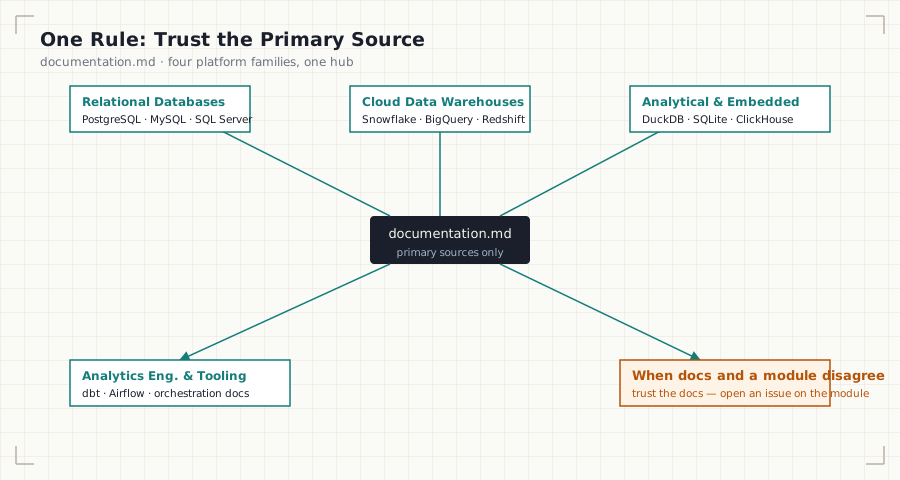
Table of Contents
Relational Databases
Recommended reading order: pick the dialect you’re actually using and read that one’s tutorial/getting-started section end to end before treating any of these as a reference. Don’t read all six front to back — that’s what books.md → SQL Pocket Guide is for.
PostgreSQL Official Documentation
| Field |
Details |
| Author / Organization |
The PostgreSQL Global Development Group |
| Category |
Relational Databases |
| Difficulty |
Beginner (Tutorial) → Advanced (full manual) |
| Best For |
The most complete, precisely written open-source database documentation available — the standard other docs get measured against |
| Why It Is Recommended |
Written by the people who implement the features, updated on every release, and unusually exact about edge-case behavior (NULL handling, MVCC visibility rules) that third-party tutorials tend to gloss over |
| Key Topics Covered |
SQL syntax and functions, indexing (B-tree, GIN, GiST, BRIN), MVCC and transaction isolation, extensions, EXPLAIN and query planning |
| Estimated Time |
2–3 hours for the Tutorial section; ongoing as reference after that |
| Official Website |
postgresql.org/docs/ |
| Free or Paid |
Free |
| Prerequisites |
None for the Tutorial; 03_JOINS for the rest |
| Who Should Read It |
Anyone using PostgreSQL, from first query to EXPLAIN ANALYZE |
| Related SQL Handbook Modules |
Applies across all modules if PostgreSQL is your dialect |
MySQL Official Documentation
| Field |
Details |
| Author / Organization |
Oracle Corporation |
| Category |
Relational Databases |
| Difficulty |
Beginner (Tutorial) → Advanced (Reference Manual) |
| Best For |
Authoritative InnoDB and replication behavior, and MySQL-specific syntax variations |
| Why It Is Recommended |
The only fully authoritative source for InnoDB locking behavior and replication semantics, which differ from PostgreSQL in ways that matter for correctness, not just syntax |
| Key Topics Covered |
SQL syntax, InnoDB storage engine, replication, indexing, EXPLAIN |
| Estimated Time |
2 hours for Tutorial; ongoing as reference |
| Official Website |
dev.mysql.com/doc/ |
| Free or Paid |
Free |
| Prerequisites |
None for the Tutorial |
| Who Should Read It |
Anyone using MySQL or MariaDB in production |
| Related SQL Handbook Modules |
Applies across all modules if MySQL is your dialect |
Microsoft Learn — SQL Server & Azure SQL
| Field |
Details |
| Author / Organization |
Microsoft |
| Category |
Relational Databases |
| Difficulty |
Beginner → Advanced |
| Best For |
T-SQL specifics and the Azure SQL / Fabric platform ecosystem around SQL Server |
| Why It Is Recommended |
Microsoft Learn consolidates docs, structured learning paths, and certification prep in one place — unusually good for going from zero to a specific credential |
| Key Topics Covered |
T-SQL syntax, Intelligent Query Processing, indexing, Azure SQL Database, SQL Server on Linux |
| Estimated Time |
2–3 hours for the “Get started” learning path |
| Official Website |
learn.microsoft.com/en-us/sql/ |
| Free or Paid |
Free |
| Prerequisites |
None |
| Who Should Read It |
Anyone on the Microsoft data stack, or preparing for a Microsoft data certification |
| Related SQL Handbook Modules |
Applies across all modules if T-SQL is your dialect |
Oracle Database SQL Documentation
| Field |
Details |
| Author / Organization |
Oracle Corporation |
| Category |
Relational Databases |
| Difficulty |
Intermediate → Advanced |
| Best For |
Enterprise Oracle Database features — PL/SQL, partitioning, RAC — used in large legacy enterprise systems |
| Why It Is Recommended |
The only authoritative source for Oracle-specific SQL extensions (hierarchical queries with CONNECT BY, analytic function variations) that diverge meaningfully from standard SQL |
| Key Topics Covered |
SQL and PL/SQL reference, partitioning, Real Application Clusters (RAC), Autonomous Database |
| Estimated Time |
Reference-style; budget 3–4 hours for the SQL Language Reference basics |
| Official Website |
docs.oracle.com/en/database/oracle/oracle-database/ |
| Free or Paid |
Free |
| Prerequisites |
03_JOINS, 05_SUBQUERIES |
| Who Should Read It |
Engineers in Oracle-standardized enterprise environments |
| Related SQL Handbook Modules |
Applies across all modules if Oracle is your dialect |
SQLite Documentation
| Field |
Details |
| Author / Organization |
The SQLite Consortium |
| Category |
Relational Databases |
| Difficulty |
Beginner → Intermediate |
| Best For |
Understanding SQLite’s intentionally different type system and its query planner, for embedded/local use cases |
| Why It Is Recommended |
Unusually short and precisely written for a database manual — SQLite’s own documentation is a good model of technical writing regardless of whether you use the database daily |
| Key Topics Covered |
Dynamic typing rules, EXPLAIN QUERY PLAN, file format, WITHOUT ROWID tables |
| Estimated Time |
1–2 hours |
| Official Website |
sqlite.org/docs.html |
| Free or Paid |
Free |
| Prerequisites |
01_FUNDAMENTALS |
| Who Should Read It |
Mobile/embedded developers, and anyone prototyping locally before deploying to a client-server database |
| Related SQL Handbook Modules |
01_FUNDAMENTALS, 15_INDEXES |
MariaDB Documentation (Knowledge Base)
| Field |
Details |
| Author / Organization |
MariaDB Foundation / MariaDB plc |
| Category |
Relational Databases |
| Difficulty |
Beginner → Advanced |
| Best For |
Where MariaDB has diverged from MySQL since their fork — storage engines, JSON handling, and features MySQL doesn’t have |
| Why It Is Recommended |
Written specifically to flag divergence from MySQL, which is exactly the information a MySQL-background reader needs and won’t get from MySQL’s own docs |
| Key Topics Covered |
Storage engines (Aria, ColumnStore), JSON functions, MariaDB-specific replication (Galera Cluster) |
| Estimated Time |
1–2 hours if you already know MySQL; longer otherwise |
| Official Website |
mariadb.com/kb/en/ |
| Free or Paid |
Free |
| Prerequisites |
MySQL Official Documentation, for comparison |
| Who Should Read It |
Anyone migrating from or to MariaDB from MySQL |
| Related SQL Handbook Modules |
Applies across all modules if MariaDB is your dialect |
Cloud Data Warehouses
Recommended reading order: whichever platform your employer or project already uses. If choosing freely, Snowflake’s docs are the most approachable starting point for warehouse-specific concepts (Time Travel, zero-copy cloning) before tackling BigQuery or Redshift’s more infrastructure-heavy documentation.
Snowflake Documentation
| Field |
Details |
| Author / Organization |
Snowflake Inc. |
| Category |
Cloud Data Warehouses |
| Difficulty |
Intermediate → Advanced |
| Best For |
Snowflake-specific SQL extensions and warehouse architecture concepts (virtual warehouses, Time Travel, Streams/Tasks) |
| Why It Is Recommended |
Clear separation between “SQL you already know” and “Snowflake-specific extensions,” which makes it fast to onboard from a standard SQL background |
| Key Topics Covered |
Virtual warehouses, semi-structured data (VARIANT), Time Travel, Streams and Tasks, Snowpark |
| Estimated Time |
2–3 hours for “Getting Started” |
| Official Website |
docs.snowflake.com |
| Free or Paid |
Free |
| Prerequisites |
18_SQL_BUSINESS_CASE_STUDIES |
| Who Should Read It |
Analytics/data engineers using or evaluating Snowflake |
| Related SQL Handbook Modules |
18_SQL_BUSINESS_CASE_STUDIES |
BigQuery Documentation
| Field |
Details |
| Author / Organization |
Google Cloud |
| Category |
Cloud Data Warehouses |
| Difficulty |
Intermediate → Advanced |
| Best For |
Serverless, distributed SQL at very large scale, and BigQuery’s specific pricing/performance model |
| Why It Is Recommended |
Google Cloud’s docs are unusually clear about the cost implications of query patterns — directly relevant since BigQuery bills by data scanned, not compute time |
| Key Topics Covered |
GoogleSQL dialect specifics, partitioning and clustering, slot-based pricing, BigQuery ML |
| Estimated Time |
2–3 hours for “Quickstarts” |
| Official Website |
cloud.google.com/bigquery/docs |
| Free or Paid |
Free |
| Prerequisites |
Data Engineer Roadmap basics |
| Who Should Read It |
Data engineers on or evaluating the Google Cloud stack |
| Related SQL Handbook Modules |
13_SET_OPERATORS, 16_QUERY_OPTIMIZATION |
Amazon Redshift Documentation
| Field |
Details |
| Author / Organization |
Amazon Web Services |
| Category |
Cloud Data Warehouses |
| Difficulty |
Intermediate → Advanced |
| Best For |
Redshift’s PostgreSQL-derived SQL dialect and its columnar, cluster-based architecture |
| Why It Is Recommended |
Clearly documents where Redshift’s SQL diverges from standard PostgreSQL (important, since it’s built on Postgres but isn’t a drop-in replacement) |
| Key Topics Covered |
Distribution keys and sort keys, COPY/UNLOAD, workload management (WLM), Redshift Spectrum |
| Estimated Time |
2–3 hours for “Getting Started” |
| Official Website |
docs.aws.amazon.com/redshift/ |
| Free or Paid |
Free |
| Prerequisites |
PostgreSQL Official Documentation, for comparison |
| Who Should Read It |
Data engineers on or evaluating the AWS data stack |
| Related SQL Handbook Modules |
13_SET_OPERATORS, 16_QUERY_OPTIMIZATION |
Analytical & Embedded Engines
Recommended reading order: DuckDB first if you want a fast, local way to feel the difference between OLTP and OLAP query execution. Spark SQL once you’re actually working with distributed, cluster-scale data.
DuckDB Documentation
| Field |
Details |
| Author / Organization |
DuckDB Foundation |
| Category |
Analytical & Embedded Engines |
| Difficulty |
Beginner → Intermediate |
| Best For |
Learning columnar, vectorized query execution hands-on, locally, with zero infrastructure setup |
| Why It Is Recommended |
The fastest way to feel the practical difference between a row-store (Postgres/MySQL) and a column-store engine, since it runs embedded — no server, no cluster, just a file |
| Key Topics Covered |
Columnar storage, vectorized execution, Parquet/CSV integration, SQL dialect compatibility notes |
| Estimated Time |
1–2 hours |
| Official Website |
duckdb.org/docs/ |
| Free or Paid |
Free |
| Prerequisites |
01_FUNDAMENTALS |
| Who Should Read It |
Anyone curious about OLAP engines without wanting to stand up a warehouse first |
| Related SQL Handbook Modules |
16_QUERY_OPTIMIZATION |
Apache Spark SQL Documentation
| Field |
Details |
| Author / Organization |
Apache Software Foundation |
| Category |
Analytical & Embedded Engines |
| Difficulty |
Advanced |
| Best For |
Distributed SQL execution across a cluster, and the Catalyst optimizer that plans it |
| Why It Is Recommended |
Primary source for how Spark’s Catalyst optimizer and Tungsten execution engine plan and run distributed SQL — necessary reading before treating Spark SQL like “regular SQL on more machines” |
| Key Topics Covered |
DataFrame/SQL API, Catalyst query optimizer, partitioning strategy, joins in a distributed context |
| Estimated Time |
3–4 hours for the SQL Programming Guide |
| Official Website |
spark.apache.org/docs/latest/sql-programming-guide.html |
| Free or Paid |
Free |
| Prerequisites |
Data Engineer Roadmap, 16_QUERY_OPTIMIZATION |
| Who Should Read It |
Data engineers working with distributed processing frameworks |
| Related SQL Handbook Modules |
16_QUERY_OPTIMIZATION, 19_SQL_PROJECTS |
dbt Documentation
| Field |
Details |
| Author / Organization |
dbt Labs |
| Category |
Analytics Engineering & Tooling |
| Difficulty |
Intermediate |
| Best For |
Modeling, testing, and documenting SQL transformations the way a modern analytics team actually works |
| Why It Is Recommended |
The primary source for dbt’s modeling conventions (staging → intermediate → marts), testing framework, and the Semantic Layer — the practical backbone of the Analytics Engineer Roadmap |
| Key Topics Covered |
Models, tests, macros (Jinja), sources and seeds, the Semantic Layer, project structure conventions |
| Estimated Time |
3–4 hours for the Quickstart |
| Official Website |
docs.getdbt.com |
| Free or Paid |
Free |
| Prerequisites |
06_CTEs, Analytics Engineer Roadmap |
| Who Should Read It |
Analytics engineers, or anyone on the Analytics Engineer Roadmap |
| Related SQL Handbook Modules |
projects/nagpurlens, projects/olist |
SQLAlchemy Documentation
| Field |
Details |
| Author / Organization |
Michael Bayer and the SQLAlchemy project |
| Category |
Analytics Engineering & Tooling |
| Difficulty |
Intermediate → Advanced |
| Best For |
Understanding how a Python ORM translates to the SQL underneath it — useful even if you write raw SQL, to know what an ORM is doing on your behalf |
| Why It Is Recommended |
Unusually transparent about the generated SQL behind ORM operations (the docs actively show you the SQL each pattern produces), which builds intuition for spotting ORM-generated N+1 query problems |
| Key Topics Covered |
Core expression language vs. ORM, session/transaction management, relationship loading strategies (lazy, eager) |
| Estimated Time |
3–4 hours for SQLAlchemy Core basics |
| Official Website |
docs.sqlalchemy.org |
| Free or Paid |
Free |
| Prerequisites |
03_JOINS, comfort with Python |
| Who Should Read It |
Backend developers using Python who want to understand the SQL their ORM generates |
| Related SQL Handbook Modules |
Backend Developer Roadmap |
Next in the library: youtube.md. Back to Resources Library.