SQL-Engineering-Handbook
 # Module 18 · SQL Interview Questions
**A structured SQL assessment system: 92 questions across 10 competency levels, built for candidates, interviewers and hiring managers.**
[](#-current-coverage)
[](#-competency-levels)
[](#-current-coverage)
[](#-contributing)
[Taxonomy](/SQL-Engineering-Handbook/18_SQL_INTERVIEW_QUESTIONS/TAXONOMY_AND_FORMAT.html) ·
[Question Index](/SQL-Engineering-Handbook/18_SQL_INTERVIEW_QUESTIONS/QUESTION_INDEX.html) ·
[Practice Tracks](/SQL-Engineering-Handbook/18_SQL_INTERVIEW_QUESTIONS/PRACTICE_TRACKS.html) ·
[Interviewer Guide](/SQL-Engineering-Handbook/18_SQL_INTERVIEW_QUESTIONS/INTERVIEWER_GUIDE.html) ·
[Scoring Rubric](/SQL-Engineering-Handbook/18_SQL_INTERVIEW_QUESTIONS/SCORING_RUBRIC.html) ·
[Handbook Home](/SQL-Engineering-Handbook/)
📑 Table of Contents
- What This Module Is
- Who Should Use This
- Competency Levels
- Current Coverage
- How the Question Bank Is Organized
- Navigation
- Diagram Gallery
- Dataset Approach
- Related Modules
- Repository Layout
- Validation
- Contributing
- Module Navigation
🎯 What This Module Is
A structured SQL assessment system, not a list of trivia. It serves two audiences at once: people preparing for SQL interviews and people running them. Every question tests whether someone can apply SQL engineering judgment, not whether they’ve memorized syntax.
[!IMPORTANT] This module does not re-teach SQL. It assumes, and cross-links to, the handbook’s core curriculum (
01_Fundamentalsthrough17_TRANSACTIONS_AND_CONCURRENCY). If a question’s underlying concept is unfamiliar, follow its Related Modules link and learn it there first.
👥 Who Should Use This
| You are a… | Start here | What you get |
|---|---|---|
| 🧑💻 Candidate | PRACTICE_TRACKS.md |
Pre-built question sequences by role and length |
| 🎤 Interviewer | INTERVIEWER_GUIDE.md |
Interview methodology, not just a question list |
| 🧭 Hiring manager | SCORING_RUBRIC.md |
An eight-dimension competency scoring model |
| 🛠️ Engineer self-assessing | FAQ.md |
Guidance on honest self-scoring |
flowchart LR
    T["TAXONOMY_AND_FORMAT<br/>learn the schema"] --> I["QUESTION_INDEX<br/>filter by level, difficulty, type"]
    I --> P["PRACTICE_TRACKS<br/>candidates"]
    I --> G["INTERVIEWER_GUIDE<br/>interviewers"]
    G --> S["SCORING_RUBRIC<br/>hiring managers"]
    P --> C["INTERVIEW_CHEATSHEET<br/>final recall"]
🪜 Competency Levels
Ten levels, numbered 0–9. Each level assumes the ones below it. Every level folder contains a QUESTION_BANK.md.
| Level | Name | Question bank |
|---|---|---|
| 0 | Foundations | 01_FOUNDATIONS |
| 1 | Core SQL | 02_CORE_SQL |
| 2 | Analytical SQL | 03_ANALYTICAL_SQL |
| 3 | Advanced SQL | 04_ADVANCED_SQL |
| 4 | Database Engineering | 05_DATABASE_ENGINEERING |
| 5 | Real-World SQL | 06_REAL_WORLD_SQL |
| 6 | Production Debugging | 07_PRODUCTION_DEBUGGING |
| 7 | Senior / Staff Engineering | 08_SENIOR_ENGINEERING |
| 8 | Interviewer / Hiring | 09_INTERVIEWER_QUESTIONS |
| 9 | SQL System Design | 10_SQL_SYSTEM_DESIGN |
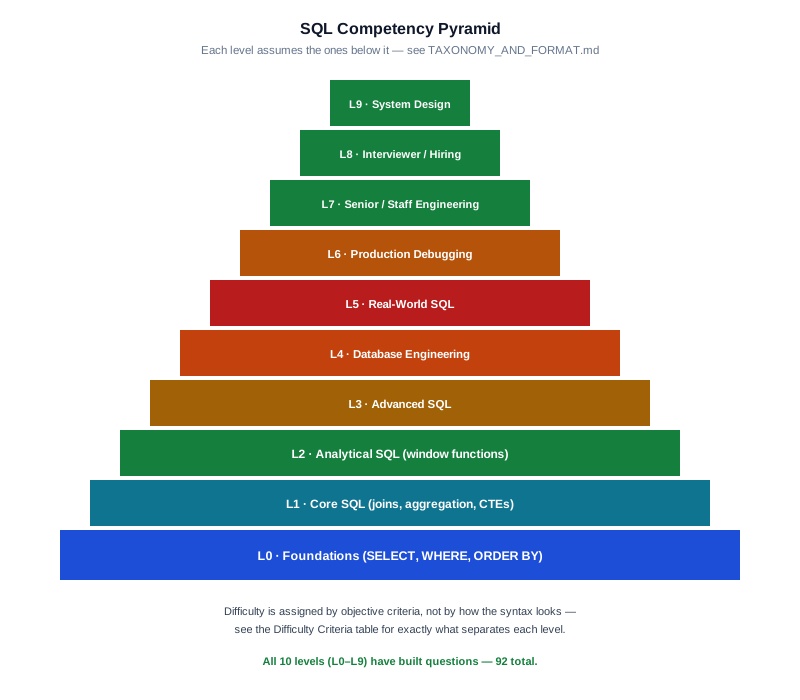
All 10 levels (L0–L9), all built
📊 Current Coverage
92 questions, built across all 10 competency levels. This is the third expansion pass beyond the original 48-question breadth pilot, targeted at Levels 1–2 (the largest remaining gap to the ~490 target). No new levels were added.
| Level | Name | Built | Target | Progress |
|---|---|---|---|---|
| 0 | Foundations | 10 | ~40 | ▰▰▰▰▰▱▱▱▱▱▱▱▱▱▱▱▱▱▱▱ 25% |
| 1 | Core SQL | 16 | ~60 | ▰▰▰▰▰▱▱▱▱▱▱▱▱▱▱▱▱▱▱▱ 27% |
| 2 | Analytical SQL | 17 | ~80 | ▰▰▰▰▱▱▱▱▱▱▱▱▱▱▱▱▱▱▱▱ 21% |
| 3 | Advanced SQL | 9 | ~70 | ▰▰▰▱▱▱▱▱▱▱▱▱▱▱▱▱▱▱▱▱ 13% |
| 4 | Database Engineering | 8 | ~70 | ▰▰▱▱▱▱▱▱▱▱▱▱▱▱▱▱▱▱▱▱ 11% |
| 5 | Real-World SQL | 8 | ~70 | ▰▰▱▱▱▱▱▱▱▱▱▱▱▱▱▱▱▱▱▱ 11% |
| 6 | Production Debugging | 6 | ~40 | ▰▰▰▱▱▱▱▱▱▱▱▱▱▱▱▱▱▱▱▱ 15% |
| 7 | Senior / Staff Engineering | 6 | ~40 | ▰▰▰▱▱▱▱▱▱▱▱▱▱▱▱▱▱▱▱▱ 15% |
| 8 | Interviewer / Hiring | 6 | ~30 | ▰▰▰▰▱▱▱▱▱▱▱▱▱▱▱▱▱▱▱▱ 20% |
| 9 | SQL System Design | 6 | ~30 | ▰▰▰▰▱▱▱▱▱▱▱▱▱▱▱▱▱▱▱▱ 20% |
| Total | 92 | ~490 | ▰▰▰▰▱▱▱▱▱▱▱▱▱▱▱▱▱▱▱▱ 19% |
What each question contains
Optional fields are omitted where they would add little value, not padded in for uniformity.
| Element | Coverage |
|---|---|
### Explanation or ### Expected Answer |
66 of 92 questions |
### Interviewer Follow-Up |
86 of 92 questions |
Explicit ### Common Mistake (or Level 8’s Weak Answer) |
About 10 of 92 carry the literal heading |
| Named “senior-level extension” | A handful. Levels 7–9 serve as the extension by design. |
Explicit Related Modules link |
26 of 92 questions |
Format notes and known gaps (read before auditing)
- Scenario-style and interviewer-facing questions (for example Levels 6 and 8) use their own section structure instead of the exact headings above. - **Q041–Q044, Q077 and Q078** have no separate follow-up section. - On most questions the common-mistake framing is folded into the explanation prose instead of being broken out as its own section. **Retrofitting a dedicated section onto every question is a real coverage gap, not yet done.** It is tracked in [`AUDIT_REPORT.md`](/SQL-Engineering-Handbook/18_SQL_INTERVIEW_QUESTIONS/AUDIT_REPORT.html) rather than silently claimed here. - The Level 7–9 questions act as the senior-level extension (harder variants of the same skills), rather than each L0–L6 question carrying its own bolt-on senior section. See also [`FINAL_VALIDATION_REPORT.md`](/SQL-Engineering-Handbook/18_SQL_INTERVIEW_QUESTIONS/FINAL_VALIDATION_REPORT.html).🧩 How the Question Bank Is Organized
Full schema: TAXONOMY_AND_FORMAT.md. In short:
| Dimension | Values |
|---|---|
| Competency levels | 10, numbered 0–9, each assuming the ones below it |
| Difficulty ratings | 5, assigned by objective criteria: 🟢 🟡 🟠 🔴 ⚫ |
| Question types | 10: Write SQL · Predict Output · Debug · Optimize · Explain · Compare · Data Reasoning · Execution Plan · Design · Production Incident |
Use QUESTION_INDEX.md to filter every question by level, difficulty and type.
🧭 Navigation
| File | Purpose |
|---|---|
TAXONOMY_AND_FORMAT.md |
The schema. Read this first. |
QUESTION_INDEX.md |
Every question, filterable by level, difficulty and type |
INTERVIEWER_GUIDE.md |
How to actually run an interview with this bank |
SCORING_RUBRIC.md |
Eight-dimension competency scoring model |
INTERVIEW_CHEATSHEET.md |
Compact recall reference |
PRACTICE_TRACKS.md |
Pre-built question sequences by role and length |
GLOSSARY.md |
Terms used throughout, linked to full explanations |
FAQ.md |
Practical usage questions |
AUDIT_REPORT.md |
Tracked coverage gaps and audit findings |
FINAL_VALIDATION_REPORT.md |
Validation results |
scripts/validate_questions.py |
Structural validation script |
🖼️ Diagram Gallery
|
Competency pyramid All 10 levels (L0–L9), all built · source |
Interview flow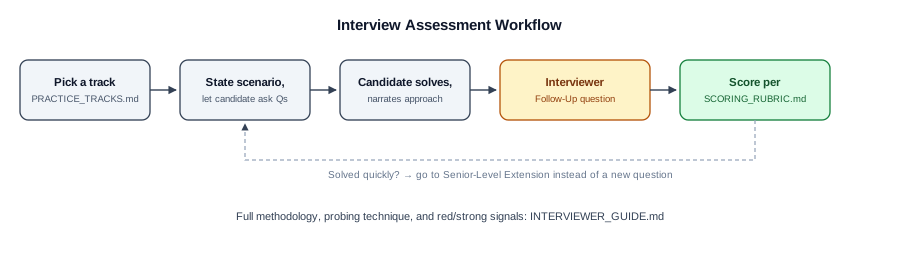 Assessment workflow, track selection to scoring · source |
🗃️ Dataset Approach
- Questions reuse the handbook’s shared
employes/departments/locationsschema wherever the scenario allows. - Level 5 (Real-World) and Level 9 (System Design) questions define small inline schemas for their specific domain (e-commerce, fintech, SaaS, healthcare, logistics) rather than introducing a large parallel dataset.
🔗 Related Modules
About a third of questions (26 of 92) carry an explicit Related Modules link to the one curriculum lesson they draw on. The rest lack a clean single link, not a connection:
- Window-function mechanics in Level 2 are mostly self-contained.
- Scenario-driven Level 5, 8 and 9 questions typically span several lessons at once.
- Level 4+ leans heavily on
16_QUERY_OPTIMIZATIONand17_TRANSACTIONS_AND_CONCURRENCY, even without a per-question link. This module tests whether you can apply what those teach.
🗂️ Repository Layout
18_SQL_INTERVIEW_QUESTIONS/
├── README.md
├── TAXONOMY_AND_FORMAT.md
├── QUESTION_INDEX.md
├── INTERVIEWER_GUIDE.md
├── SCORING_RUBRIC.md
├── INTERVIEW_CHEATSHEET.md
├── PRACTICE_TRACKS.md
├── GLOSSARY.md
├── FAQ.md
├── AUDIT_REPORT.md
├── FINAL_VALIDATION_REPORT.md
├── 01_FOUNDATIONS/            └─ QUESTION_BANK.md
├── 02_CORE_SQL/               └─ QUESTION_BANK.md
├── 03_ANALYTICAL_SQL/         └─ QUESTION_BANK.md
├── 04_ADVANCED_SQL/           └─ QUESTION_BANK.md
├── 05_DATABASE_ENGINEERING/   └─ QUESTION_BANK.md
├── 06_REAL_WORLD_SQL/         └─ QUESTION_BANK.md
├── 07_PRODUCTION_DEBUGGING/   └─ QUESTION_BANK.md
├── 08_SENIOR_ENGINEERING/     └─ QUESTION_BANK.md
├── 09_INTERVIEWER_QUESTIONS/  └─ QUESTION_BANK.md
├── 10_SQL_SYSTEM_DESIGN/      └─ QUESTION_BANK.md
├── scripts/
│   └── validate_questions.py
└── assets/
    ├── images/hero.svg
    └── diagrams/
        ├── competency-pyramid.svg
        └── interview-flow.svg
✅ Validation
Run from this module’s root:
python3 scripts/validate_questions.py .
It checks duplicate IDs, missing required fields and broken relative links. See the script’s docstring for documented limitations.
🤝 Contributing
- Follow the format and deduplication policy in
TAXONOMY_AND_FORMAT.md. - Assign the next sequential
Q###ID. - Run
scripts/validate_questions.pybefore submitting.
Released under the MIT license.