SQL-Engineering-Handbook
05 — Covering Indexes
Introduction
A covering index doesn’t just help the database find rows — it can let the database avoid touching the table at all. This file explains index-only scans, why they’re dramatically faster, and how to design a composite index that covers a specific query.
Learning Objectives
- Define a covering index and an index-only scan
- Read
EXPLAINoutput to confirm whether a query is index-only - Design a composite index that covers a specific SELECT list
- Explain the trade-off covering indexes make (storage vs. read speed)
Business Motivation
A dashboard runs this exact query thousands of times per hour:
SELECT order_id, order_date, status
FROM orders
WHERE customer_id = 88291;
An index on customer_id alone still requires a second lookup into the
table (or clustered index) to fetch order_date and status for every
matching row. If the index instead includes all three columns, the
database can answer the entire query from the index alone — no table
access required. At high query volume, this is the difference between
acceptable and unacceptable dashboard latency.
Why This Exists
Secondary indexes normally store just enough to locate the full row (a primary key value in InnoDB, a TID in PostgreSQL). If every column the query needs is already present in the index itself, that second lookup is unnecessary — this is what “covering” means, and the resulting plan is called an index-only scan.
Production Use Cases
- High-frequency dashboard queries with a small, fixed SELECT list.
- API endpoints returning a lean DTO rather than
SELECT *. - Aggregate queries (
COUNT,SUM) that only need indexed columns.
Architecture Discussion
INDEX (customer_id, order_date, status)   <- from File 03

SELECT order_id, order_date, status FROM orders WHERE customer_id = X;
Wait — order_id isn’t in the index definition above as a value column,
but in InnoDB it IS present implicitly: every secondary index leaf
entry includes the primary key value (needed to locate the full row if
required). So this composite index already covers order_id,
order_date, and status — it satisfies the whole query from the index
alone.
Syntax
-- MySQL: composite index that happens to cover the query
CREATE INDEX idx_orders_customer_date_status
    ON orders (customer_id, order_date, status);

-- SQL Server: explicit INCLUDE for non-key covering columns
CREATE INDEX idx_orders_customer
    ON orders (customer_id)
    INCLUDE (order_date, status);

-- PostgreSQL: equivalent explicit INCLUDE (v11+)
CREATE INDEX idx_orders_customer
    ON orders (customer_id)
    INCLUDE (order_date, status);
Syntax Breakdown
- MySQL has no
INCLUDEclause — you achieve covering purely through composite column order, which is why File 03’s leftmost prefix design and File 05’s covering design are really the same underlying tool used for two purposes. - SQL Server/PostgreSQL’s
INCLUDEadds columns to the leaf level without making them part of the searchable key — useful when you want covering without affecting sort order or leftmost-prefix behavior.
Visual Explanation
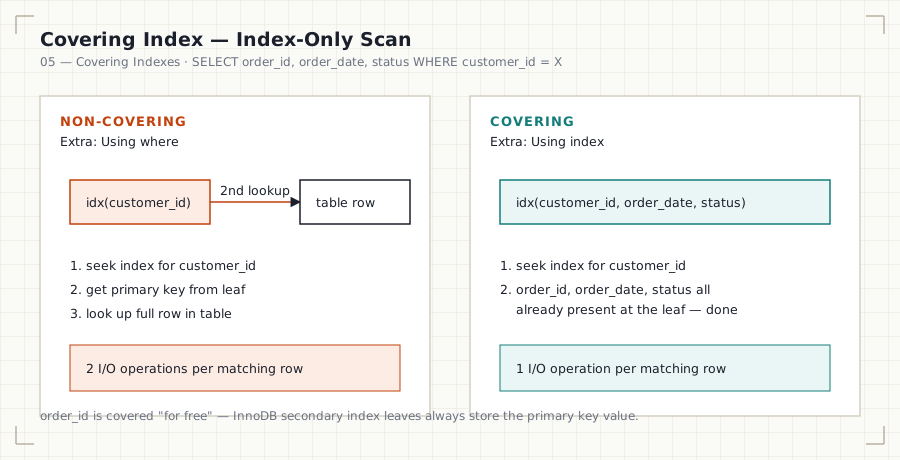
Non-covering index lookup:
  index seek → get primary key → SECOND lookup into table/clustered
  index to fetch remaining columns              (2 I/O operations)

Covering index lookup:
  index seek → all needed columns already at the leaf → done
                                                  (1 I/O operation)
ASCII Diagram
EXPLAIN output, Extra column:

  "Using where"                → normal filter, may still hit table
  "Using index"                → COVERING — index-only scan, no
                                   table access required
  "Using index condition"      → index condition pushdown, still
                                   touches table for final columns
Execution Flow
- Optimizer checks whether every column referenced in the SELECT list, WHERE clause, and any JOIN/ORDER BY is present in a single candidate index.
- If yes, and that index also serves the WHERE clause efficiently, the optimizer marks the plan as index-only and skips the base table entirely.
- If any referenced column is missing from the index, the engine falls back to a normal index-then-table-lookup plan.
Engineering Notes
SELECT * defeats covering indexes almost by definition — the wider the
SELECT list, the less likely any reasonably-sized index covers it. This
is one of the concrete performance reasons (beyond general hygiene) to
select only the columns you actually need.
Performance Notes
- Index-only scans avoid random I/O into the table entirely, which is often the single biggest win available for a hot, narrow, high-volume query.
- The gain is largest when the table doesn’t fit comfortably in buffer pool/cache — under full cache, the difference shrinks but doesn’t disappear (fewer cache lookups is still cheaper).
Storage Considerations
Covering indexes are wider than the minimal index needed just for filtering, so they cost more disk space and more write overhead per insert/update — this is the direct trade-off against read speed, and should be a deliberate choice for specific hot queries, not a blanket strategy.
Optimizer Notes
MySQL’s EXPLAIN shows Using index in the Extra column specifically
to signal an index-only scan — this is the exact string to check for
when validating that a covering index design is actually working as
intended.
ANSI SQL Notes
Covering indexes are purely a physical optimization; there is no standard SQL concept for them — the standard only defines what a query returns, and covering never changes that, only how cheaply it’s produced.
MySQL Notes
- No
INCLUDEsyntax — achieve covering via composite column ordering. - Confirm with
EXPLAIN ... \Gand checkExtra: Using index.
PostgreSQL Notes
INCLUDE(v11+) lets you add covering columns without affecting the key’s sort/search behavior — useful when the covering columns shouldn’t influence leftmost-prefix matching.- Confirm with
EXPLAINand look forIndex Only Scan.
SQL Server Notes
INCLUDEis the idiomatic way to build a covering index; SQL Server’s execution plan explicitly labels the operator as an Index Seek with no corresponding Key Lookup when covering succeeds.
Oracle Notes
- Oracle covering behavior is achieved through composite index design,
similar to MySQL; look for
INDEX (FAST FULL SCAN)or the absence of aTABLE ACCESS BY INDEX ROWIDstep in the execution plan.
Edge Cases
- Adding one extra column to a SELECT list that isn’t in the covering
index silently drops the index-only optimization — always re-check
EXPLAINafter query changes, not just after index changes. - Very wide covering indexes can occasionally be slower to scan than a narrower index plus a table lookup, if the covering index itself no longer fits efficiently in cache.
Best Practices
- Design covering indexes around specific, known-hot query shapes — not speculatively.
- Re-verify covering behavior with
EXPLAINwhenever the query’s SELECT list changes.
Anti-patterns
- Adding covering columns to every index “for safety,” inflating storage and write cost with no measured benefit.
- Using
SELECT *on a table with a carefully designed covering index, which defeats the design.
Common Mistakes
- Assuming any index containing the WHERE columns is automatically covering — covering requires every referenced column, including the SELECT list, to be present.
- Not checking
Extra: Using indexand assuming a plan is index-only because an index was used at all.
Interview Questions
- What is the difference between an index being used and a query being covered?
- Why does
SELECT *tend to prevent covering-index optimization? - How would you confirm, using
EXPLAIN, whether a query is actually achieving an index-only scan in MySQL? In PostgreSQL? - What’s the storage trade-off of designing a covering index?
Summary
A covering index contains every column a query needs, letting the engine
answer the query from the index alone — an index-only scan — without
touching the underlying table. This is one of the most impactful
optimizations available for narrow, high-frequency queries, at the cost
of additional index storage and write overhead. EXPLAIN’s Using
index (MySQL) or Index Only Scan (PostgreSQL) confirms whether it’s
actually happening.
Practice
See 12_PRACTICE_PROBLEMS.md, Advanced section, Problems 1–2.