SQL-Engineering-Handbook
04 — Unique, Primary & Foreign Key Indexes
Introduction
Primary keys, unique constraints, and foreign keys are enforced using indexes under the hood — they aren’t just logical constraints, they’re physical structures with real performance implications. This file covers what each one actually builds, and where their behavior diverges from a plain secondary index.
Learning Objectives
- Explain how a primary key constraint is implemented as an index
- Explain how a unique constraint differs from a unique index
- Explain why foreign keys generally require a supporting index
- Predict the indexing consequences of adding or removing each constraint
Business Motivation
A customers table with no index on email allows two customers to
register with the same email — a data integrity bug that surfaces as
duplicate accounts, split order histories, and support tickets. A unique
index on email prevents the bug at the database layer, not just in
application code (which can be bypassed by a second write path, a script,
or a race condition).
Why This Exists
Constraints need enforcement mechanisms. A primary key constraint requires the database to check every insert against every existing value for uniqueness (and reject NULLs) — the only structure that makes that check fast is an index. The same logic applies to unique constraints. Foreign keys require checking that a referenced value exists in the parent table on every insert/update — again, expensive without an index.
Production Use Cases
- Primary key:
order_id— the canonical row identifier. - Unique index:
customers.email,users.username— enforce one row per real-world entity. - Foreign key:
orders.customer_id → customers.id— enforce referential integrity and speed up join queries.
Architecture Discussion
- Primary key — In MySQL InnoDB, the primary key is the clustered index: the table’s rows are physically stored in primary key order, and every secondary index stores the primary key value as its pointer back to the row.
- Unique index — A standard B+Tree index with a uniqueness check applied on every write. A unique constraint and a unique index are effectively the same implementation in MySQL/PostgreSQL — the constraint is enforced by the index.
- Foreign key — A logical constraint checked against the parent table’s primary/unique key. MySQL InnoDB requires an index on the foreign key column automatically if one doesn’t already exist, precisely because the constraint check would otherwise be a full table scan on every write.
Production Use Cases (continued)
- Composite unique constraints:
UNIQUE(tenant_id, email)— one email per tenant, not globally unique.
Syntax
-- Primary key (also creates the clustered index in InnoDB)
CREATE TABLE customers (
    id    BIGINT UNSIGNED PRIMARY KEY AUTO_INCREMENT,
    email VARCHAR(255) NOT NULL,
    UNIQUE KEY uq_customers_email (email)
);

-- Foreign key — MySQL auto-creates a supporting index if absent
ALTER TABLE orders
    ADD CONSTRAINT fk_orders_customer
    FOREIGN KEY (customer_id) REFERENCES customers (id);
Syntax Breakdown
PRIMARY KEYonidboth enforces uniqueness/non-null and determines physical row storage order in InnoDB.UNIQUE KEY uq_customers_email (email)creates a secondary unique index — distinct from the clustered primary key index.- The
FOREIGN KEYclause enforces referential integrity; MySQL will silently createcustomer_idan index if no compatible one exists, since InnoDB requires it for the constraint check.
Visual Explanation
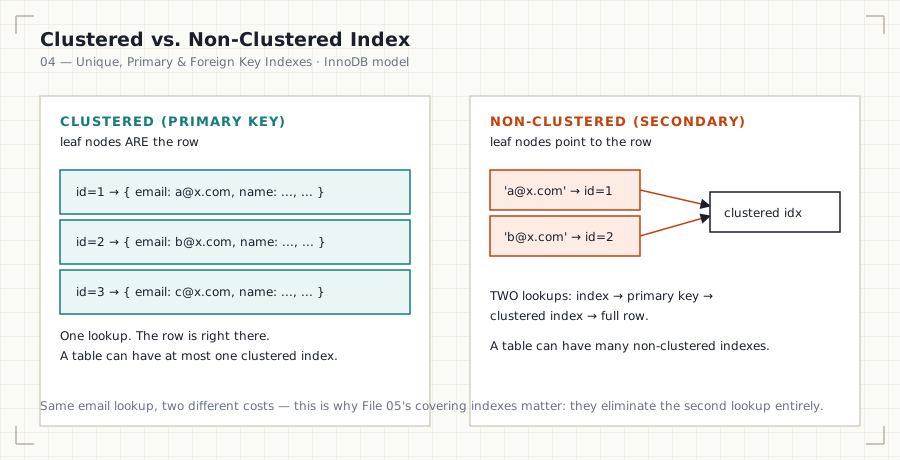
customers (InnoDB clustered on id):
  id=1 → { email: 'a@x.com', ... }   (full row stored at leaf)
  id=2 → { email: 'b@x.com', ... }

uq_customers_email (secondary unique index):
  'a@x.com' → id=1
  'b@x.com' → id=2
  (lookup by email → get id → second lookup into clustered index)
ASCII Diagram
        Write: INSERT INTO orders (customer_id, ...) VALUES (999, ...)
                              │
                 ┌────────────┴────────────┐
                 │ FK constraint check:      │
                 │ does customers.id = 999   │
                 │ exist?                    │
                 └────────────┬────────────┘
                    Indexed lookup on customers.id
                    (fast — O(log n), not O(n))
Execution Flow
- On
INSERT/UPDATEof a unique-constrained column, the engine seeks the existing index for the new value before committing — a match raises a duplicate-key error. - On
INSERT/UPDATEof a foreign-key column, the engine seeks the parent table’s primary/unique index for the referenced value — a miss raises a constraint violation. - Both checks are index seeks, not scans, provided the required index exists.
Engineering Notes
A foreign key without a supporting index on the child table’s column (the referencing column, not the referenced one) still enforces correctness but does so by scanning — MySQL InnoDB prevents this specific case by auto-creating an index, but not every engine or every constraint type does this automatically. Always verify.
Performance Notes
- Uniqueness checks add write overhead: every insert must seek the index before it can proceed, not just append.
- Missing an index to support a foreign key check is one of the most common causes of slow bulk inserts/deletes in production — deleting a parent row can trigger a full scan of the child table to verify no orphaned references remain, unless that child column is indexed.
Storage Considerations
In InnoDB, the clustered primary key index is the table — there’s no additional storage cost beyond the table itself. Every secondary index (including unique ones) is additional storage, sized by however many columns it covers.
Optimizer Notes
Foreign key columns are frequently join columns — the same index that
supports the constraint check also accelerates
JOIN customers ON orders.customer_id = customers.id, which is why
“index your foreign keys” is close to a universal rule, not just a
constraint-performance detail.
ANSI SQL Notes
PRIMARY KEY, UNIQUE, and FOREIGN KEY are all ANSI SQL standard
constraint declarations — the standard mandates their logical behavior
but not how they’re implemented internally.
MySQL Notes
- InnoDB requires
PRIMARY KEYto exist for optimal storage; a table without an explicit primary key gets an invisible auto-generated clustering key, which loses the benefit of clustering on a business-relevant column. - InnoDB auto-creates an index on a foreign key column if none exists.
PostgreSQL Notes
- PostgreSQL does not auto-create an index on a foreign key’s referencing column — this is a common production gap; you must add it explicitly.
SQL Server Notes
- A
PRIMARY KEYin SQL Server defaults to creating a clustered index unlessNONCLUSTEREDis explicitly specified.
Oracle Notes
- Oracle also does not auto-index foreign key columns — explicit indexing is required and is a standard part of Oracle schema review checklists.
Edge Cases
- Composite unique constraints allow duplicate values in each individual column as long as the combination is unique.
- NULLs are treated as distinct from each other by unique indexes in MySQL/PostgreSQL — multiple NULLs are allowed in a UNIQUE column, which surprises engineers coming from a purely mathematical notion of uniqueness.
Best Practices
- Always index foreign key columns explicitly — don’t rely on engine-specific auto-creation behavior.
- Choose primary keys that align with your dominant access pattern in InnoDB, since the primary key determines physical row order.
Anti-patterns
- Foreign keys with no supporting index on PostgreSQL/Oracle/SQL Server.
- Using a large, randomly-ordered column (e.g., a UUID) as an InnoDB primary key without accounting for the page-split cost from File 02.
Common Mistakes
- Assuming all databases auto-index foreign keys the way MySQL InnoDB does.
- Forgetting that a
UNIQUEconstraint allows multiple NULLs.
Interview Questions
- In InnoDB, what physically is the primary key index?
- Why does a foreign key without a supporting index cause slow deletes on the parent table?
- Does PostgreSQL auto-create an index for a foreign key’s referencing column? What are the operational implications if you forget?
- Can a
UNIQUEcolumn contain more than one NULL value? Why?
Summary
Primary keys, unique constraints, and foreign keys are all enforced via indexes, not free-standing logical rules. In InnoDB, the primary key defines physical row storage; unique constraints are index-backed uniqueness checks; foreign keys require an index on the referencing column to avoid full scans on every write and delete — a requirement MySQL enforces automatically but PostgreSQL, SQL Server, and Oracle do not.
Practice
See 12_PRACTICE_PROBLEMS.md, Intermediate section, Problems 8–9.