SQL-Engineering-Handbook
03 — Composite Indexes
Introduction
Most production queries filter on more than one column. A composite (multi-column) index can serve several of these queries at once — but only if its column order matches how the query filters. This file covers that ordering rule in depth, since getting it wrong is one of the most common indexing mistakes in production systems.
Learning Objectives
- Build a composite index and explain what its physical sort order is
- State and apply the leftmost prefix rule
- Predict, for a given composite index, which query shapes can and cannot use it
- Choose column order deliberately based on query patterns
Business Motivation
A support dashboard queries orders by customer, then by date, then by status:
SELECT * FROM orders
WHERE customer_id = 88291
  AND order_date > '2026-01-01'
  AND status = 'completed';
Three single-column indexes exist as an option, but MySQL can typically
use only one index per table per query block efficiently (barring index
merge, which has its own overhead). A single composite index ordered
(customer_id, order_date, status) can serve this exact filter pattern in
one seek — this is the entire motivation for composite indexes.
Why This Exists
A composite index is sorted first by its first column, then by its second
column within each value of the first, and so on. This nested sort
order means the index can only be searched efficiently starting from its
leftmost column — you cannot binary-search a structure sorted by
(customer_id, order_date) using only order_date, for the same reason
you can’t look up a phone book by first name when it’s sorted by last
name.
Production Use Cases
- Multi-tenant SaaS:
(tenant_id, created_at)— nearly every query in a multi-tenant system filters by tenant first. - Order search:
(customer_id, order_date, status). - Audit logs:
(user_id, event_type, timestamp).
Architecture Discussion
INDEX (customer_id, order_date, status)

Sorted as:
  customer_id=4471,  order_date=2026-01-02, status='completed'
  customer_id=4471,  order_date=2026-01-05, status='pending'
  customer_id=4471,  order_date=2026-01-09, status='completed'
  customer_id=88291, order_date=2026-01-01, status='completed'
  customer_id=88291, order_date=2026-01-03, status='cancelled'
  customer_id=91002, order_date=2026-01-01, status='pending'
Notice: within customer_id, rows are sorted by order_date; within
each (customer_id, order_date) pair, by status. This is why the
index is only directly searchable starting from customer_id.
Syntax
CREATE INDEX idx_orders_customer_date_status
    ON orders (customer_id, order_date, status);
Syntax Breakdown
- Column order in
CREATE INDEXis not stylistic — it is the physical sort order and directly determines which query shapes benefit. - There is no syntax to declare “any order” — the order you write is the order the index is built in.
Visual Explanation — The Leftmost Prefix Rule
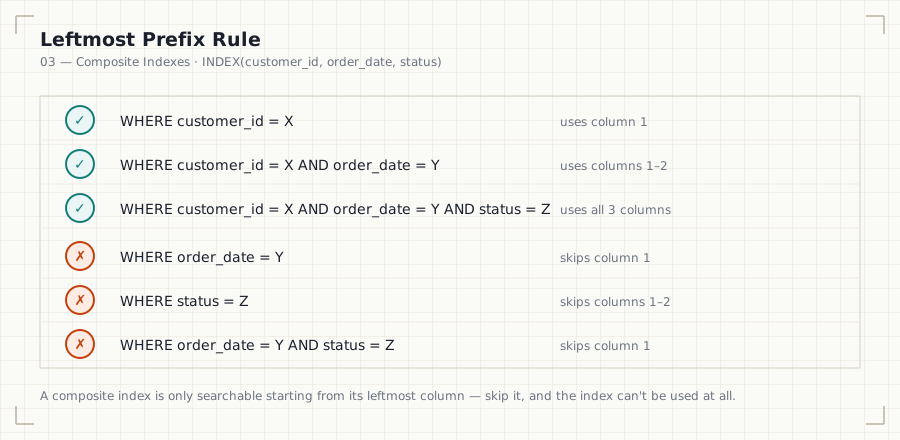
INDEX(customer_id, order_date, status)

✓ WHERE customer_id = X                                   -- uses col 1
✓ WHERE customer_id = X AND order_date = Y                -- uses cols 1-2
✓ WHERE customer_id = X AND order_date = Y AND status = Z -- uses all 3
✗ WHERE order_date = Y                                    -- skips col 1
✗ WHERE status = Z                                        -- skips cols 1-2
✗ WHERE order_date = Y AND status = Z                     -- skips col 1
ASCII Diagram
                    customer_id (sorted)
                    /        |        \
              4471        88291       91002
              /  \          |  \
        order_date      order_date  ...
        (sorted within  (sorted within
         customer_id     customer_id
         =4471)           =88291)
Each level of sort only exists within the level above it — you must enter the tree from the top (leftmost column) to benefit from any of it.
Execution Flow
- Optimizer inspects the
WHEREclause for a contiguous prefix of the composite index’s column list, starting from column 1. - It seeks to the matching prefix range in the index.
- Any trailing columns of the index that also appear as equality filters in the query are used to narrow the seek further within that range.
- Any query column not covered by the prefix falls back to a filter applied after retrieval (or the index isn’t used at all for that predicate).
Engineering Notes
Equality columns should generally precede range columns in a composite
index. (customer_id, status, order_date) for a query filtering
customer_id = X AND status = 'completed' AND order_date > Y lets the
index narrow by two equalities before applying the range — placing
order_date earlier would end the useful sort narrowing at the first
range predicate, since everything after a range column in the index
can’t be used for further seeking within that same lookup.
Performance Notes
- A composite index that matches a query’s full filter prefix performs identically to a purpose-built single-column index would for a simpler query — the “extra” columns cost nothing when unused, but they must be present and correctly ordered to help.
- Over-wide composite indexes (5+ columns) increase storage and write cost for diminishing returns — most production composite indexes are 2-4 columns.
Storage Considerations
A composite index stores all indexed columns’ values at every leaf entry, not just the first — a 3-column composite index on large VARCHAR columns can be significantly larger than a single-column index on the same table.
Optimizer Notes
MySQL 8.0+ can sometimes use index merge to combine two separate single-column indexes for a query, but this is generally more expensive than a single well-ordered composite index and should be treated as a fallback the optimizer reaches for, not a design strategy to rely on.
ANSI SQL Notes
As with all index structures, composite index behavior is implementation-specific; the standard has no concept of “leftmost prefix” since it doesn’t define physical access paths at all.
MySQL Notes
- MySQL has no index skip scan capability — unlike Oracle and PostgreSQL (below), the leftmost prefix rule is not a heuristic MySQL can work around; a predicate that omits the leading column of a composite index cannot use that index at all, full stop. Design composite indexes around this constraint rather than expecting the optimizer to compensate for it.
PostgreSQL Notes
- PostgreSQL follows the same leftmost prefix logic for standard
btreecomposite indexes.
SQL Server Notes
- SQL Server refers to non-leading composite index columns as
“included” only when explicitly using
INCLUDE(File 05) — a plain composite index follows the same leftmost rule as MySQL/PostgreSQL.
Oracle Notes
- Oracle’s composite B-Tree indexes follow the identical leftmost prefix principle; Oracle additionally offers index skip scan as a distinct, more mature optimizer feature for some non-leading-column queries.
Edge Cases
- A query filtering only on the second and third columns of a composite index (skipping the first) generally cannot use that index at all, regardless of how selective those columns are.
ORDER BYcan sometimes be satisfied by a composite index’s trailing columns even without a filter on them, but only if the leading columns are constrained by equality predicates first.
Best Practices
- Order composite index columns as: equality filters first, then a
single range filter, then columns needed only for
ORDER BYor covering (File 05). - Design composite indexes around actual query patterns, not table schema order.
Anti-patterns
- Creating a composite index in column-alphabetical or table-definition order instead of query-access order.
- Assuming a composite index helps every query that references any of its columns.
Common Mistakes
- Placing a range-filtered column before an equality-filtered column.
- Not realizing that
WHERE status = Zalone gets zero benefit fromINDEX(customer_id, order_date, status).
Interview Questions
- Given
INDEX(a, b, c), which of these queries can use the index, and how much of it:WHERE a = 1,WHERE b = 2,WHERE a = 1 AND c = 3,WHERE a = 1 AND b = 2 AND c = 3? - Why should equality-filtered columns generally precede range-filtered columns in a composite index?
- You have three single-column indexes and query performance is still poor on a query filtering all three columns together. What would you investigate?
Summary
A composite index is one physical structure, sorted by its columns in declared order, nested left to right. The leftmost prefix rule follows directly from that physical sort: the index is only searchable starting from its first column, and a well-designed composite index should mirror actual query filter patterns — equality columns first, then at most one range column, then any trailing columns needed for ordering or covering.
Practice
See 12_PRACTICE_PROBLEMS.md, Intermediate section, Problems 4–7.