SQL-Engineering-Handbook
02 — B-Tree Indexes
Introduction
The B-Tree (and its variant, the B+Tree) is the default index structure in almost every relational database. This file explains why that structure was chosen, how it’s shaped, and how MySQL, PostgreSQL, SQL Server, and Oracle each implement it slightly differently.
Learning Objectives
- Explain why B-Trees are the default structure for general-purpose indexing (as opposed to hash tables)
- Distinguish a B-Tree from a B+Tree
- Describe how a B+Tree lookup, range scan, and insert work
- Identify which engines use B-Tree vs. B+Tree internally
Business Motivation
A reporting dashboard filters orders by a date range:
SELECT * FROM orders
WHERE order_date BETWEEN '2026-01-01' AND '2026-01-31';
A hash index could resolve order_date = X in O(1), but it cannot answer
a range query at all — hash structures have no concept of “next
value.” B+Trees preserve sorted order, so a range scan is a single
sequential walk once the starting point is found. This is why B+Trees,
not hash tables, are the default index structure in production databases.
Why This Exists
Databases need a structure that supports equality lookups, range scans, and ordered traversal, all while staying balanced as data grows and minimizing disk I/O (each tree level read is typically one disk page read). B-Trees satisfy all three; B+Trees improve on them for range scans specifically by chaining leaf nodes together.
Production Use Cases
- Date-range reporting (
BETWEEN,>,<on timestamps) - Alphabetical customer/product search (
LIKE 'Sm%'prefix search) - Pagination (
ORDER BY id LIMIT 50 OFFSET 100) - Any primary key lookup
Architecture Discussion
B-Tree: a balanced tree where every node holds both keys and data (or data pointers), and internal nodes participate in the search.
B+Tree: only leaf nodes hold data; internal nodes hold keys used purely for navigation. Crucially, leaf nodes are linked together in a sorted linked list, so once you reach the first matching leaf, a range scan is a straight walk forward — no need to revisit internal nodes.
Nearly every production RDBMS index (MySQL InnoDB, PostgreSQL default
btree access method, SQL Server clustered/non-clustered indexes, Oracle
default indexes) is a B+Tree despite frequently being called “B-Tree” in
documentation and tooling.
Syntax
-- MySQL: BTREE is the default and typically doesn't need to be stated
CREATE INDEX idx_orders_order_date
    ON orders (order_date)
    USING BTREE;

-- PostgreSQL: btree is also the default access method
CREATE INDEX idx_orders_order_date
    ON orders USING btree (order_date);
Syntax Breakdown
USING BTREEis explicit but redundant in MySQL for InnoDB tables — InnoDB only supports BTREE and (separately) full-text/spatial indexes; the clause matters more when working with the MEMORY engine, which also supports HASH.- PostgreSQL’s
USING btreefollows the same logic — stating it is optional but self-documenting.
Visual Explanation
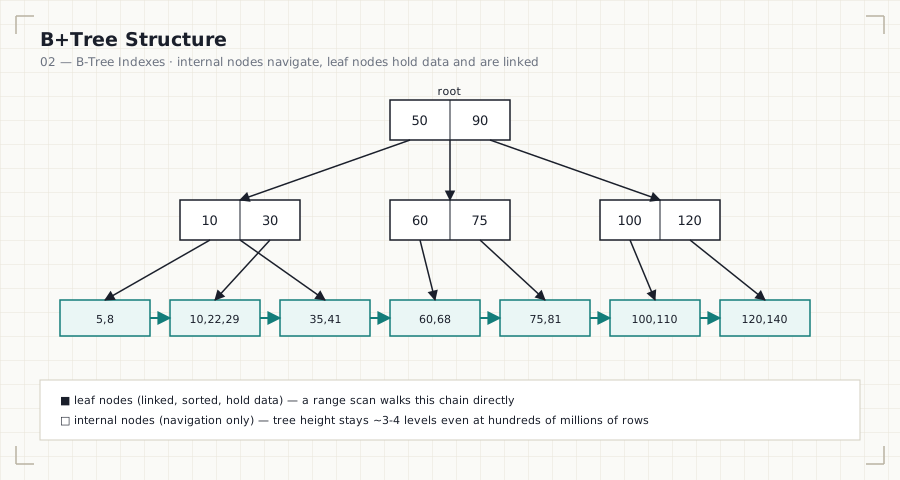
                    [ 50 | 90 ]                 <- root (internal node)
                   /     |     \
          [10|30]     [60|75]    [100|120]      <- internal nodes
          /  |  \      /  |  \      /  |  \
       leaf leaf leaf ...                        <- leaf nodes (linked →)

Leaf nodes: [5,8]→[10,22,29]→[35,41]→[60,68]→[75,81]→[100,110]→...
             ─────────────────────────────────────────────────►
             sorted, linked — a range scan walks this chain directly
ASCII Diagram
Point lookup (order_date = '2026-01-15'):
  root → internal node → leaf node → found, stop.
  O(log n) disk reads (tree height, typically 3-4 levels
  even at hundreds of millions of rows)

Range scan (order_date BETWEEN '2026-01-01' AND '2026-01-31'):
  root → internal node → first matching leaf
       → follow leaf-to-leaf links until out of range
  O(log n) to find start + O(k) to walk k matching rows
Execution Flow
- Start at the root node.
- Compare the search key against the node’s keys to choose a child pointer.
- Descend one level; repeat until a leaf node is reached.
- For equality: return the match at the leaf.
- For a range: return the current leaf’s matches, then follow the leaf-link pointer to the next leaf and repeat until out of range.
Engineering Notes
Tree height stays small even at huge scale because each node holds many keys (determined by page size — typically hundreds of keys per 16KB InnoDB page), so a B+Tree over 100 million rows is usually only 3-4 levels deep. This is why index lookups stay fast as tables grow — the cost grows logarithmically, not linearly.
Performance Notes
- Insertions and deletions may trigger node splits or merges to keep the tree balanced — this is part of the write overhead discussed in File 06.
- Sequential inserts on an auto-incrementing key are cheap (append to the rightmost leaf); random-order inserts on a UUID primary key cause scattered page writes and more frequent splits — a known operational pain point when choosing UUID vs. auto-increment primary keys.
Storage Considerations
Every level of the tree is stored on disk as pages. A wider tree (more keys per node) means fewer levels and fewer disk reads per lookup — this is why database page sizes (commonly 8-16KB) are tuned for this trade-off rather than left arbitrary.
Optimizer Notes
The optimizer estimates cost partly from expected tree height and page reads. A range query’s estimated cost accounts for both the descent to the starting leaf and the estimated number of leaf pages that must be walked — this is where selectivity estimates (File 07) directly affect whether the optimizer prefers this index or a full scan.
ANSI SQL Notes
As with all indexing behavior, B-Tree structure is implementation detail, not part of the ANSI standard — the standard only guarantees result correctness, not the retrieval mechanism.
MySQL Notes
- InnoDB’s primary key index is a clustered B+Tree — leaf nodes store the full row, not just a pointer to it (see File 04).
- Secondary indexes in InnoDB store the primary key value at the leaf, requiring a second lookup into the clustered index to fetch full rows (unless the secondary index is covering — File 05).
PostgreSQL Notes
- PostgreSQL’s default
btreeaccess method is a B+Tree variant; leaf entries store a TID pointing to the row’s physical heap location. - PostgreSQL tables are not clustered by default, so even a primary key
lookup involves an index-to-heap fetch unless
CLUSTERhas been run (a one-time physical reorder, not an ongoing guarantee).
SQL Server Notes
- A clustered index’s leaf level is the data (same model as InnoDB); a table can have at most one clustered index.
- Non-clustered indexes store the clustering key (or a row ID if the table is a heap) at the leaf.
Oracle Notes
- Oracle’s default B-Tree index leaf nodes store a ROWID pointing to the physical block/row location, unless the table is an Index-Organized Table (IOT).
Edge Cases
- Extremely low-cardinality columns still perform poorly with a B-Tree even though the structure itself is efficient — the bottleneck is selectivity, not tree shape (see File 07).
- Very large keys (e.g., indexing a long VARCHAR without a prefix limit) reduce how many keys fit per page, increasing tree height and page reads.
Best Practices
- Prefer narrow, sequential key types (integers, well-chosen composite keys) for primary keys to minimize page splits.
- Index columns used in range queries and
ORDER BY, not just equality filters — B+Trees are what make both fast.
Anti-patterns
- Using random UUIDs as a clustered/primary key on a high-write table without understanding the page-split cost.
- Indexing a large free-text VARCHAR column directly instead of using a prefix index or full-text index.
Common Mistakes
- Assuming all indexes are hash-based and therefore can’t help with range queries — B+Trees are the default precisely because they can.
- Confusing “B-Tree” and “B+Tree” — nearly every production index you’ll encounter is technically the latter.
Interview Questions
- Why do relational databases default to B+Trees instead of hash indexes for general-purpose indexing?
- What is the practical difference between a B-Tree and a B+Tree?
- Why does a sequential auto-increment primary key tend to perform better on writes than a random UUID primary key?
- Explain why tree height stays roughly constant (3-4 levels) even as a table grows into the hundreds of millions of rows.
Summary
B+Trees are the default index structure because they support equality lookups, range scans, and ordered traversal efficiently, while staying balanced and shallow (O(log n)) as data grows. Their linked leaf nodes are what make range scans fast — a property hash indexes fundamentally can’t offer.
Practice
See 12_PRACTICE_PROBLEMS.md, Intermediate section, Problems 1–3.