SQL-Engineering-Handbook
09 — Interview Guide: Views
Module: 14 — Views Previous: 08 — Real-World Case Studies · Next: 10 — Practice Problems
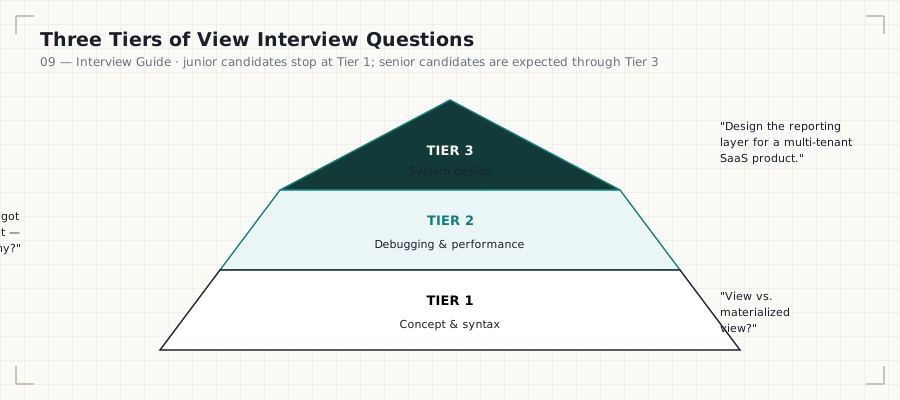
This guide is structured in three tiers, matching how Views actually get tested: conceptual fluency (any Data Analyst interview), design/architecture (Analytics Engineering interviews), and “spot the bug” (both, and the most revealing tier).
Tier 1 — Conceptual Fluency
Q1. What is a View, exactly? Does it store data?
No. A View stores a query definition in the catalog (information_schema.VIEWS). Every query against a View re-executes (or is merged into) that definition against current base-table data. There is no independent storage of rows.
Q2. If I insert a row into a base table, does an existing View immediately reflect it? Yes, always — MySQL Views are never cached snapshots by default. There is no refresh step.
Q3. What’s the difference between a View and a CTE? A CTE exists only for the duration of a single query and isn’t a catalog object. A View is permanent, named, reusable across sessions, queryable by other users/applications, and independently grantable.
Q4. Can you index a View? No — indexes exist only on base tables. A View’s performance depends entirely on the indexing of the tables it reads from.
Q5. Does using a View make a query faster? No, never, by itself. A View adds zero performance benefit over its underlying query — it’s an abstraction and reuse mechanism, not an optimization.
Tier 2 — Design & Architecture
Q6. Design a reporting layer for a company where Finance and Product need different definitions of “active customer” from the same raw tables. Expected shape: raw tables never queried directly by BI → one staging View normalizing/cleaning the raw data → two divergent reporting Views, each encoding one team’s business rule explicitly, each documented → BI tools point only at the reporting layer. See Module 08.
Q7. How would you restrict a role to see only aggregated salary data, never individual salaries?
An aggregated SQL SECURITY DEFINER View grouping by department/role, granted SELECT instead of the base table; explicitly revoke/never-grant base table access to that role. Strong candidates also mention that column-level grants alone don’t solve this, because they still expose one row per employee.
Q8. Does MySQL support materialized Views? What do you do instead?
No native support. The practical equivalent is a physical summary table refreshed on a schedule (via EVENT or an external ETL job), trading staleness for read speed — the same tradeoff Postgres/Snowflake materialized Views make explicit.
Q9. You have a 3-layer nested View chain that’s slow in production but fast in testing. Walk through your diagnosis.
Run EXPLAIN (and EXPLAIN FORMAT=TREE) on the exact production query pattern; look for Using temporary at each layer; identify whether an outer filter is failing to push down into a TEMPTABLE-algorithm layer; consider flattening the chain or moving an aggregating layer to a scheduled summary table.
Q10. When would you choose SQL SECURITY INVOKER over the default DEFINER?
When you want the View to enforce access using the querying user’s own privileges/context — e.g., a row-level “my own records” pattern relying on CURRENT_USER() — rather than a fixed elevated privilege level for every consumer.
Tier 3 — Spot the Bug
Q11.
CREATE VIEW vw_active_orders AS
SELECT * FROM sales_orders WHERE status = 'PENDING';
What’s wrong? SELECT * — any base table schema change silently changes this View’s output columns. Also missing WITH CHECK OPTION if this View is meant to be written through.
Q12.
CREATE VIEW vw_pending AS
SELECT order_id, status FROM sales_orders WHERE status = 'PENDING'
WITH CHECK OPTION;
-- Application code:
UPDATE vw_pending SET status = 'COMPLETED' WHERE order_id = 106;
-- Application logs an error and the team is confused why "a simple update failed."
What’s wrong? Nothing is wrong with the View — this is WITH CHECK OPTION working as intended. The update is correctly rejected because the resulting row would no longer satisfy status = 'PENDING'. The bug is in the application’s expectation, not the SQL. This scenario tests whether a candidate understands WITH CHECK OPTION’s purpose or just recognizes the syntax.
Q13.
CREATE OR REPLACE ALGORITHM = MERGE VIEW vw_customer_totals AS
SELECT customer_id, SUM(total) AS lifetime_total
FROM orders
GROUP BY customer_id;
What’s wrong? ALGORITHM = MERGE is only a hint; GROUP BY structurally disqualifies merge, so MySQL silently falls back to TEMPTABLE regardless. The hint isn’t “wrong” syntactically, but the author likely misunderstands that it won’t actually force merge behavior here.
Q14.
GRANT SELECT ON vw_salary_bands TO 'regional_manager'@'%';
GRANT SELECT ON hr_employees TO 'regional_manager'@'%';  -- "just in case reporting needs it"
What’s wrong? The second grant defeats the entire point of the security View — regional_manager now has direct access to individual salaries regardless of what vw_salary_bands restricts.
Q15.
ALTER TABLE hr_employees DROP COLUMN annual_salary;
-- Migration passes CI with no errors. Two weeks later, vw_salary_bands
-- starts throwing errors in production.
What’s wrong / what should have happened? MySQL does not block a column-level ALTER TABLE for View dependents the way it can for DROP TABLE. The migration should have included an information_schema.VIEWS dependency audit (Module 06) as a required pre-migration step; the failure was deferred to View query time, not caught in CI.
How to Use This Guide
Work through Tier 1 until every answer is automatic. Tier 2 questions should be answered out loud, as a design conversation, not a one-liner — practice narrating tradeoffs. Tier 3 is best done cold: read only the code, find the bug before reading the explanation.
Further Reading
- MySQL 8.0 Reference Manual — Views