SQL-Engineering-Handbook
03 — Data Standardization
Introduction
Free-text fields are where data quality problems concentrate the most. A single customer can appear as "john smith", "John Smith ", and "JOHN SMITH" across three different systems — and to SQL’s default string comparison, those are three different values. This chapter covers the functions used to standardize text before it’s grouped, joined, or reported on.
Concept Overview
TRIM()/LTRIM()/RTRIM()— remove leading and/or trailing whitespace. They do not remove whitespace in the middle of a string.REPLACE(string, search, replacement)— substitutes every occurrence of one substring with another, including collapsing internal double spaces when combined with itself.UPPER()/LOWER()— normalize casing for consistent grouping and comparison.INITCAP()— capitalizes the first letter of each word (native in PostgreSQL/Oracle; MySQL has no built-in equivalent and requires a custom expression).
Why This Exists
Humans enter data inconsistently, and no amount of front-end validation fully prevents it — copy-paste artifacts, autocomplete quirks, and legacy system migrations all introduce formatting noise. Standardization functions exist to normalize that noise at query time (or, better, at ingestion time) so that grouping, joining, and deduplication work correctly.
Business Context
A GROUP BY customer_name that’s supposed to produce one row per customer instead produces three, because of casing and whitespace differences. A JOIN on email address fails to match because one system stored the email in uppercase and the other in lowercase. A city column contains "Mumbai", "mumbai ", and "MUMBAI" as three “different” values in a regional sales report.
Real Company Examples
- CRM deduplication: standardizing
LOWER(TRIM(email))before matching leads across two marketing platforms. - Retail regional reporting: standardizing city names so
"Bangalore"and"bangalore"roll up into a single row instead of fragmenting the region’s totals. - Support systems: standardizing agent names before computing per-agent ticket resolution metrics.
Business Problems Solved
Standardization fixes broken GROUP BY aggregations, restores JOIN match rates across systems with inconsistent formatting, and is a prerequisite for reliable duplicate detection (covered in the next chapter).
Visual Explanation
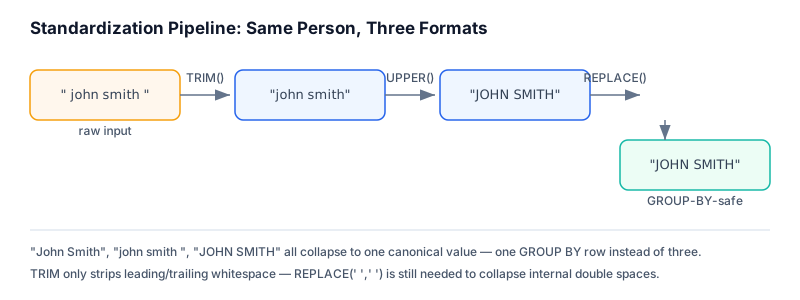
"  John Smith  "
        │
        ▼  TRIM()
"John Smith"
        │
        ▼  UPPER()
"JOHN SMITH"

"John  Smith"   (double space in the middle)
        │
        ▼  TRIM()          -- no effect, TRIM only handles the edges
"John  Smith"
        │
        ▼  REPLACE(name, '  ', ' ')   -- explicitly collapses internal spaces
"John Smith"
Syntax
TRIM(column_name)
LTRIM(column_name)
RTRIM(column_name)
REPLACE(column_name, 'search_string', 'replacement_string')
UPPER(column_name)
LOWER(column_name)

-- MySQL has no INITCAP(); PostgreSQL/Oracle do:
INITCAP(column_name)          -- PostgreSQL / Oracle only
Detailed Explanation
TRIM’s scope is commonly misunderstood: it removes whitespace only from the start and end of a string, never from the middle. A value like "John Smith" (double internal space) survives TRIM completely unchanged. To collapse internal whitespace, you need REPLACE(), often applied twice or combined with a regular expression function in engines that support one (REGEXP_REPLACE in PostgreSQL/MySQL 8+).
Casing standardization should happen consistently at the point of comparison, not just the point of display — WHERE LOWER(email) = LOWER(@input_email) is safer than assuming stored data is already normalized. For high-volume queries, however, wrapping an indexed column in a function this way defeats index usage (see Performance Notes) — the better long-term fix is standardizing data at write time so query time doesn’t need to.
Production Workflow
- Identify which text columns feed into grouping, joining, or deduplication logic
- Apply
TRIM()+LOWER()(orUPPER(), per your team’s convention) as a standard normalization step for those columns - For columns with known internal whitespace issues, add explicit
REPLACE()collapsing logic - Where possible, standardize at ingestion/ETL time and store the clean value, rather than repeating normalization logic in every downstream query
Engineering Considerations
- Standardization changes how data groups and joins — always validate row counts before and after applying it to catch unexpected collisions
- Case standardization can lose information that matters for display (e.g., proper nouns) — separate “comparison casing” from “display casing” when both matter
- MySQL string comparisons are case-insensitive by default under common collations (e.g.,
utf8mb4_general_ci) —UPPER()/LOWER()may be unnecessary for equality comparisons on such columns, but is still needed for GROUP BY output display consistency and for engines/collations that are case-sensitive
Performance Notes
Wrapping an indexed column in TRIM(), UPPER(), or LOWER() inside a WHERE clause typically prevents the optimizer from using an index on that column, since the function must be evaluated per row before comparison. For frequently-filtered columns, consider storing a pre-normalized value in a separate indexed column instead of normalizing at query time.
Common Mistakes
- Assuming
TRIM()removes all whitespace, including internal double spaces - Standardizing case for comparison but forgetting to also standardize for
GROUP BY, resulting in duplicate groups that only differ by case - Applying
REPLACE()for space collapsing only once, which doesn’t fully collapse triple-or-more consecutive spaces (chainingREPLACE(REPLACE(col,' ',' '),' ',' ')or using a regex function is more robust)
Edge Cases
- A string of only whitespace (e.g.,
" ") becomes an empty string after TRIM, not NULL — a later check forIS NULLwill not catch it; you needTRIM(column) = ''as well NULLpassed intoTRIM(),UPPER(),LOWER(), orREPLACE()returnsNULL, not an error and not an empty string — always handle NULL and blank separately- Unicode and multi-byte characters can behave inconsistently across
UPPER()/LOWER()depending on collation — verify behavior for non-ASCII text before relying on it
Best Practices
- Normalize at ingestion time and store clean values when possible; treat query-time normalization as a stopgap, not a permanent strategy
- Always check for both NULL and whitespace-only/empty string when validating “is this field actually filled in”
- Keep a documented, consistent convention (e.g., always lowercase for comparison keys) across the codebase rather than mixing UPPER and LOWER arbitrarily
Interview Questions
- Does
TRIM()remove spaces in the middle of a string? If not, how would you collapse internal double spaces? - Why might two seemingly identical string values fail to match in a
WHEREclause? - What’s the difference between an empty string, a whitespace-only string, and NULL — and how would you detect each?
- Why can wrapping a column in
UPPER()inside aWHEREclause hurt performance on a large table?
Summary
Standardization functions exist to make free-text data comparable and groupable despite real-world entry inconsistency. TRIM handles edges only, REPLACE handles arbitrary substring cleanup including internal whitespace, and UPPER/LOWER normalize casing — together they form the baseline cleanup layer that should run before any GROUP BY, JOIN, or deduplication logic touches text data.
Practice Challenges
- Write a query that standardizes a
citycolumn to trimmed, uppercase form for a regional sales rollup. - Write a query that detects rows where a
namecolumn is whitespace-only (not NULL, not truly empty, but not meaningfully filled in either). - Write a query that collapses internal double spaces in an
emp_namecolumn usingREPLACE(). - Explain why storing a normalized
email_lowercolumn might be preferable to normalizingemailat query time in a high-traffic lookup query.