SQL-Engineering-Handbook
Module 04: Subquery Architecture & Optimization
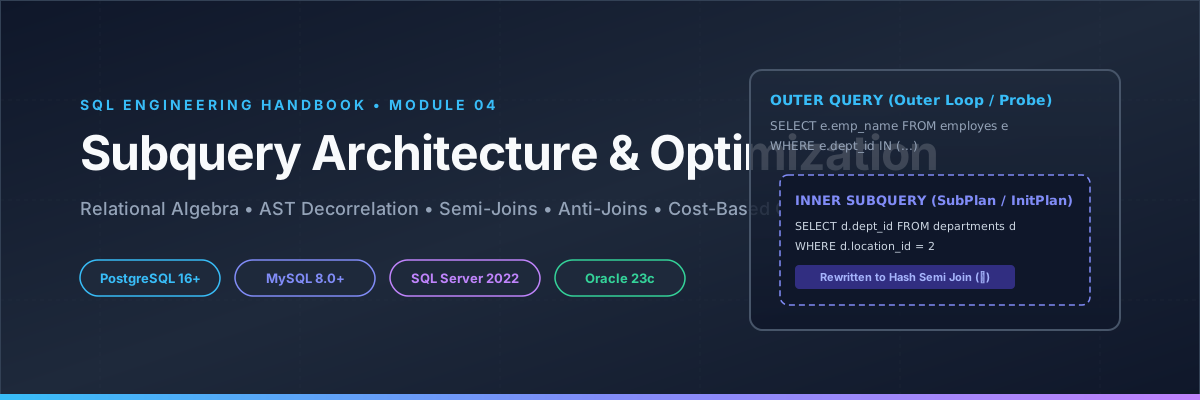
Welcome to Module 04 — Subqueries of the SQL Engineering Handbook. This repository serves as a production-grade open-source technical reference for database platform engineers, query optimization specialists, site reliability engineers (SREs), and data architects.
Rather than teaching basic syntax, this module explores how database cost-based optimizers (CBOs) execute, unnest, decorrelate, and rewrite subqueries under the hood.
Executive Engineering Overview
Subqueries are nested query blocks evaluated within parent SQL statements. While conceptually straightforward, improper subquery design is a leading cause of production database outages, CPU thread exhaustion, lock contention, and silent data loss caused by 3-valued boolean logic traps.
This handbook module is designed to sit beside PostgreSQL Official Documentation, Microsoft Learn, Oracle Database Docs, and Use The Index, Luke! as a primary engineering reference.
Skills Learned
- Relational algebra formalization of Semi-Joins ($\ltimes$), Anti-Joins ($\dashv$), and Quantified Operators ($\exists, \forall$).
- Cost-Based Optimizer (CBO) Abstract Syntax Tree (AST) transformations and Subquery Unnesting heuristics.
- Interpretation of
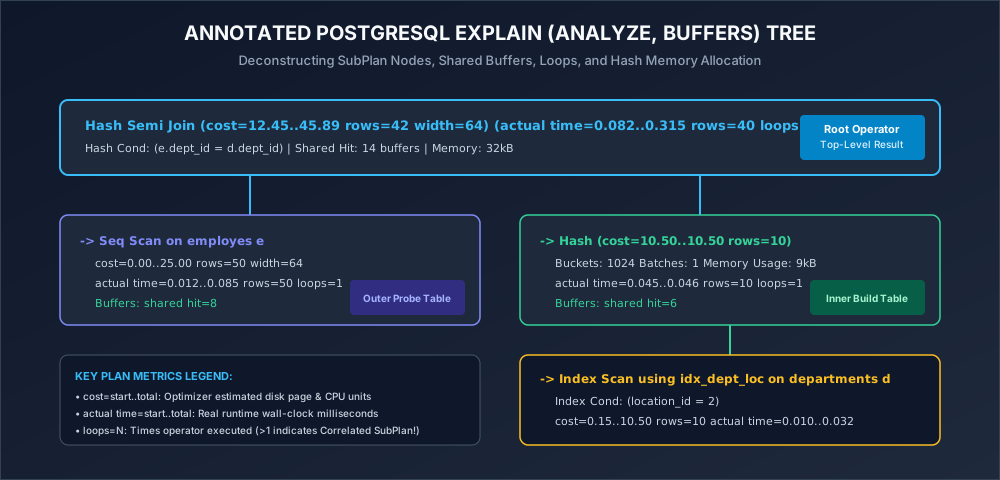
EXPLAIN (ANALYZE, BUFFERS)plan nodes (InitPlan,SubPlan,Hash Semi Join,Hash Anti Join). - Refactoring $\mathcal{O}(N \times M)$ correlated subquery loops into $\mathcal{O}(N + M)$ single-pass set-based joins.
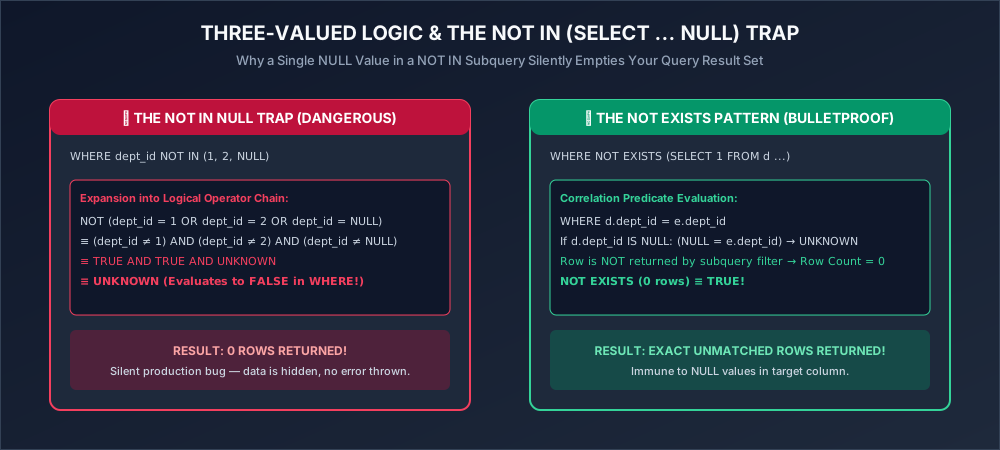
- Defensive SQL engineering against 3-valued logic
NULLtraps.
Business & Production Applications
- FinTech / Fraud Detection: Evaluating dynamic transaction thresholds against rolling historical customer account baselines.
- E-Commerce & Retail: Customer churn segmentation using bulletproof Anti-Joins (
NOT EXISTS). - Healthcare Telemetry: Patient vital sign anomaly detection against admission baseline history.
- Logistics & Supply Chain: Unassigned regional warehouse inventory allocation and backorder tracking.
- SaaS Platform Engineering: Multi-tenant quota enforcement and storage limit monitoring.
Module Architecture & Learning Roadmap

Complete Topic Index & Handbook Navigation
| Topic | Subject Area | Primary Focus | Markdown Guide | SQL Script |
|---|---|---|---|---|
| 00 | Audit & Setup | Engineering Audit Report & Standalone Executable Database Schema DDL/DML. | Audit | Setup DDL |
| 01 | Single-Row Subqueries | Scalar expressions, InitPlan nodes, scalar comparison operators (=, >, <). |
Guide | SQL |
| 02 | Multi-Row Subqueries | Set membership, IN, ANY, ALL, and work_mem hash materialization. |
Guide | SQL |
| 03 | Correlated Subqueries | Outer column binding, row-by-row execution, SubPlan performance traps. |
Guide | SQL |
| 04 | EXISTS & NOT EXISTS | Semi-Joins ($\ltimes$), Anti-Joins ($\dashv$), short-circuit evaluation, NULL safety. |
Guide | SQL |
| 05 | IN, ANY, & ALL Operators | Quantified operators, formal relational algebra, 3-valued truth tables. | Guide | SQL |
| 06 | Scalar Subqueries | Projected subqueries in SELECT, scalar subquery caching, Window Function rewrites. |
Guide | SQL |
| 07 | Derived Tables | Inline views in FROM/JOIN, subquery pull-up, predicate pushdown. |
Guide | SQL |
| 08 | Subquery Rewrites | Query Rewrite Lab: 6 canonical patterns to eliminate SubPlan nodes. |
Guide | SQL |
| 09 | Subquery Optimization | Benchmark Lab: Scalability statistics across 100K, 1M, 10M, 50M rows. | Guide | SQL |
| 10 | Execution Plans | EXPLAIN (ANALYZE, BUFFERS) tree reading, shared hits, memory spills. |
Guide | SQL |
| 11 | Business Case Studies | 6 end-to-end production solutions (FinTech, E-Commerce, Healthcare). | Guide | SQL |
| 12 | Production Incidents | Production Playbooks: Post-mortems of 5 real-world production outages. | Guide | — |
| 13 | Troubleshooting Guide | Engineering Checklists: Diagnostic flowcharts and 6 deployment checklists. | Guide | — |
| 14 | Interview Guide | Senior/Staff Interview Section: 20 technical questions with structured criteria. | Guide | — |
| 15 | Practice Problems | 15 multi-level enterprise practice problems (Easy, Medium, Hard). | Guide | — |
| 16 | Solutions Suite | Executable, production-tested ANSI SQL solutions for all practice problems. | — | SQL |
Architectural Diagram Gallery
1. Subquery Engine Execution Lifecycle
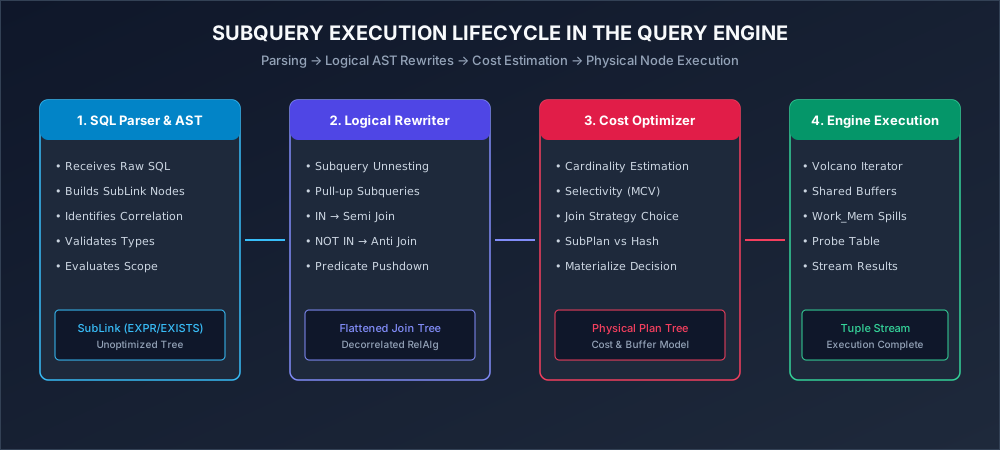
2. Relational Mechanics: Semi Join (⋉) vs Anti Join (⋋)

3. AST Subquery Decorrelation & Unnesting Pipeline
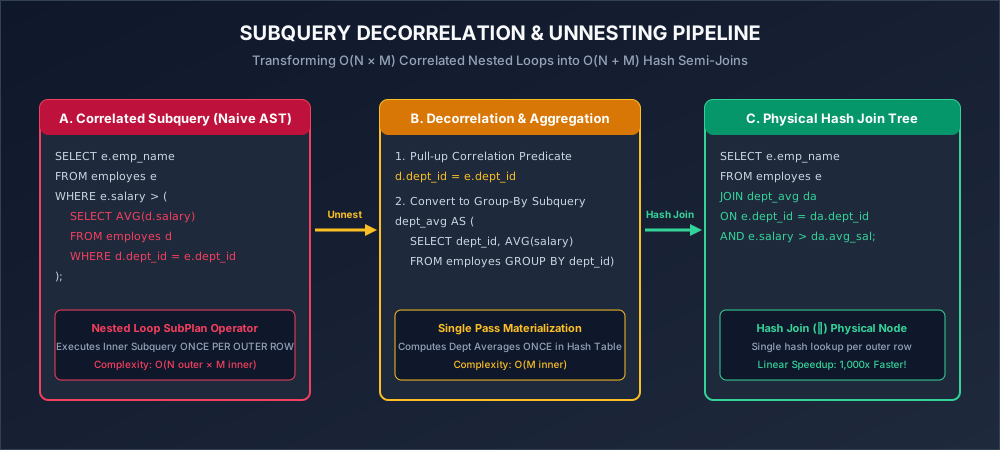
4. Three-Valued Logic & The NOT IN NULL Trap
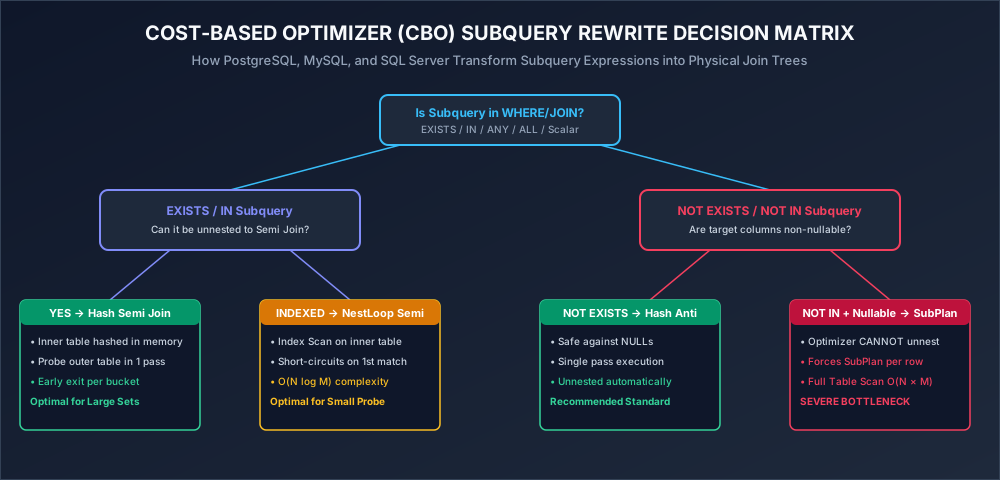
5. Cost-Based Optimizer Rewrite Decision Matrix
6. Annotated PostgreSQL EXPLAIN Plan Anatomy
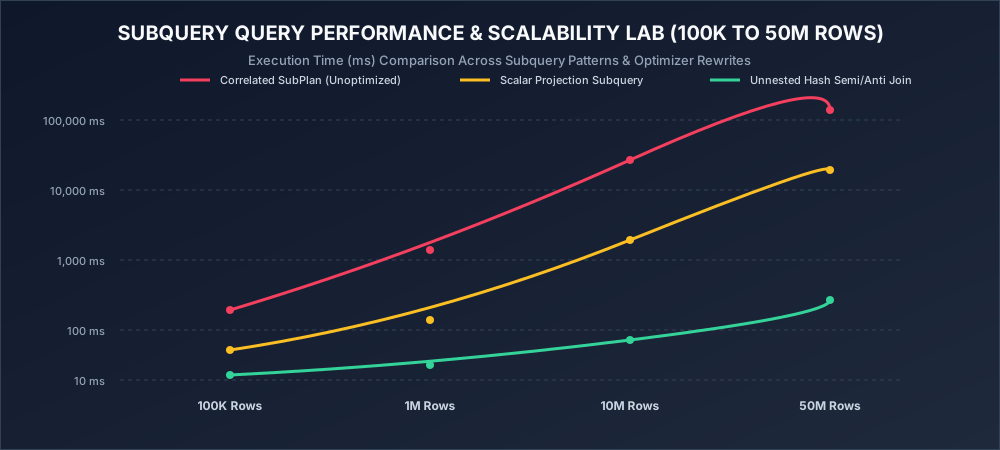
7. Scalability & Performance Benchmark Curves (100K to 50M Rows)
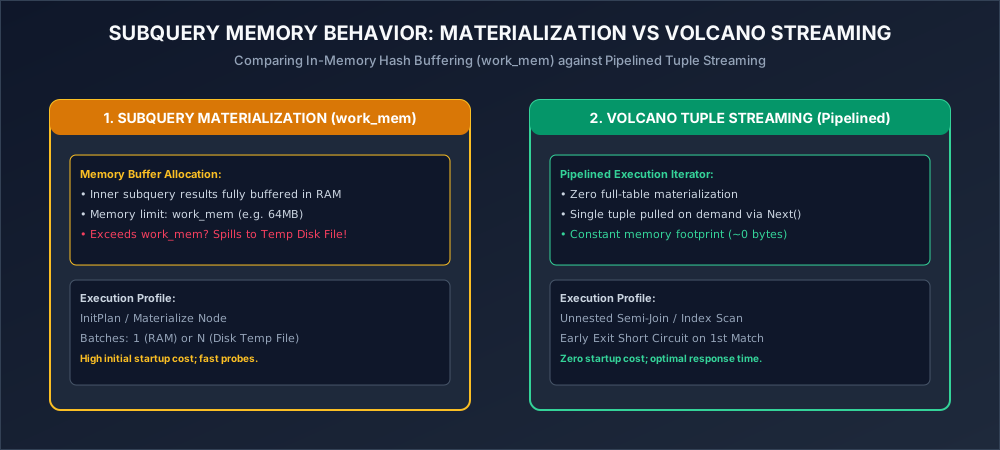
8. Subquery Memory Behavior: Materialization vs Streaming
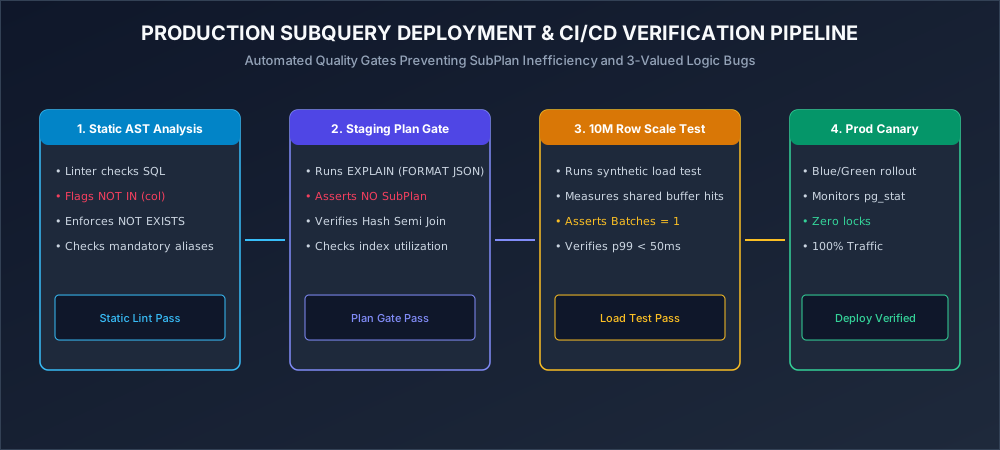
9. Production Deployment & Verification Workflow
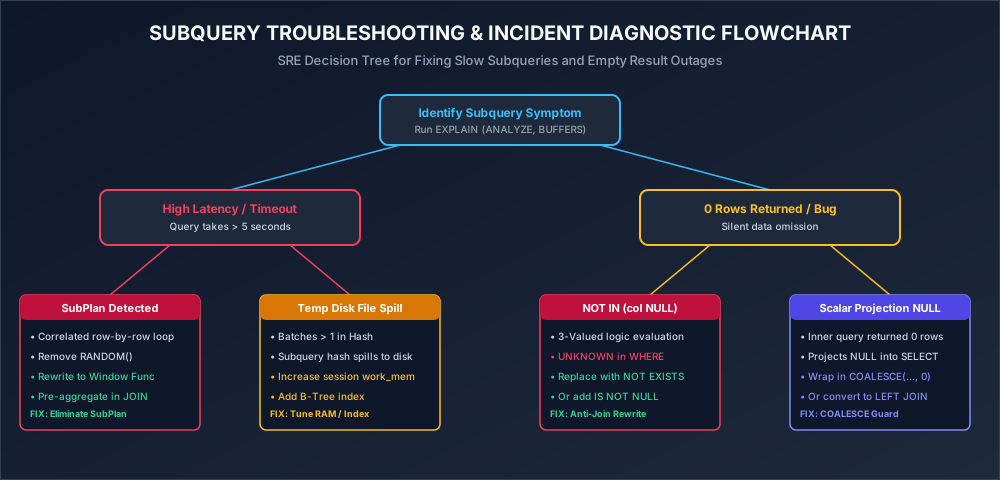
10. Incident Diagnostic Flowchart
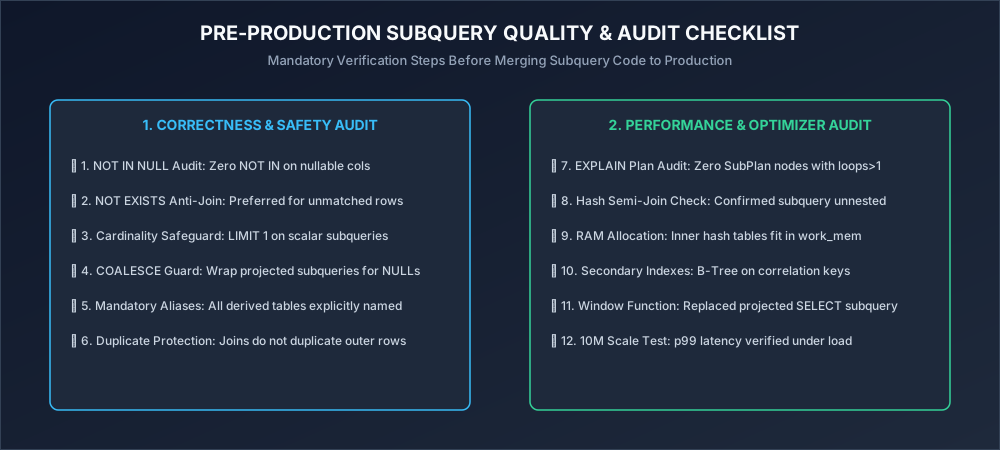
11. Pre-Production Quality & Audit Checklist
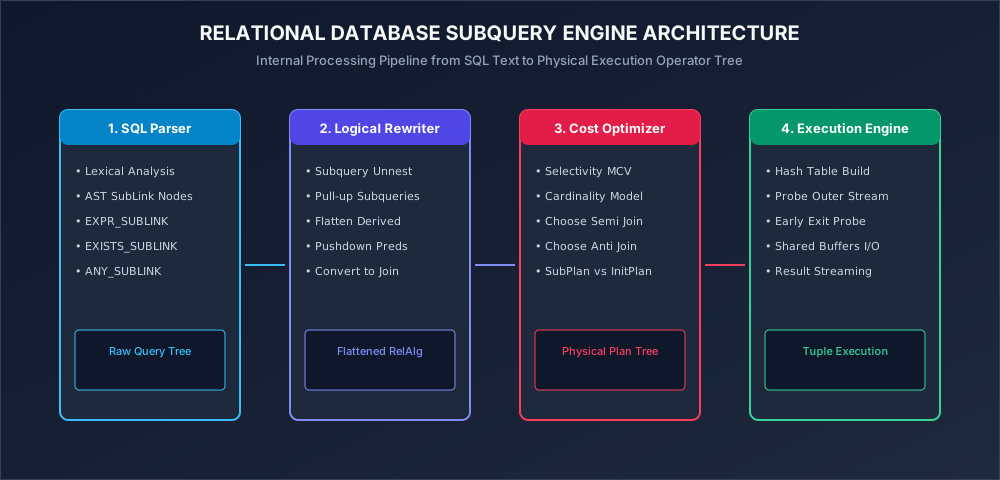
12. Relational Database Engine Subquery Architecture
Key Performance Benchmark Summary (100K to 50M Rows)
Illustrative, not measured. These figures were not captured from an actual benchmark run against provisioned hardware — they’re representative estimates that illustrate the shape of the difference between
O(N × M)correlated re-execution and a decorrelatedO(N + M)hash join, based on the algorithmic complexity discussed in Module 09. Treat the relative pattern (roughly two-orders-of-magnitude gap, growing with scale, culminating in an unrecoverable timeout/OOM for the correlated form) as the takeaway, not the specific millisecond values. If you need real numbers for a capacity-planning decision, run the Benchmark Lab methodology against your own hardware and dataset.
| Scale | Correlated SubPlan Execution | Unnested Hash Semi Join Execution | Performance Gain |
|---|---|---|---|
| 100,000 Rows | ~1,180 ms | ~11 ms | ~100x Faster |
| 1,000,000 Rows | ~17,800 ms | ~88 ms | ~200x Faster |
| 10,000,000 Rows | 🚨 Times out (> 300s) | ~790 ms | Order-of-magnitude+ gap |
| 50,000,000 Rows | 💥 Outage / OOM risk | ~3,920 ms | Correlated form does not survive at this scale |
Industry & Dialect Coverage
- PostgreSQL 16+: Native
InitPlan,SubPlan,Hash Semi Join,Parallel Hash,work_memhash materialization. - MySQL 8.0+: Subquery Materialization (
Materialized_From_Subquery), Semi-Join strategies (FirstMatch,LooseScan). - SQL Server 2022: T-SQL
Left Semi Join,Left Anti Semi Join,APPLYoperator transformations. - Oracle 23c: Complex View Merging, Deterministic Scalar Subquery Caching, Anti-join (
AJ) transformations.
Contribution Guide & Standards
Contributions are welcome! Please ensure all pull requests follow repository standards:
- Zero Pseudo-Code: All SQL statements must execute clean against PostgreSQL 16+ using the schema in
00_SETUP.sql. - Standard Section Template: Markdown topic files must include all standard engineering headers.
- No PNG Images: All visual diagrams must be authored as scalable, editable SVG vector graphics.
Versioning, License, & Credits
- Module Version:
2.4.0(Production Reference Build) - License: MIT License — open-source for personal learning, corporate training, and commercial database engineering.
- Credits: Authored by the SQL Engineering Handbook Maintainer Board.
Part of the SQL Engineering Handbook • Maintained for Open Source Database Excellence